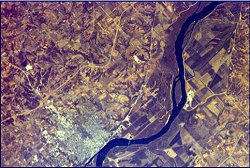
Photo of the Mississippi
River taken by middle school students
with the EarthKam
during a Space Shuttle flight. The camera is
now based permanently on the International Space Station.
Students
can control the camera over the Internet.
This section provides links
to resources on the net related to space education.
The resources range from online courses to NASA outreach
programs.
HobbySpace
is itself a space education site and hopes to provide
students with lots of resources for homework and projects.
HobbySpace
also emphasizes space related hobbies and activities
that individuals can also do independently of school,
government or industry.
However, to carry out those
activities, you often need to educate yourself in particular
areas. So this page will try to help you find sites
that can help with your studies such as tutorials, online
books, and even full-fledge on line courses.
The enormity of the range of
space education resources on the net is truely daunting.
One could easily create a site as large as all of HobbySpace
just to categorize properly the incredible diversity
and number of space education sites.
So this section can only provide
a small sampling of what's available. Many of the linked
sites will have space education link lists as well.
If you don't find here exactly the resource you are
searching for, follow links that are related to your
topic of interest and perhaps link lists at those sites
will in turn lead you to your goal.
Discovery
Space: Next Generation - postings from " students
working in space science, astronomy, engineering,
physics and other fields all over the world."
Robotic
Telescopes have recently become available
for students to propose and carry out actual observations
via the Internet on large, professional telescopes.
Contests
- many of the contests listed here are aimed at student
participants.
Games
- many space games are both fun and educational.
History
- lots of resources for students studying the history
of rocketry, space exploration, and the politics surrounding
them.
History
Topics - a selection of interesting
events and periods of significance in space history.
Living
Space - links to sites that display
imagery and other data as it arrives from spacecraft
currently in orbit. Most of the science spacecraft
projects offer elaborate outreach projects
to involve students.
Multimedia
- lots of media resources for exploring space: images
galleries, Virtual Reality tours of space stations
and the shuttle, CDROM and DVD space disks, and more.
MusicSpace
- nothing can catch the attention of young people
like music and there are many space inspired songs
and compositions in virtually every music style. Furthermore,
the Space
Music for Young People section discusses
music directly intended to teach kids about space.
Near
Space - high altitude balloons offer
a very low cost alternative to rocket launches for
reaching space-like conditions above most of the atmosphere.
This section provides information on how educators
and students, along with amateur radio enthusiasts,
are utilizing our space shoreline.
RadioSpace
- involvement with space radio projects such as scanning
for satellite signals provides a tremendous learning
experience.
Rocketry
- model rocketry for kids is safe and very exciting
way for young people to learn about science and engineering.
High power and advanced rocketry provide lifelong
learning challenges.
Satellite
Building - AMSATs and student satellite
projects provide direct hands-on experience in space
engineering.
Satellite
Watching - observing and photographing
spacecraft passing overhead will fascinate students
of all ages.
SETI
- projects like SETI@Home let students and the general
public become directly involved with the search of
extraterrestrials.
Simulators
- one of the most fun ways to learn about piloting
spacecraft is to "fly" a simulator on a
computer or a full-size replica in hardware.
Software: Online
& Offline
- lots of programs related to space and astronomy.
SpaceCamping
- tens of thousands of students have spent several
days at the original Space Camp in Huntsville, Alabama
experiencing a bit of what real astronauts go through
to train for space.
Space
Science - amateur groups like the Mars
Society are carrying our sophisticated ground simulations
to develop techniques for space exploration. NASA
requires that all space science spacecraft groups
provide outreach programs to involve students
with the projects.
SpacePorts
- go to the Kennedy Space Center and other spaceports
around the world to see launches and spacecraft under
preparation for launch.
Arts Catalyst:
the science-art agency - British-based organization
that carries out collaborative art and science projects
such as dancers performing in zero-g on parabolic
flights.
Project
ASTRO NOVA - a collaboration of "Astronomers
and Teachers as Partners for Learning"
Astronaut
Scholarship Foundation - "More than 50
astronauts from the Mercury, Gemini, Apollo, Skylab,
and Shuttle programs are helping the United States
retain its world leadership in science and technology
by providing scholarships for college students who
exhibit motivation, imagination, and exceptional performance
in the science or engineering field of their major.
To date, the foundation has awarded more than $2 million
in scholarships to 195 deserving students."
"At DreamUp, our mission is to realize
an educational community where space-based research
and space-based projects will be available to
all students, from primary to post-doctorate,
to the International Space Station and beyond."
Future
Astronauts of America Foundation - "multi-faceted
program designed to encourage young students and adults
to become involved with the exciting world of space
science and it's applications"
EarthKam
- camera on the Space Station is controlled over the
Internet by middle school students to take pictures
of the earth. The project is based at the Univ. of
California at San Diego and funded by NASA.
Galaxy
Explorers - a new program similar to tradional
scouting in which students in grades 3-11 can participate
in rocketry, space science and other space related
programs
Imaginary
Lines - Sally Ride's program to encourage
the interest of young girls in science and engineering
Moonshot
Challenge - participatory reenactment of the
Apollo 11 mission -
"Participants receive multiple weekly tasks,
tackling aspects as propulsion, orbital mechanics
or life-support, building up to the grand goal
of landing a man on the moon. This challenge –
based learning shows real-world science and allows
participants to experiment with many areas of
science, seeing how they complement each other
(i.e. chemistry for the fuel combustion and physics
for the fuel pressure)."
National
Aerospace Development Center - "independent
nonprofit, nonpartisan center supporting the development
of space through information research, analysis, outreach
and education."
Odyssey
of the Mind- student problem solving competitions
- sometimes involve space related challenges.
Our
Space program in the UK, sponsored by Richard
Garriott, offers educational materials
and lessons
based on his visit to the ISS and the scientific work
and demonstrations he did while there.
Paragon
Foundation - "promoting an awareness
of space exploration through learning contests, special
events, and participation in launch events."
Dragoon Rocket development complete
Passport
to Knowledge - "interactive learning
adventures connecting essential Life, Earth, Space
and Physical science". Funded by NASA, NSF and
NOAA
PAT Projects
(Preservation of Aerospace Techology) - "aerospace
educational products through a unique teaming arrangement
of grade K-12 teachers with a pool of the nation;s
most qualified test pilots and engineers. This work
is partially funded by the NASA Dryden Flight Research
Center."
Permission
to Dream - this program, run by the Space
Frontier Foundation, introduces disadvantaged
students around the world to the marvels of astronomy.
It will "donate telescopes to schools in Los
Angeles, Southern Africa, and Sri Lanka" and
provide a program in which the students use the scopes
to make regular observations and record and analyze
the data.
PongSat(tm)
- split a ping pong ball in two, put in your experiment,
reseal and fly to high altitude or even to orbit.
This fun project is run by the amateur rocketry group
JP Aerospaceand
now has several hundred students involved.
Rocket
Science Tutors (RST) - volunteer group aims
to help students boost their studies in Science, Technology,
Engineering and Math (STEM). They provide guides for
weekly online lab projects.
SCIENCE U
- fun on line science site with some astronomy sections
Space
Day - this organization has developed a program
with worldwide participation of students and teachers
that focuses on space for one day each May.
Signatures
in Space - a Space Day program that has
arranged for the signatures of over 96,000 elementary
school students to be sent to space aboard space
shuttles since 1997.
Space
Explorers, Inc.
"... committed to bringing the excitement and
challenges of space exploration into classrooms worldwide.
Space Explorers promotes discovery, inquiry, and analysis
by offering standards-based curricula, mission simulations,
and experiments that incorporate actual NASA data.
Through these Internet-based programs, the company
strives to inspire a new generation of explorers to
pursue careers in science, math, and technology."
Space4Schools
- The Starchaser
rocket company runs this ambitious education program
in Britain.
Space
Generation "the global network of active
youth interested in space!"
Space
Race - this on line program offers a high-quality
animation adventure/education series for kids.
SpaceWander.com
- "take a virtual space-trip to the depths of
the Universe! All of SpaceWander's space pictures
are real NASA images! Our award-winning multimedia
space tour takes about 12 minutes. You can sit back
and enjoy it or you can press buttons on the spaceship
to see additional in-context information."
Space
Week - UN recognized yearly event that recognizes
the benefits of space for humanity. Includes lots
of education related programs.
Space
Explorers - privately held company based in
Green Bay, WI, with the mission of providing innovative
K-12 Standards-based education programs, delivered
via the Internet, that motivate children to learn
using methods of discovery, inquiry, and analysis.
TERC -
nonprofit group seeking to improve math and science
education
The
Dream Rocket program aims to connect space,
education and art via a huge collaborative project:
The Dream Rocket is reaching out to students,
teachers, schools, individuals, groups and organizations
to create and submit over 8,000 "Dream Theme" or
"Visionary" panels that will be sewn together in
Huntsville, Alabama. This historical 30,467-square
foot quilt will represent dreams from all over the
world. During May and June of 2010, (60 days) this
quilt will completely wrap the 363-foot vertical
Saturn V Rocket which stands in front of the U.S.
Space & Rocket Center® in Huntsville, Alabama.
Tomatosphere
- Canadian project in which students "grow tomato
plants from three different types of seeds - a control
group, seeds that have been exposed to a Mars-like
environment, and those exposed to a simulated Mars
greenhouse environment."
Young
Astronaut Program - : A hands-on, multimedia,
educational program offering print curriculum, fun
activities, live television, an interactive CD, and
an online community for kids, parents, and educators.
Sports
in Space
Sport
activities in space can be used to interest young people
in space and to teach physics and other topics.
SpaceSportilization.com
- Former professional football player Ken Harvey uses
sports in space to teach science
Collaboration with Richard
Garriott on space related demonstrations during
Garriott's flight t the Int. Space Staion.
NASA provides an enormous number of space education
related sites. Apparently, almost every NASA department
must provide some public education resources.
Note also that NASA requires that all space science
spacecraft projects provide outreach programs
to involve students with the projects. This includes
all the university collaborators on the projects as
well. See the Living
Space section for lists of current NASA spacecraft
projects.
Imagine
Mars - JPL - "[K-12] students explore
their own community and decide which arts, scientific
and cultural elements will be important on Mars.
Then they develop their ideal community, from
an inter-disciplinary perspective of arts, sciences
and technology."
multi-tiered year-round program designed
for students in ninth- to 12th -grade who are
interested in science, technology, engineering,
and mathematics, or STEM, education and careers.
Teaching
from Space :
"Imagine speaking live with crew members
orbiting Earth on the International Space Station.
Or imagine helping your students learn about their
world by remotely programming cameras to capture
images taken from space. Teaching From Space offers
unique resources and opportunities that give you
the tools to launch students into a deeper understanding
of science, technology, engineering and mathematics.
Explore this Web site and discover a new frontier
of learning possibilities!"
OCT is interested in attracting graduate
students that are committed to developing
disruptive technologies for the aerospace
sector and to being part of NASA’s technological
future by working on high-priority technologies
to sustainably explore space, and who
are interested in pursuing NASA’s Grand
Challenges.
Space Mission Outreach Programs:
Living
Space - List of ongoing science
missions, most of which will have educational
outreach programs
Teaching
From Space - connect teachers and students
directly to space mission activities.
The
Solar System Ambassador Program - JPL program
in which volunteers are trained to give presentations
to promote space exploration and science.