Jeff Foust - spacetoday.net
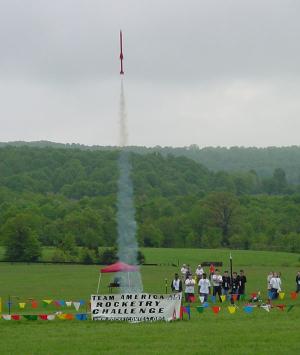
A student rocket launch at the Team
America Rocketry Challenge final
competition in Virginia, May 11, 2003. The Challenge
has been continued
annually since then.
Amateur rocketry now ranges from the model
rockets you buy at your local hobby store to high
power rockets available to qualified adults to advanced
rockets, built by serious amateur rocketry groups,
that are approaching the threshold
of space.
Model rocketry grew
rapidly in the 1950's with the wave of interest in
the new space age. It introduced rocketry while using
safe, commercially available motors, and thus avoided
the dangers of mixing ones own propellants. It is
a popular hobby both for adults and young people.
High power rocketry
has grown in the past few years to become a booming
hobby for adults with numerous clubs and regular
rocket meets. These events must obtain a special clearance
from the FAA for a given maximum altitude allowed
for the day.
Amateur rocketry, however,
now extends even beyond high power to Advanced Rocketry. Numerous rocketry groups are attacking
amateur high altitude records and are getting
close to the official borderline of space, i.e. around
100km.
Note that the participants
in these efforts require advanced training and skills
to deal with the dangers and complexities of building
their own rocket solid rocket motors as well as liquid
fuel engines and hybrids of solid and liquid propellents.
Model rocketry is a great hobby for young and old (more
than half the people flying model rockets are adults
(ref)). You will learn the basics of rocketry and have
a lot of fun at the same time.
Model rockets are constructed of non-metallic
materials, e.g. cardboard or plastic. One can purchase
rocket frames or build ones own. However, only commercially
available solid rocket motors should be used. This avoids
the serious dangers involved in making ones own propellants.
Motors are limited to G or lower (see the NAR
Motor Power tables).
Model rockets can be purchased at most hobby stores.
Most of them allow new motors to be inserted for multiple
use.
Although model rockets don't reach the size and altitudes
of the high power variety, they still can provide an
impressive show with G powered rockets standing up to
2 meters. Furthermore, they can be quite elaborate and
sophisticated with such enhancements as multiple
stages, video camera payloads, radio telemetry,
radio controlled glider return, etc.
For more introductory information on model rocketry,
see
Handbook of Model Rocketry,
G. Harry Stine, 6th edition, John Wiley & Sons,
1994, ISBN:0-471-59361-3.
High
Power Rockets
While still part of consumer rocketry (i.e.
certified motors are purchased from dealers rather than
built at home), high power rocketry is an adults only
hobby that requires training and certification.
High power rockets use motors above G level (see
the NAR Motor Power tables) and can reach
over 6000 meters in altitude. (see Tripoli Altitude Records
records.)
See the NAR
-- High Power Rocket Safety Code for guidelines
for using HP rockets. High power rocket launchings in
the U.S.A. require an FAAWaiver. If the
propellant exceeds 62.5 grams, a permit from the Bureau
of Alcohol, Tobacco and Firearms is required. For more
information:
National Association of Rocketry
NAR is the largest and oldest of the amateur rocketry
associations was founded in 1957. Its provides
numerous services to the amateur rocketry community
including organizing sport
events (launching for fun) and competitions (e.g. highest, longest
flight, most realistic,etc), issue high-power certifications, sell
liability insurance for rocket meets, and more.
The web site provides lots rocket educational
pages such as a nice introductory overview.
The Technical Services section (NARTS) provides
model rocket design plans, books, software, etc.
They also have an extensive catalog
with items for sell that include books, reports,
paraphernalia, posters, scale data, rocket plans,
software, etc.
Tripoli
Rocketry Association
One of the largest organizations devoted to high-powered
rocketry. Provides user certifications, sponsors
rocketry meets such as the national LDRS
event, publishes the Rockets Magazine,
etc.
Independent Association
of Rocketry
IAR is an organization of non-professional rocketeers
to promote all levels of rocketry from low-power
to high-power. Founded in 1995.
Team
America Rocketry Challenge - NAR
& AIA sponsored a "national model
rocket competition for U.S. high school and
junior high school students." The organizations
"challenge you to design, build, and fly a multi-stage
model rocket carrying two raw eggs and an electronic
altimeter to exactly 1500 feet, returning both
eggs intact. The top five teams shared in a
total prize pool of approximately $50,000 in
savings bonds, and approximately $9,000 in cash
awards will be divided among the sponsoring
teachers' departments." Held annually since
2002.
NASA
MSFC Student Launch Initiative(SLI)-
US students (grades 7-12) can particpage in
the Student Launch Initiative by placing in
the top 3 Level two teams at the Rockets for
Schools competition held in Wisconsin or by
placing in the top 18 teams at the Team America
Rocketry Challenge, or TARC held in Virginia.
The AeroTech
rocketry company is sponsoring contests
at NAR
and Tripoli-sanctioned
rocket meets. Money prizes will be awarded
to those who achieve the highest altitudes
using its rockets in three different classes
.
Lander
Challenge "requires a competing
team to launch a sport rocket containing a simulated
lander, to safely land the lander, and to deploy
a rover. The rover must then be remotely navigated
to a predetermined spot on the flying field."
BnB
Rockets
"At BnB
Rockets, each rocket kit is carefully designed,
and engineered, ensuring you experience the thrill of
a perfect build, and launch, every time."
FlyRockets.com
This site was "created by a group
of individuals affectionately know as the SRN Volunteers
for the sole purpose of attracting new rocketeers into
our clubs and organizations."
The site provides materials to "introduce you
to every aspect of Sport, Experimental, and Amateur
Rocketry. Inside you'll find easy to understand information
for the beginner, information on local clubs and national
organizations, a vast array of rocketry vendors, and
links to other great rocketry web sites."
Rocketry
Online!
This massive site provides resources on virtually every
aspect of amateur rocketry. Has dozens of separate sections
such as vendors, books, education links, etc.
Rocketry.Org
Devoted to amateur and experimental rocketry, T.J. Patterson
has created this site with lots of links and resources.
Estes
Educator
Virtually synonymous with model rocketry, Estes provides
a nice site with a strong emphasis on education rather
simply an online product catalog.
John
Coker's Rocketry
Lots of rocketry resources ranging in areas from model
rocketry to advanced high power amateur projects.
Essence's
Model Rocketry Reviews
Read reviews of rockets before you purchase them. This
site encourages you to contribute your review of a rocket
you enjoyed or was disappointed by.
European
Rocketry Webring:
A web ring devoted to "model rocketry, experimental,
amateur and highpower rocketry".
Jetex.org
This site provides "a comprehensive online resource
covering the technical and historical aspects of small
sustained thrust micro rocket motors for use in model
airplanes and other craft."
The rocket weighs over 1,600 pounds, stands over
36 feet tall and will be powered by a massive array
of nine engines, eight 13,000ns N-Class motors and
one 77,000ns P-Class motor. The estimated peak altitude
of the flight is 4,000 feet.
Creating Space: : The Story of the Space
Age Through Models
Mat Irvine - 2002
Amazon: USUK
Creating Space takes us on a journey through
the history of the space age, up to the present and beyond... a detailed
chronicling of vehicles is given, side by side with pictures
and details of models that depict the multitude of aircraft and spacecraft
developed throughout the world....
extensive appendices provide details of all
of the space-related models ever made and the many manufacturers
and distributors who have supplied them "
Spaceship Handbook
Jack Hagerty,
Jon C. Rogers - 2001
Amazon: USUK
All about spaceship designs in both sci-fi and
actual aerospace. Great for modelers but also for anyone interested in
the history of spaceship concepts.
High Power Rocketry
Amazon: US
Created for the adult enthusiast, each issueof High Power Rocketry comes
with great model designs and instructionals, reviews of the latest equipment
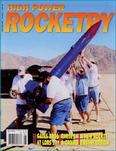
and technology and profiles of the people who share in your love of rocketry.