John F. Kennedy in his famous Rice
University speech referred to space as our New
Ocean. And just as an ocean possesses a shore, so
do we find a shore above us at the transition from earth
to space.
This space shore is often referred to as Near
Space.
The realm of Near Space officially lies between 75,000
feet (~23km) and and 62.5 miles (100km) according to
the International Aeronautical
Federation (FAI). Here we consider a wider range
that extends up to 200km or so where it becomes safe
for satellites to remain in orbit without immediately
becoming dragged down by friction with the residual
atmosphere.
The vehicles that traverse this high altitude domain
are called nearcraft. These include sub-orbital
rockets, which make quick jumps into and
out of near space, and high-altitude
balloons that can loiter there for extended
periods.
Weather
balloons routinely go to 27km (~90k ft). Scientific
balloons go to 42 km (137k ft or 26mi) and remain
at high altitudes for several days. The world record
altitude reached by an unmanned balloon is 51.82km
(170k ft or 32.2mi).
The record for altitude reached by a crewed balloon
was set by Malcom D. Ross and Victor A. Prather who
flew to 34.668km (113,740ft or 21.54mi) on April 5,
1961.
Compared to orbital flights and journey's to the Moon
and Mars, Near Space may seem of little interest, only
an interlude on the way to more exciting places. In
fact, Near Space offers numerous exciting benefits and
applications.
Here is a list of some possible benefits of utilizing
Near Space:
Cheaper and quicker access to space-like conditions
are offered by nearcraft as compared to getting a
launch to orbit. See the Ballooning
and Sub-orbital
rocket entries below.
Amateur groups participation: Ham radio enthusiasts,
students, and amateur scientists carry out high altitude
experiments in astronomy and atmospheric studies,
taking high altitude pictures, and testing equipment
that will be used on satellites.
High altitude cameras can see for several hundred
miles farther than with aerial photography and access
to a given area is more flexible than with the infrequent
fly-overs by remote sensing satellite.
Development of sub-orbital RLVs will be much quicker
and cheaper than orbital vehicles. The technology,
operations techniques, etc. learned from sub-orbital
systems will then be applicable to second generation
vehicles intended for orbit. See the article Sub-orbital
Rockets to Space: The Next Logical Step?
Sub-orbital space tourism packages will offer trips
that may last in total only half an hour or so. Yet,
at the top of 100km trajectory one will see the curvature
of the earth below and a dark starry sky above and
one will experience the accelerating thrill of riding
a rocket and then feel a few minutes of microgravity.
Many people may actually prefer this kind of brief
initial space experience over a full blown stay in
orbit for several days. See the Sub-orbital
Space Tourism section
Copyright TVNSP
Image of a lake taken from +100k ft by a camera on an
amateur high altitude balloon.
Cameras can see the horizon out to several hundred miles
from Near Space.
So just as there are those who prefer the sea shore
for such activities as swimming and fishing rather than
sailing out into the open sea, so there will be many
people who prefer the Near Space shore over voyages
into open space.
Note: This section was inspired
by a suggestion from near space enthusiast Paul
Verhage.
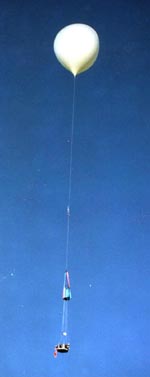
A near space stack consists
of a helium balloon, recovery parachute, and nearcraft,
and can reach fifty feet (~17m) in length. Such
a stack can fly to over 100,000ft (~33km) in altitude
yet costs only a few hundred dollars. The balloon
expands as the stack rises and will eventually burst.
The payload then parachutes to earth and is tracked
with GPS data sent via telemetry on amateur radio
.
The cost to launch anything to orbit is
usually quite high - thousands of dollars per kilogram.
Even a free piggyback ride on someone else's launcher
can require long delays.
Sounding rocket flights are not so cheap
either and the flights last for only a brief time.
An alternative is to put a payload on
a high altitude balloon, which can cost only a few hundred
dollars to fly. A balloon can reach as high as 25km
and remain aloft for days. At such altitudes the payloads
are above much of the atmosphere, they see the black
canopy of space, and view clearly a big swath of the
earth with a curved horizon out to several hundred miles.
Balloons can be good alternative for educational
projects in which students usually only have a year
or so to participate.
So it's not surprising that amateur high
altitude ballooning has become a growing activity that
involves ham radio enthusiasts and educators looking
for low cost but exciting science projects for their
students.
FAA
Liaison - EOSS
"Basically, if you're biggest payload box
is under 6 lb and total payload weight is under
12 lb, and lateral density is under 3 oz/in^2,
then you're exempt and aren't required to notify
the FAA at all - it's like you're a party balloon
that escaped its tether. See 14 CFR 101.1(a)(4).
"
(ARHAB combines amateur radio with high altitude
ballooning to explore "Near
Space". A standard mission involves a latex
weather balloon, a payload, and a recovery parachute
for the payload when it is released from the balloon.
The payload will typically consists of an transmitter
in the amateur radio band and a GPS tracking system
that broadcasts the location of the balloon via
the transmitter, plus other devices such a camera,
atmospheric sensors, etc.
Edge of Space Sciences
- An educational program that lets students, both
K-12 and university levels, in Colorado build "satellites"
for flights on high-altitude balloons. These broadcast
data from on board experiments to student receivers.
Organized by Workshop
88, a "hackerspace in the Chicago suburbs",
organized this near-space balloon competition
that invited hackerspaces worldwide to join in.
The project has (as of Feb.10)
HighShips
- "low-cost provider of scientific and civic
event unmanned ballooning services. We are developing
a unique service to keep up to 2 pounds of payload
up at 90,000+ feet for two to seven days."
RC Explorer -David Windestål of Sweden attached
a RC plane to a balloon which flew to 30km. The plane
detached from the balloon and after eventually regaining
control, was and flown back to earth
"We launch high altitude weather balloons
in collaboration with schools to teach students
physics concepts, experimental research skills,
and to make space exploration accessible to students.
A weather balloon lifts a specially designed payload
package that is composed of HD cameras, GPS tracking
devices, and other science equipment. The payload
is constructed and attached to the balloon by
the students with low-cost materials."
The goal of the project is to construct
an atmospheric probe and equip it with different
sensors. The probe will be mounted on a meteorological
balloon, and lifted to approximately 35 000 m (115
000 ft). The ascent and descent will be recorded
with two on-board GoPro cameras, and the probe will
be tracked via GPS.
The top four teams will be awarded travel
expenses and up to $1,000 to develop their flight
experiment or technology demonstration. Teams
will participate in three flight days to release,
track and recover their experiments. In addition,
students will tour Glenn facilities and present
their findings at Glenn's Balloonsat Symposium.
These
commercial projects seek to place platforms at high altitude
to provide services such as cell phone and broadband communications
relays for urban areas, carry scientific instruments for
weather and atmospheric measurements, remote sensing,
etc.. (With the recession in telecommunications, most
if not all of the telecom balloon projects are on hold.)
Angel
Technologies - Scaled
Composites' Proteus piloted, fan jet powered aircraft,
that reached 19.1km (62,786 ft) in November 2000.
Flying in 8 hour shifts, 3 planes would provide 24hour
coverage.
Global Aerospace
Corp. - developing "guided stratospheric
balloons" under a NASA contract.
StratoSail
- a sail hung on a tether from the balloon.
Big Blue
- student project at Univ. of Kentucky to study Mars
glider by releasing prototypes at high altitudes where
atmosphere density similar to that on Mars.
High
Altitude Glider Project - project by Art Vanden
Berg involving a "small, self-guided glider,
designed to fly at very high altitudes. The glider
is carried up by its tail with a helium weather balloon
to altitudes of up to 85,000 feet above sea level,
and then released to fly back to the launch point."
Stratofox
Aerospace Tracking & Recovery Team - "
team of Amateur Radio operators mostly in or near
Silicon Valley who perform or participate in tracking
and recovery operations for amateur rocketry and high-altitude
balloon ("amateur aerospace") flights."
29.4km (96,500 ft) - solar-powered, unmanned
Helios in 2001 reached - highest for a non-rocket
powered aircraft. Built by Aerovironment
with NASA funding.
34.668km (113,740ft or 21.54mi) - highest
altitude for a crewed balloon - April 5, 1961
by Malcom D. Ross and Victor A. Prather
51.82km (170,000 ft. or 32.2mi) - highest
altitude for unmanned research balloon - launched
from Chico, California in 1972.
107.990km (354,300 ft) - X-15 in 1963 - highest
altitude for a piloted rocket powered aircraft
- (Space shuttle not counted here since it goes
to orbit.)
QinetiQ
1 - attempt to break balloon high altitude
record and ascend to 132,000 feet - almost 40km high
(25 miles).
The technique of carrying a rocket by
a balloon to a high altitude for launch has been around
since the 1940's. Such combo systems came to be called
rockoons. Not only does a balloon give a rocket
a head start in altitude, but by launching the rocket
above much of the atmosphere it saves the fuel needed
to punch through a lot of air when launched from the
ground..
However, there are drawbacks in that the
balloon does not provide a very stable platform. (JP
Aerospace is attempting to build more elaborate balloon
borne structures to provide greater stability and flexibility.)
Rockoons are obviously affected by the wind and other
weather conditions and so launches often get delayed.
Some recent rocket projects, especially
amateur groups seeking to break rocket altitude records,
have resurrected the rockoon approach and have made
launches with them. Here are some groups working with
balloon launched rockets:
JP Aerospace
Intends to be the first amateur organization to put
a payload into space. Following a systematic step-by-step
approach, they've developed increasingly complex balloon
launch systems for their rockets. Initially, the rocket
hung far below a balloon but now they are developing
balloon platforms from which rocket launches can take
place and also can carry oher payloads such as scientific
instruments.
Pongsat
- a split table tennis ball is used to hold simple
experiments created by school kids for flights
on high altitude balloons and sub-orbital rockets.
Satellite
Building - amateur and student satellite
projects share many features with Near Space efforts
including a low cost approach and building robuts
systems that can survive the rigors of a high vacuum
environment.
Space
Radio - Ham radio enthusiasts have long
led the way in amateur involement with space including
communication with satellites, building of satellites,
and now Near Space projects.
Advanced
Concepts
Here
we provide a sample of concepts involving Near Space that
are particularly ambitious and exciting.
Near
Space Tourism
Strato-X
This company plans to provide adventure tourists the
opportunity to ride a high altitude helium balloon to
100, 000ft (30km). The flight would last for about 40
hours. The balloon reaches the 100kft altitude about
3 hours after launch. The "stratonauts" will
have great views of the curvature of the earth, of the
black sky, and of a majestic sunrise and sunset.
Airship
Hotel- WATG
WATG (Wimberley Allison Tong & Goo) is a well respected
leisure and entertainment design firm that does speculative,
futuristic
projects on the website.
zero2infinity
This Spanish firm plans a high altitude balloon system
that will take paying passengers in a spacious gondola
to 36km altitude.
zero2infinity has successfully launched its newest
prototype, the microbloon 2.0, to the edge of Space
at almost 32km in altitude. The microbloon 2.0, designed
by zero2infinity, is 2 m in diameter and is a scale
model of bloon, the commercial vehicle that is soon
to take 4 passengers and 2 pilots to the edge of Space
at an altitude of 36 km.
They plan their first human flight by the end of 2013
World
View
A similar project to zero2infinity in which a passenger
model with 2 pilots and 6 passengers travel via helium
balloon to about 30 km. The venture was founded by Paragon
Space Development Corp.
Copyright
- JPAerospace
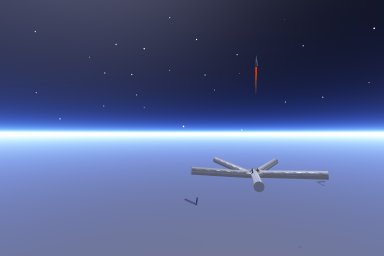
JP Aerospace's Stratostation concept for a "manned
sub-orbital space station. Floating at 140,000 feet
this structure will serve as a launch platform, research
facility and tourism destination. At over a mile across,
it will be supported by multiple Helium lift cells."
See ATO
Airship To Orbit (pdf) for details
The floating city in the sky has long
been a staple of science fiction. City sized platforms
such as those in Star Trek or Star Wars require technology
far beyond our current capabilties (e.g. anti-gravity
systems that violate fundamental physics laws as we
currently understand them.)
However, it's quite within our capabilities
to float a platform at very high altitudes that is big
enough to hold, say, living quarters for a few people
and a substantial amount of equipment.
For example, JP Aerospace is proposing
to build the Stratostation (see figure above.) It would
offer a facility useful for a number of applications
such as a place for atmospheric and space scientists
to place sensors and observatories. It could also be
useful for launching rockets. Vee Airships would provide
access to the station.
Note that
launching at high altitudes removes the fuel penalty
that a ground launched vehicle must pay to punch through
the atmosphere. Also, to perform efficiently, rocket
nozzles must either compensate for atmospheric pressure
(e.g. use an extensible mechanism or the aerospike
approach) or the vehicle must use a multi-stage system
in which the first stage engine nozzles are optimized
for low altitudes and the second and third stages
set for low air pressure and vacuum regions.
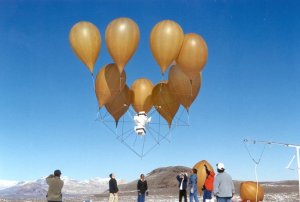
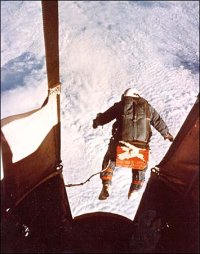
In 1959-1960 the Air Force carried out a series of
tests called Project
Excelsior, in which Captan
Joseph Kittinger dived from balloon gondolas at
increasing altitudes, the highest reaching 31km in altitude.
He nearly reached supersonic speed before releasing
his parachute. He was testing whether pilots of high
altitude aircraft like the U2 spyplane could survive
if they had to bail out.
Similar jumps from even higher altitudes, and perhaps
eventually even from orbit, may become the ultimate
extreme sport.
In the 1960's there were several US projects that investigated
whether astronauts could rescue themselves from disabled
spacecraft by "bailing out" in various types
of personal
protection outfits. These included General Electric's
MOOSE
(Manned Orbital Operations Safety Equipment) scheme
in which the astronaut lay in an injection-seat type
of pod with a heat shield and small rocket to initiate
re-entry.
These and other schemes may some day lead to space
diving and space surfing as the ultimate
in space thrills!
StratEx - April 14, 2015 - 41 422 m free
fall by Alan Eustace of the USA.
The possibility of an orbital system that somehow grabs
a vehicle from high altitudes and brings it up to orbit
is one of those hand waving kind of concepts that is
often proposed but seldom makes sense.
However, with the development of space
tethers and high stength fibers, practical
proposals have begun to appear:
HASTOL
- a concept at Tethers
Unlimited in which the end of a rotating tether
will rendevous with a rocketplane at 100km and pick
up a payload to take to orbit.