On this page we look at several topics related to space
tourism and offer some additional reference
materials.
Space tourists will want to stay in a roomy habitat
when they reach orbit and some serious work is going
into devloping space
hotels.
One way to experience weightlessness without going
to space is to buy a ticket for a parabolic
plane ride.
A vicarious way to travel space is to place personal
tokens
on spacecraft or simply broadcast a message
towards another star via a big radio antenna.
Space
Tourist Lodging
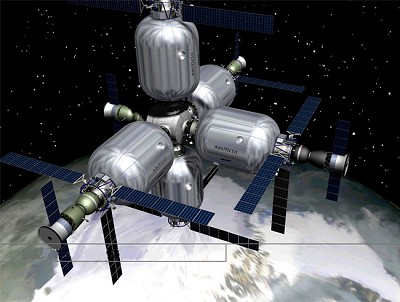
A future Bigelow
Aerospace orbiting facility assembled from multiple
BA-330 inflatable modules. Such a facility would be
used for
space tourism plus science and engineering projects.
While the mega-rich can now head directly
for the ISS, what about the lesser rich space tourists?
Sub-orbital hops will eventually become boring and even
lapping the earth a few times in low earth orbit will
become routine.
Not wanting to remain strapped into their
seats for long periods of time in a small cramped spaceship,
space tourists will demand somewhere to go to enjoy
extended stays in space. It's unlikely the government-run
ISS will welcome dozens or eventually hundreds of guests.
MirCorp, see below,
was the first serious effort to fund a private space
habitat. The project involved privatizing the Russian
Mir space station. The project did fund the first private
manned space mission but due to a series of unfortunate
bad breaks, they did not succeed in time to prevent
the de-orbiting of the station.
At about that same time in the late 1990s,
early 2000s, Robert Bigelow began his Bigelow Aerospace
company with the goal of creating orbital habitats using
inflatable structure technology developed at NASA. So
far, the company has successfully orbited two prototypes
and is working on a crew capable spacecraft for launch
in the 2011 timeframe. See below
for more details.
Bigelow
Aerospace
This company is developing plans for a space tourism
infrastructure that includes orbital hotels. Owner of
Budget Suites of America, Robert Bigelow is planning
to spend several hundred million dollars over the course
of a couple of decades on this project.
The company began a collaboration with NASA on inflatable
space habitats, continuing the work that began with
NASA's Transhab project for the Space Station.
Bigelow plans a series of modules planned that will
lead to the launch of crew capable habitats by 2010.
Their first prototype module - Genesis
I - was successfully launched on July 12, 2006.
Genesis
II was launched on June 28, 2007. The Sundancer
module, a 3 person moduel, will launch in in late 2010.
See Space
Transport News web log for the latest update. Do
a search there on "Bigelow" to obtain a list
of postings with links to stories about the project.
MirCorp
In the late 1990s, the telecom mogul Walter
Anderson and some partners created this firm to
work with the Russian RSC Energia company on obtaining
rights to the Mir space station to use for commercial
activities, particularly visits by space tourists.
However, the inability of Russia to support both Mir
and its ISS committments forced Russia to de-orbit Mir
in early 2001. So MirCorp shifted its emphasis to the
ISS.
The company attempted to launch a commercial space
station in collaboration with RSC. The $100 million
dollar Mini Station 1 would "accommodate up to
three visitors for 20-day stays..."
MirCorp hoped to use the station as a space tourism
destination. It's also worked with several space toursit
and game show enterprizes to send civilians to space
- either the ISS, the MiniStation, or just a few orbits
in a Soyuz..
The company also hoped to develop several commercial
activities that range from TV broadcasts from space
to micro-gravity product manufacture. For example, it
arranged for a Radio Shack commercial to be filmed on
the ISS.
Subsequently, Anderson, along with Dennis Wingo, shifted
interest to Orbital
Recovery, which is developing a space tug for docking
with and maintaining comsats that have run out of station-keeping
fuel.
MirCorp also became involved with the Xero company
that planned to offer zero-gravity experiences on an
airliner flying parabolic flights out of northern Sweden.
Anderson in 2005 was arrested for tax invasion. The
MirCorp company no longer exists but the site MirCorp.org
provides the history of the company.
The movie Orphans
of Apollo, released on DVD in 2009, tells the
behind the scenes story of the MirCorp project.
Jeffrey
Manber, who was deeply involved in the attempt to
privatise Mir, posted on his Aviation Week blog a note
about the " anniversary of the world’s first-and still
only—privately funded manned space mission": Anniversary
of MirCorp Mission - OnSpace/AvWeek - Apr.6.09.
In a Space
Show interview on Dec. 16, 2008, Manber gave lots
of interesting background info on the MirCorp
saga, as well as on Russian-US space relations in the
1990s.
MirCorp & Dennis Tito: Dennis
Tito first worked with MirCorp to go to Mir
and undergo the Cosmonaut training program. After Mir
was deorbited, MirCorp continued to facilitate his dealings
with the Russian agencies, although Space
Adventures became the primary agent.
Walt Anderson, the billionaire investor in MirCorp,
once wrote an angry letter to Aviation Week disputing
the level of Space Adventures involvement in initiating
Tito's flight.
Space Buffs Attempt to Make Their Mir Tourist Venture
Fly - Wall Street Journal - June.16.2000 - This
was the first article to reveal the plans by Tito pay
the Russians for a ride to Mir. MirCorp was his liason
with the Russians. When Mir was deorbited he changed
his destination to the ISS.
Space
Island Group This project wanted to use of Space
Shuttle external tanks to build a commercial space
station that could serve as a hotel for tourists as
well as for scientific applications. The group's advisors
included NASA and aerospace industry leaders.
See their information pages for more details and graphics
about the design of their station.
Hilton Internation has provided some funding for the
group
lunararchitecture-lunar
base 2002 workshop - June 10-21, Nordwijk , The
Netherlands. This is a "student workshop for
design of extra-terrestrial bases for human settlement
of the Moon. The workshop aims to inspire, engage
and challenge European students to create design concepts
for Lunar Bases for our return to the Moon."
WAT&G
This architectural and development company has done
some design studies of space hotels. There are no details
given but the futuristic
projects page does show artwork of a space station.
Microgravity
& High Altitude Experiences &
Spaceflight Training
(Courtesy ZERO-G)
Professor Stephen Hawking weightless during his parabolic
flight on April 26, 2007.
Here are resources related to weightlessness experiences
via rides on aircraft as they fly parabolic trajectories.
There are now a number of ways that members of the public
can pay for such rides.
Russian
Spaceport & Adventure Travel - a list of some
travel agencies that provide opportunities to ride
the microgravity and Mig fighter flights.
Near
Space - high altitude experiences with ballooning,
sub-orbital rockets, etc.
ZERO-G:
Zero Gravity Corporation
This company, began offering commercial parabolic flights
to the public in Septmber 2004. The first 20 flights
were already sold out before the official opening. ZERO-G
was co-founded by Peter
Diamandis who also co-founded the X-PRIZE,
A ride on the 90 minute flight costs around $3000.
The first few parabolas give Mars-like gravity, the
next set gives Moon-like gravity, and the last 10 or
so give zero-g. This gradual approach to zero-g, plus
keeping the number of parabolas at 20, greatly reduces
the incidents of motion sickness.
Sponsored by Northup-Grumman, "teachers from across
the U.S. and around the world will experience first
hand the application of math, science and engineering
principles to human activities in a weightless or low-gravity
space environment". The program will let 240 teachers
ride on the aircraft of Zero
Gravity (ZERO-G)
Tim’s job is the closest thing there is to being
an astronaut without actually going into space. He
spends his days assisting and training people in aircraft
flights that simulate a microgravity environment—effectively
he’s a flight attendant teaching people how to fly—and
he is one of only nine people on the planet qualified
to do this.
Tim has performed over 150 such flights, each with
multiple parabolas—where the craft goes up and down
at a steep angles to create a “weightless” free-fall
environment inside—equating to over 24 hours of his
life that Tim has spent unencumbered by the Earthly
bonds of gravity. This has led to Tim’s unique ability
to, as he puts it, “execute some fairly bad-ass flips
in any axis [x, y, and z].”
Atlas
Aerospace - Zero Gravity
This Russian firm offers a wide range of space adventure
experiences including parabolic flights
"Participate in parabolic flights for achievement
zero gravity on russian IL-76 MDK airplane! The zero-g
fligts technology is used for cosmonauts and astronauts
training in weightlessness. Also commercial flights
for advertising projects are carried out."
Xero
This company planned to offer parabolic flights out of
a base in Kiruna in northern Sweden. They would have used
a Russian il-76. The company was supported by Mir-Corp.
Appears to have folded as of 2008.
Interview
on the Space Show, April 25, 2004 with Walt Anderson,
investor in Mir Corp and Xero.
Adventure Travel Microgravity
Packages
These adventure travel companies offer vacation packages
that include microgravity flight experiences:
Space
Adventures, Inc - Travel to Star City, Russia
and experience zero-G on a Russian plane used for
training the cosmonauts. Also, see their MIG flight
experience. See entry in Spaceflight
section.
Incredible
Adventures - Incredible Adventures offers
a number of adventure tourism packages including Zero-g
flights on Russian cosmonaut training aircraft.
NASA
Microgravity University- NASA offers parabolic
flight opportunities for both students and their micro-g
experiments. The flights are offered on a competitive
basis according to the experiment proposals.
ESA
Outreach: Student Parabolic Flight Campaign -
European students compete for the chance to experience
weightlessness on a parabolic flight in this program
at the European Space Agency. Groups of 4 students
design and propose an experiment to run during the
flight on an Airbus 300.
Novespace
- This is a French company that carries out parabolic
flights for European space agencies and universities.
Rides not available for the public.
Spaceland
is a non-governmental research organization based
in Italy that focuses on microgravity, especially
with regard to the life sciences.
Spaceflight
Training and Space-like Experiences
There are services opening up to provide independent
training facilities and education for those involved
in space tourism. These could be pilots on space tourism
vehicles or passengers that need a quick introduction
to what they will encounter. There are also opportunities
to fly high altitude jets that provide a near space
experience.
MiGFlug.com -
"Fly your own fighter jet in Europe and USA"
Edge
of Space Stratospheric Jet Flight in Russia |
MiGFlug.com - "Probably the mightiest
experience in the world: The Edge of Space flight
in the MiG-29 Fulcrum. Depending on weather and
temperature conditions, you can reach up to 20-22km
altitude, though at least 17km is guaranteed.
Only astronauts and cosmonauts aboard the ISS
will fly higher at this point. You can clearly
see the curvature of the earth. The atmosphere
looks like a blue fog, covering the earth far
below. Above you, the sky turns very dark, sprinkled
with innumerous stars. An incredible view which
only a few people were able to enjoy so far!"
OCP
- The Orbital Commerce Project
Training in suborbital spaceflight for pilots and
passengers.
Various training courses related to suborbital spaceflight.
National
Aerospace Training & Research (NASTAR) Center
This facility in Bucks County, Pennsylvania offers
"state-of-the-art equipment and professional
instructors to train space travelers how to cope with
the effects of sustained elevated G exposure, altitude
exposure, and spatial disorientation."
Starfighters Signs Space Act Agreement with
NASA-KSC Space Florida Integral to New Commercial
Venture 20 New High-Tech Jobs Anticipated - Starfighters/Space
Florida - Oct.22.09
Weightlessness
Course at Interglobal
Space - an early attempt by Rand Simberg in collaboration
with Weaver Aerospace to provide parabolic flights
for the public. Unfortunately, the project was blocked
by the FAA.
Patrick Collins, editor of the site and a Professor
of economics at Azabu University in Japan, is a long
time proponent of space commericialization. Reports
archived at the site include:
Derek
Webber gave this Google Tech-Talk in May 2009 titled,
Space Tourism Markets: What We Know And What We Don't
Know :
Lunar
Tourism
Tourist flights to the Moon are no longer a crazy fantasy.
Constellation
Services, for example, has proposed the Lunar
Express in which a Soyuz spacecraft attached to the
ISS would be used for a fly-by of the Moon for about $100M.
For two passengers, the $50M tickets would be a lot
more than the $20M Tito and Shuttleworth spent on their
flights. However, compared to the billions spent to
make Apollo
8 happen, its still a sign of how things are progressing.
Rand Simberg
investigates the prospects for space tourism. The report
looks at preliminary services such as parabolic aircraft
flights (see below), high
altitude aircraft flights, and sub-orbital
flights. (The latter includes an interesting discussion
of modifying the X-34 for passengers.) Medical
issues are reviewed.
He also discusses regulatory
and liability
issues, which may be the biggest hurdles for getting
space tourism off the ground.
Expedition
Earth Space tourism information including an interesting
comparison of sea yachts and future "space yachts".
The group organized a world expo about space tourism
in 1998 and planned a new one for 2002.
"Spacetopia Inc has been established to
exploit the emerging market for space tourism
and related services in Japan. It will also participate
in other commercial space activities that will
arise with the sharp reduction in launch costs
that space passenger travel will bring about.
Founded by partners with extensive knowledge of
both the Japanese travel market and global efforts
to bring space tourism services to reality, Spacetopia
Inc will have three main fields of activity -
travel, media, and business services. Spacetopia
is a unique gateway to Japan for non-Japanese
companies looking to participate in this field
- whether seeking partners, aiming to serve the
Japanese market, or requiring consultancy on specific
projects."
Weddings & HoneyMoons
in Space
SpaceLove.com
- space activists "George and Loretta Whitesides
will be the first couple to honeymoon in space on
Richard Branson’s Virgin Galactic Spaceline".
License to Orbit: The Future of Commercial Space
Travel by Joseph Pelton & Peter Marshall (2009)
How to Build Your Own Spaceship: The Science
of Personal Space Travel by Piers Bizony (2009)
Tourists in Space: A Practical Guide by Erik
Seedhousex (2008)
Destination Space: Making Science Fiction a Reality
by Kenny Kemp (2007)
The Hazards of Space Travel: A Tourist's Guide
by Neil Comins (2007)
The Space Tourist's Handbook: Where to Go, What
to See, and How to Prepare for the Ride of Your Life
by Eric C. Anderson and Joshua Piven (2005)
Space Tourism: Adventures in Earth Orbit and
Beyond by Michel van Pelt (2005)
Space Tourism: Do You Want to Go? by John
Spencer (2004)
Your Spaceflight Manual - How You Could be a
Tourist in Space Within Twenty Years by David
Ashford and Patrick Collins, pub. 1990
and 120pp. This book was the first seriously to discuss
space tourism. See also David Ashford's list of papers
on space tourism at the Bristol
Spaceplanes, which is designing the Ascender
for the X-Prize.
Robert
Goehlich Robert Goehlich did his graduate work on space tourism
and is now doing postdoc work in Japan on this area.
See info about his lecture series:
He also has two books based on his studies. From his
space
tourism class at Keio University you can obtain
copies of his lectures in pdf format.
Space Tourism Market Simulation (STMS) is an
interactive simulation covering various disciplines
such as rocket engineering, economics, design,
laws, ethics, art, etc. around space tourism to
understand and practice coherences about this
topic. Participants can choose one out of eight
specific groups such as passenger, manufacturer,
organization, space travel agency, investor, government,
opposition or own created group. They can either
cooperate or compete with other groups. The idea
of STMS is to improve participant’s knowledge
and skills of space tourism in the fields of strategic
decision-making, engineering, teamwork, marketing
and entrepreneurial activities.
Space
Tourism Society This organization led by John Spencer is involved
in various aspects of space tourism ranging from the
design of space theme parks on earth to space yachts
in orbit.
Politics
of Space Tourism As space tourism becomes a reality, government involvement
becomes an important factor in its development. The
dispute between NASA and the Russian space agencyover
the Tito flight, for example, brought intense publicity
to the issue.
Companies hoping to build reusable
space ships for the tourist market need a clear
and stable regulatory environment. They also will lobby
Congress for tax credits or other support.
Here are various links related to the politics of space
tourism.
The biggest question about space tourism is whether
there is really a sizable market for it.
This is of particular interest with regard to sub-orbital
rides since private companies can begin building sub-orbital
vehicles today. But to get even the few $10s of millions
needed to do that, they must convince investors that
there exists a strong chance of getting their money
back.
There have been various surveys over the years of varying
size and depth. The new Zogby survey is considered the
most significant since it was done by an impartial professional
survey company and they talked only with people of high
net worth, which is the group from whom space tourists
would generally come.
The fact that Zogby found that 19% of the respondents
were interested in sub-orbital flights is highly significant.
Most companies proposing to build such vehicles only
need 50-100 riders per year to make a profit.
Dr.
Geoffrey Crouch interview on the Spaceshow - Dec.21,
2005 - "Dr. Geoffrey Crouch is the Chair
of Marketing in the School of Business, La Trobe University,
Melbourne, Australia." "Crouch has undertaken
innovative and state of the art market research for
suborbital and orbital tourism using Discrete Choice
Modeling."
Virgin
Galactic - as of the end of 2005, the company
had over $10M in deposits and full payment for the
$200k tickets and flights for the first two years
are sold out.
Health & Safety Issues
How healthy does a space tourist need to be before he
or she is allowed to fly? What stresses and strains
will a space tourist on a suborbital flight undergo?
Will there be age limits on space tourists? Here are
some resources for such questions.
History of Space Tourism
Trips to space for the general public here have been
discussed since the beginning of the rocket age in the
1920s and 1930s. But only since Tito's flight has it
been taken generally seriously.
Space Transportation Association (STA) was a leader
in advocacy of space tourism in the 1990s under the
leadership of the late Tom
Rogers. You can search for the web pages for spacetransportation.org
and reports in the STA
archive at the Wayback
Machine. The site spacetransportation.us
does not provide the resources linked to below.
The Space
Transportation Association, formed by leading
members of the space launch industry, previously
had a separate division dedicated to space tourism.
It sponsored a number of meetings and reports early
in the development of space tourism.
Space Tourism Conference June 25, 2001
- Proceedings - included presentations by Patrick
Collins and Robert Bigelow
Space Oddity: Promoters insist that zero-G
tourism is no joke. Maybe it's time to start planning
an out of this world vacation - Washington
Post Magazine- Dec.9.01
STA-NASA Report on Space Tourism- PDF
- March, 1998 this NASA funded study gives a generally
positive judgement on the feasibility of a Space
Tourism becoming a successful business if launch
costs are substantially reduced.
Evolution of the Moder Cruise Trade and Its
Application to Space Tourism - Robert L. Haltermann
- Nov.1996
More
Resources:
Commercial
Space Federation - collaboration of various companies
involved in commercial human spaceflight related activities.
A team of faculty and students at the University
of Petroleum and Energy Studies (UPES), Dehradun in
association with the Institute of Air & Space Law,
McGill University, Montreal, Canada released a research
report in 2011 on space tourism:
X-Prize Foundation
- The X-Prize succeeded in its goal of stimulating
development of a 2 person reusable rocket vehicle
capable of reaching 100 km in altitude. Now the annual
XP
Cup rocket exhibition and competition will continue
the push for practical spaceflight vehicles..
Interorbital
Space Vacation - Interorbital
Systems is a California based rocket company that
is competing for the X-Prize with its Neptune
I sea launched reusable rocket. It hopes to develop
from this a 2-stage system to take 3 tourists at a
time into earth orbit.
Vicarious
Space Travel Send some token of yourself
to the cosmos...
A number of projects
past and present involve sending personal messages and
tangible mementos into space. This might involve a CD
type disk intended as a time capsule that will travel
in space or land on a planet. Or it could involve radio
transimission to another star.
Google
Lunar Legacy
This is part of the Google
Lunar Prize program in which private organizations
will compete for $30M in prize money to put a rover
on the Moon. Members of the public can pay $10 and get
a digital picture and message taken to the Moon on the
rover. Half of the donation will go towards the contest
purse, the other half to the X PRIZE Foundation's educational
programs.
Operation
Immortality
Personal spaceflight participant Richard
Garriott has created this project in which he will
take an archive of digital messages, data about humanity,
and strands of DNA to the ISS during his trip in the
fall of 2008.
YourNameInToSpace.org
The Mars
Gravity Biosatellte project will test the effects
of Martian gravity on mammals by spinning a satellite
with a colony of mice aboard. Led
by students from MIT, Georgia Tech, and several
other schools, the project so far has gotten some seed
money from NASA but it needs a lot more to keep on track.
With the YourNameInToSpace.org
program, they are offering the public the opportunity
to put a "name, signature, corporate logo, photograph,
or other MIT-approved imagery" on the outside of the
spacecraft for a donation. There will be a return capsule
for the mice and those who pay the top price will get
a piece of the hardware after it comes back to earth.
Teacher Contest - You can win free space for your
favorite teacher by telling them how "your teacher
inspired you or helped launch your career. Entries
may be submitted in any format: essay, video clip,
song, painting, etc. - creativity is encouraged!".
Deadline is May 15th, 2007.
KEO
This French organized non-profit program plans to launch
a capsule into an Earth orbit that would last 50000
years. The capsule will carry messages from ordinary
people, biological samples and an extensive database
of human knowledge. The letters K, E and
O are 3 most common phonemes in major languages.
Signatures
in Space
Since 1997 this project of the Space
Day organization has arranged for the signatures
of over 97,000 US elementary school children to be sent
into space aboard space shuttles.
In the program a large poster is sent by Lockheed Martin
to the school and all students are invited to sign it.
The poster is then photographed and "NASA packages
the negatives and includes them in the manifest of a
U.S. Space Shuttle mission."
The flight typically occurs in the fall and schools
are encouraged to arrange lesson plans and other activities
around the particular shuttle mission.
After the flight, the poster is returned to the school
along with a NASA certification and other documents
and photos related to the flight.
Approximately 500 schools per year can participate.
Cosmic
Connection - a French project involving transmission
of messages submitted from the public to space. A
documentary film will be developed around the project.
Stardatecards
- Sending Messages to the Universe! - This
site offers you the opportunity to send a message
via laser to another star. You can monitor its
position as the light pulse heads to your target
star.
Difinity
- This company is seeking to "... archive
individual, human history..... nanoengrave it
in biographical disks.....combine it with a DNA
sample and a portion of the individuals cremated
remains; and inter this in space. DIFINITY INC.
is a space burial corporation."
SpaceFlori
- The space memoribilia site SpaceFlori
offered the opportunity to fly small items, e.g.
business cards, on missions to the International
Space Station and previously to Mir.
UP
Aerospace - send novelty items, personal mementos,
to space on the company's suborbital vehicles.
TransOrbital
The company TransOrbital
planned to launch its TrailBlazer spacecraft from
the Russian cosmodrome at Baikonur under contract
with the Kosmotras space launch company. However,
TransOrbital went dormant after failing to raise
sufficient capital to carry through on the project.
Sign
Up for Mars! - NASA
invited everyone to send their name to Mars on the
Mars 2003 rovers! Easy
online signup. Your name will be included
on a CD that will be carried by one of the landers
to the surface of Mars.
The two Mars rovers will be launched in May-June
of 2003 and land on Mars on January of 2004.
"Star
Prince" Muses-C - The Japanese chapter
of the Planetary Society and the Japanese Institute
of Space and Astronautical Science, ISAS,
sponsored this program that allowed people to place
their names on the Muses-C
spacecraft.
Muses-C
will launched in May 2003 and is travel to an asteroid
where it will land and then return with a sample
of material from the surface.
Mars
Polar Lander carried a CD-ROM containing names
submitted by email. Perhaps someday the crash site
will be located and the CD-ROM found intact.
StarDust
Explorer -the NASA JPL Stardust spacecraft
is going to pass through the tail of a comet and return
to earth with samples. currently carrying over 1.1
million names etched on microchips.
One chip will return with the sample return capsule
and another will travel on forever with the spacecraft.
NASA's Genesis spacecraft launched in 2001 and
flew through the solar wind to pickup samples
and returned them to earth. The spacecraft carried
messages called a Genesis Gram on the spacecraft:
"A Genesis Gram is a 100 character (or
less) thought that will travel through space.
All acceptable Genesis Grams, with the authors'
names, will be engraved on a special "chip"
that will be carried aboard the Genesis spacecraft
and brought back to Earth. If you are using
Genesis Gram as a class writing project, you
may combine up to five entries for a longer
thought (up to 500 characters)"
Team Encounter According to a Space News article in the Oct.
24, 2005 issue, the Team Encounter firm was shut
down by its primary investor. No word on what happened
to the money paid by customers. See Team
Encounter - Jan 3, 2004 - Waybackmachine.org
and previous entries there for archive information
about the project. One of the partners in this venture
was Celestis,
a Houston-based company that launched human ashes
into orbit. It was bought out by a separate group
and is now run as Space
Services Inc.
Formerly, Encounter 2001, planned send personal
information, e.g. letters, photos, drawings, etc,
plus DNA from strands of your hair on an interstellar
voyage with a flyby of Jupiter for $49.95. Registration
also included a poster, pins and other benefits.
On May 24, 1999, the "Cosmic Call" broadcast
was sent to 4 stars 50-70 light years away with
messages from over 50000 paying customers. Similar
broadcasts will be sent in Feb. 2000 and Feb. 2001.