HobbySpace proposes
that real space exploration in our own time, in our
own solar system, can be as thrilling, captivating,
and popular as any intra-galactic fiction of the 23th
century.
This page, as described in an essay,
is devoted to:
Science fiction about developments
in our own solar system.
Hard science fiction, i.e. technically realistic
and plausible.
Near term scenarios, i.e.
between now and the end of the 21st century or
so, are of particular interest.
Science fiction is such an enormous genre that we can
only point out a few of the authors
and books that follow this theme.
Also, the page gives some links to online
sci-fi including books, stories, and webcasts of
sci-fi audio and video presentations.
A selection of general
resources is provided for futher exploration of
the enormous world of web sci-fi. We also provide some
writers
resources for those who want to write their own
Solar Sci-Fi.
Here is a very small sampling of authors who
have often written works in the Solar Sci-Fi theme.
Note that many of them also write more far-future, galactic
works as well.
Stephen
Baxter
Baxter has written several "near-future, near-space"
novels. He has degrees in mathematics and engineering.
He taught math, physics and computer science for several
years before becoming a full-time author in 1995. This
background clearly shows in his "hard sci-fi"
style.
Gregory
Benford
Gregory Benford is a professor of physics at the University
of California in Irvine and so has the background for
writing sci-fi that is truely hard. However,
this has not limited his imagination or story telling
skills. He has won all the major awards in science fiction
including the Nebula.
Ben
Bova
Ben Bova writes novels with scenarios that seem taken
if not from todays newspaper perhaps tomorrows. The
technologies are those just within reach and the politics
seem quite plausible enough to see us back to the Moon
and onward to Mars.
Ray
Bradbury
Bradbury is the sci-fi writer with the greatest poetic
spirit. He uses space and other futuristic settings
to beautifuly illustrate the human condition. While
not obeying strict technical realism, his space stories
still realistically depict the challenges of living
and working on a difficult and demanding frontier. The
members of future expeditions to Mars won't find ruins
of Martian civilizations, but they will nevertheless
face the same yearnings, loneliness, and challenges
that he chronicled so well.
Arthur C. Clarke
What more can be said about the dean of hard sci.fi?
The inventor of the geostationary communication satellite,
Clarke went on to write some of the most influential
sci-fi of all time. Many scientists and engineers were
originally inspired to pursue their careers by reading
his work. A short story inspired Stanley Kubrik to seek
out a collaboration with Clarke to create his masterpiece
2001: A Space Odyssey.
Hal Clement
Hal Clement, pen name of Harry Clement Stubbs, began
writing sci-fi in the early 1940's and is still at it.
Considered the "quintessential hard" sci-fi
author, he used the knowledge gained from degrees in
astronomy and chemistry to create stories with a strong
degree of scientific realism.
Usually his conflicts revolve around scientific and
engineering challenges placed upon the individual rather
than the usual good guy - bad guy approach.
Robert
Heinlein
Robert Heinlein was one of science fiction's best
writers. While still obeying technical realism, he
created fascinating fully-developed characters within
marvelous plots.
His so-called juveniles, such as the novel Rolling
Stones that he targeted for young people, nevertheless
had great appeal for adults. Despite the "old future"
depicted in his novels that now seems a bit quaint and
outdated, his works still stand shoulder to shoulder
with modern sci-fi.
Innumerable young people have come across his novels
in the libraries and gotten hooked on a lifelong love
of science fiction and spaceflight.
Though many of his plots led to galactic adventures,
he also had many novels and stories about the conquest
of the solar system.
James P.
Hogan
James Hogan decided he could do a better first encounter
than Kubricks 2001 and succeeded on a bet at getting
Inherit
the Stars published in 1977. He has continued
since with a series of sucessful science fiction novels.
Geoffrey
A. Landis
A NASA scientist who has become well known for his short
stories. (His first novel will be out soon.) He also
writes extensively on various issues about both science
fiction and science fact with essays and articles in
many magazines.
More Authors
These authors write at least the occasional book in
the "hard sci-fi" mode, though many often
go beyond a near-term, solar system scenario:
Shadows
of Medusa - a "true-science Mars exploration
novel". A near future novel that involves
the first human flight to Mars and the secrecy
and intrigue surrounding the mission, which is
threatened by a "web of murder and deceit".
The Firestar Saga comprises four books:
Firestart, Rogue Star, Lodestar,
and Falling Stars. It involves a near term
future scenario with entrepreneurs creating a
space infrastructure and diverting an asteroid
from colliding with earth.
Some particularly interesting recent examples of works
that illustrate the Solar Sci-Fi theme.
The
Hohmann Transfer by
Tom
Sylvester
Tom Sylvester's first novel laid the basis for the movie
Space
Cowboys. Here, though, instead of some aging flyboys,
a young female engineer is the only one with the knowledge
to save a satellite from reentering the atmosphere.
Four
chapters (pdf).
This book is a great example of the Solar Sci-Fi theme.
It combines an exciting adventure yarn with a strong
degree of technical realism to illustrate the incredible
things we could do in space with the technology we already
have.
Red
Mars, Green Mars, Blue Marsby Kim Stanley Robinson Kim Stanley
Robinson's monumental trilogy about the terraforming
of Mars has convinced many people that maybe it's not
such a crazy idea afterall. Beginning with an initial
expedition of 100 people, Mars is gradually transformed
into an earthlike planet with breathable air, plant
life and oceans.
However, along the way a deep conflict arises between
the Greens, who believe in terraforming, and the Reds,
who want the harsh but beautiful Martian world to remain
as undisturbed as possible. War and destruction follow.
Life extension techniques allow many of the original
100 to live through the centuries of terraforming efforts.
Several of the original 100 serve as the central characters
and connect developments over the course of the three
novels.
The Martian landscape is vividly protrayed and the
techniques of terraforming are described with enough
technical detail to give them a high degree of plausibility.
Mars
Underground by William Hartmann
William Hartmann, a well known space scientist at JPL,
who also paints,
wrote this well reviewed book about colonizing Mars (1997,
New York: TOR Books).
Young People's Science Fiction
Here are solar sci-fi aimed at youngsters from kindergarten
to high school.
Ken Murphy has assembled
these excellent compilations with thumbnails of the
covers and brief descriptions of each book:
The
Rocket Company: This fictional
account of the development of a fully reusable space
transport vehicle was initially provided at HobbySpace
in serialized fashion. Today, only two chapters
are provided because the book was accepted for publication
in print. Amazon
Stranded in orbit, with no way home before
the air runs out… A veteran pilot flying a revolutionary
spaceplane, A media mogul on an urgent mission halfway
around the world, And an aerospace legend fighting
to save his legacy, in the face of a government
that would stand aside to let it be destroyed. At
hypersonic speed, Arthur Hammond’s fleet of Clipper
spaceplanes has become the premium choice for high-flying
travel, placing every corner of the globe within
a few hours’ reach. But when the line’s flagship
is marooned in space with a load of VIP clients,
its crew must fight to stay alive knowing that help
may never arrive.
As they struggle with failing life support and increasingly
desperate passengers, their colleagues back on Earth
scramble to mount an audacious rescue. A contentious
mix of old airline hands and NASA veterans, they
will face shocking betrayals in a battle to save
their friends.
In this race against time, Hammond must confront
an onslaught of horrendous press, nitpicking bureaucrats,
and dubious financiers – all of them pawns in a
larger game, with his business empire as the prize.
Amid a spreading web of industrial espionage, he
may find the truth to be worse than imagined. And
in space, one man will discover that escape may
demand a terrible sacrifice..
The
Expanse - "a new science fiction
series from James S.A. Corey, the pen name for a collaboration
between Daniel Abraham and Ty Franck",
Oxygen (2001) & the sequel The Fifth
Man (2002) by Randall Ingermanson and John B.
Olson . In the first book, an explosion cripples
a spacecraft on a voyage to Mars. The crew's survival
depends on complete trust in one another—but is
one of the four the saboteur? In the sequel , the
crew tries to devise a way to return to earth.
Moon Shots - Edited by Peter Crowther and
with an introduction by Ben Bova, 16 authors contribute
to this anthology dedicated to the 30th anniversary
of the first lunar landing. The stories have the
common theme of the Moon as a place where we should
once again return and continue our explorations.
Review
at Space.com * Amazon
Kings of the High Frontier by Victor Koman
- 1997 Prometheus Award winning novel about near
future intrigue and conflict surrounding "humanity's
next stage of evolution: the jump into Space."
Amazon
Orbit (2006) by John J. Nance
A mishap leaves a space tourist stranded in orbit.
the story of the US/USSR space race, told in comic
book form, but with a different focus from many other
books on the subject, since in addition to the astronauts
and cosmonauts and politicians and everyone else who
usually gets the limelight, this points the spotlight
on the engineers and scientists on both sides of the
Iron Curtain. And that perspective is something I
don’t think you see too often in books on Apollo and
Soyuz.
Role
Playing Games
Role playing games have grown into a major industry
with elaborately created scenarios, characters, and
background development. Within the framework of the
game rules, the creation of characters and their unique
responses to situations can essentially lead to collaboratively
created works of fiction. Every game is a new, unique
story.
Here are some RPG's that involve space scenarios:
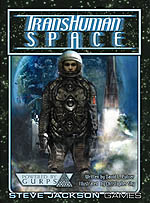
Transhuman
Space by David Pulver and the top GURPS authors.
- develops a scenario similar to the one described
in the essay
here in which humans have spread throughout the solar
system and genetic engineering has resulted in a "multitude
of artificial races".
Space-Ops
RPG - an online, forum-based, role-playing game
of space exploration, science, technology and adventure.
"The game is basically a simulation of a small
scientific outpost on Mars, where players are involved
in conducting experiments, exploration missions,
developing technology, and interacting as explorers
and settlers of Mars. The spirit of the game is
to encourage and develop interest in space exploration,
with an initial focus on human exploration of Mars.
We hope to expand the game into all areas of space
exploration, such as Moon settlement, asteroid mining,
space tourism, etc."
Virtual Solar Sci-Fi
Virtual world environments built around a Solar Sci-fi
scenario.
Extropia:
"Extropia is an online community in the world
of Second
Life, built around a positive, near-future science
fiction theme."
Webcasts/On
line Short Films and Animations
Dimension
X - collection of audio files of this radio
program from 1950-51 that presented sci-fi stories
of appeal to grown-ups. Many of the stories are by
writers of the "Golden Age" of sci-fi such
as Robert H. Heinlein, Isaac Asimov, and others.
Cyber Sci-fi
Network - fledgling web broadcaster. See the
promo for Mars
& Beyond, a drama about exploration of space
and includes a supporting role for Majel Barrett Rodenberry.
Crimsonaut is a real time fiction
drama about the first expedition sent to colonize
Mars. The story is told from the inside. The
systems engineer crew member Daniel J.R. III
unveils the story through his dairy that writes
at the end of each day. But Daniel's expedition
is not the only one heading to the red planet.
Another twin spacecraft was sent two months
before Daniel's lift-off to ensure mission success.
But the communications with the other spacecraft
were lost at the very same moment that Daniel
lifted-off. Now the whole mission succes depends
on Daniel's spaceship.
Onboard each spacecraft travels a 3 man and
3 woman crew that will have to get along in
a reduced space for the 180 days trip to the
red planet. Isolation from Earth and fear to
suffer the same luck as their twin spacecraft
will have an important psychological effect
on the crew. Also technical difficulties will
arise soon and the crew will have to deal with
them without ground support.
When everything will go wrong what will keep
the crew up and running is the expectation of
reaching the red planet, and arrive to the fully
functional habitat landed there 2 years before
their lift-off. Will they get there?
Mars
Frontier by Robert Stockman. It deals
with "the first landing on Mars, exploration
of the planet, and its eventual settlement.
The novel attempts to make reasonable assumptions
about the technology available to send humans
to Mars in the 2020s, but speeds up the pace
of settlement somewhat. It also sets the exploration
and settlement of Mars in the context of exploration
of the moon, Venus, asteroids, Mercury, and
the outer solar system."
To
Distill Some Water - Science@NASA - Aug.9.02
- "This fact-filled science fiction tale,
based on Jack London's "To Build a Fire"describes
an astronaut's urgent search for something to
drink on Mars."
Mars
by Stealth -Written by the late Peter
Rasmussen, a professional screenwriter, who
said he wrote "this short story to help popularise
human missions to Mars in the near future.
Moon:
Lunar
Pioneers by Dr.
Philip R. Harris w/Dr. David G. Schrunk -
the rights to this sequel to the author's book
Launch
Out, about a private project to estabilsh
a colony on the Moon, was provided by the author
to Out of the Cradle and Moon Society.
"Galaxiki is a fictional online galaxy
that can be edited by its community. Each star,
each planet and each moon is represented by a
wiki page that can be edited by its site members.
Users can make changes to solar systems, add creatures
and write stories. One of the main goals is to
invent and write collaborative stories, which
requires users to make sure their solar system
histories remain compatible."
-Write a short story of no more
than 8,000 words, that shows the near future
(no more than about 50-60 years out) of
manned space exploration. -No entry fee.
But please only submit one story...your
best one! -No reprints.
Solar drift is an episodic science fiction
tale set in the year 2430. It follows the exploits,
trials and tribulations of an unlikely pair of spacers
who are thrust together by fate and into a time
of change.
Man
Conquers Space
A film under development that is based on Von Braun's
and Chesley Bonestell's proposals in 1952 of how space
exploration should proceed. Using advanced 3D graphics
and animation techniques, the Australian firm Surfaces
Rendered is creating an alternative space history
of the 1950s and 1960's.
Man
Conquers Space will show how space exploration would
have proceeded if it had gone according to the program
outlined in the famous series of articles written by
Wernher Von Braun for the Colliers
Magazine in 1952.
In this version of history, the Moon is first visited
in 1963 and people land on Mars in 1968. A giant rotating
space station orbiting the earth provides a way station
to the solar system.
The films visual style will follow closely to that
in Chesley
Bonestell's illustrations for the articles.
Several preliminary videoclips
are available for viewing on-line.
Check out a clip of the
soundtrack , written and performed by Blair Joscelyne,
to the film.
Space:
1889
Dan Thompson developed this site about the role playing
game Space: 1889 invented by Frank Chadwick. It involves
an alternative world where space travel developed futher
along a Jules Verne / late Victorian style technology.
Thompson includes some original stories here based
on this universe and also displays some of his models
of spaceships described in the stories.
Other Alternate Histories
Voyage
by Stephen Baxter, 1997- JFK survives the assasination
attempt. His efforts keeps the space effort robust
and eventually results in a manned Mars mission.
Analog Science Fiction & Fact
Amazon: US
Analog Science Fiction and Fact contains compelling, hard-to-put-down
futuristic sci-fi stories and scientific features.
Sci-Fi Magazine
Amazon: US
What's hot in Sci-Fi movies, TV & games from the official Sci-Fi Channel
magazine.



 (2010) with
 by Patrick Chiles. Available as