Amateur advanced (or Experimental) and student rocketry
groups develop sophisticated rockets that are reaching
towards the threshold of space (100km or so depending
on whom you ask!).
The vehicles include liquid and hybrid propulsion
technology in addition to solid fuel motors.
Besides trying to break high altituderecords,
these rockets are intended to provide low cost vehicles
for research in such areas as microgravity.
Though these advanced rocket projects demand enormous
amounts of work and dedication, they are fun, exciting
and educational for all involved.
The organizations listed here include student groups,
student/commercial company collaborations, purely amateur
clubs, amateur/company collaborations, and small, entrepreneurial
companies.
See History
of Experimental Rocketry by Jeff Hove for reference
information on current and past experimental rocketry
groups and projects.
News about launches and other developments in advanced
rocketry typically appear first in one of the bulletin
boards or mailing lists.
News sites include:
Advanced
Rocketry News - latest developments in
the world of advanced amateur and student rocketry,
experimental rocketry, and entrepreneurial rocket
companies
Black
Brant Project
The Black
Brant Project will build a 107% scale version of
the Black
Brant II and propel it with three "54,600 NS
motors (33% "P" motors), all lit on the pad." It
should reach 14,700 feet (4.48km) and a velocity of
Mach 1.20 (1320 Feet/Second)
They plan to launch the vehicle at BALLS
2004 in Nevada.
Experimental Rocket
Propulsion Society [ERPS] ERPS is a San francisco Bay area group that
concentrates currently on development of liquid fuel
rockets. In particular, hydrogen peroxide (H2O2) oxidizers
combined with fuels such as kerosene and jet fuel.
"EMRAA is a attempt to bring science fiction
into reality, to make manned rocketry common place.
EMRAA is a Internet meeting place where engineers,
technicians, aviators, and craftsmen can find each
other to start projects, share ideas and information,
and make friends with people who have liquid rocket
engines, hybrid rocket motors, and manned rocketry
as a common interest. This is a association, there
are no officers or dues. EMRAA is not a pie in the
sky organization.
EMRAA projects will be worked on in spare time by
most people. Capital will be generated by individuals,
advertising sponsors, and by bartering services. Even
though the aerospace giants are working on projects
their is no good reason why individuals and small
companies cannot get together and accomplish a lot
for manned rocketry. Remember what the Germans accomplished
before World War Two. If you know someone who is interested
tell them about this home page.
If you have a manned rocket project of any kind
we would love to hear about it. If you are building
a powerful safe rocket motor or engine let us know."
- EMRAA
statement of purpose
The Experimental Sounding Rocket Association is dedicated
to getting students of all ages excited about rocketry
and space exploration through building and launching
experimental sounding rockets and other rocket-related
technology. An "experimental sounding" rocket bridges
the gap between "experimental" or "research" rockets
built by hobbyists and professional/government "sounding"
rockets that reach suborbital space, with potentially
some overlap at each end of the spectrum. Generally,
"experimental sounding rockets" can be a small as
launching a 10-pound payload to 10,000 feet above
the ground, to being able to launch a 50-pound payload
in excess of 100 miles altitude.
and
ESRA was formed in 2003 in Logan, Utah, as an outgrowth
of the "Unity IV" four-university (Brigham Young University,
University of Utah, Utah State University, and Weber
State University) student hybrid rocket program.
"In 2003 four guys Kevin Baxter an inventor,
Fred Holmes a patent attorney, Mark Holthaus an electrical
engineer, and Ted Rothaupt a mechanical engineer,
came together to form the Friends of Amateur Rocketry,
Inc. (FAR). Their goal was to encourage cooperation
between individuals and groups involved in amateur
rocketry. To this end, they purchased and developed
FAR site, a ten-acre property which is a safe location
to test and launch rockets.
FAR has since become a publicly supported nonprofit
corporation recognized by the IRS. Its mission has
expanded to educate the general public in science,
technology, engineering, and mathematics (STEM) through
the use of amateur rocketry; and to foster rocket
technology by supporting individuals, hobbyists, student
groups, businesses, and other like-minded non-profit
entities. To date, FAR has worked with the Boy Scouts,
hobbyists, university students, aerospace start ups,
and the Mythbusters cable television show.
The FAR site is uniquely located under the R2508
controlled air space umbrella of Edwards Air Force
Base, at the edge of a military supersonic corridor,
many miles from any inhabited area. This allows us
to have a much higher launch altitude than most other
locations in California. Our FAA Wavier allows rockets
up to 9,208-lb. sec. total impulse. Launch altitudes
are up to 18,000-feet Monday through Friday and 50,000-feet
on Saturday and Sunday. We have also received all
the necessary local, state, and federal licenses,
allowing a user to test rocket technologies without
the overhead found at government and military ranges.
In addition, we have pyrotechnic operators licensed
by the California State Fire Marshal and the ATF to
help you safely manufacture, store, set up, test,
and launch rockets. Our facility has a blockhouse,
viewing bunkers, explosive magazines, fire fighting
equipment, propellant storage, static test stands,
and launch rails. Other facilities include: an assembly
building, work shops, storage, sun shade, weather
station, internet, electrical power, street lights
(for night operations), non-potable water, outhouse
(restrooms are under construction), and camping.
We have an assortment of heavy equipment such as:
all-terrain-forklift, skip loader, and boom crane
to help with loading, unloading, and setup. For fabrication
and assembly we have a lathe, mill, drill press, chop
saw, grinder, and welder. For safety, we have first
aid, automatic defibrillator, oxygen, and a helipad
for emergency evacuations.
The FAR
test facilities in Mojave are now used by many amateur
and small company teams to carry out engine tests, tethered
vehicle flights, and launches.
Huntsville
Alabama L5 Society
This group has a very active high-altitude rocket program
underway. Their rockoon - balloon launched rockets -
are intended to set high altitude records and eventually
to provide low cost research sounding rockets. Project
HALO -- High Altitude Lift Off
Ozark
Propulsion Labs
This program is "run by an avid amateur / experimental
rocketeer, Darren Wright. He has designed and sucessfully
flown the largest motor east of the Misissippi, a 54,000ns
'P' motor. He will also be building the motors for the
second heaviest amateur rocket attempt, the Maryland
/ Delaware Rocketry Association (MDRA) group project,
the Liberty Project. He also runs propellant classes
to introduce rocketeers to the science of propellant
deisgn and manufacturing."
The OPL also works with the JAMSTAR
program at the Florida Institute of Technology mentioned
below.
Reaction Research
Society
RRS, founded in 1947, is "...oldest continuously
operating amateur experimental rocket group in the United
States." RRS carries out a full range of rocketry
research including "...designing, building, and
testing solid, hybrid, and liquid fueled rockets."
RRS
media - images and videos of rocket flights and
engine tests
SPACESHOT
2000, launched in Sept.29,2000, reached 3,205mph
(Mach 4.9)and 40k ft before the vehicle broke up.
It had been expected to reach 60miles in altitude.
Rocket
Mavericks
This organization was formed in 2007 to carry out advanced
amateur rocketry and spacecraft (e.g. cubesat) projects.
The founders include Stanford smallsat guru Bob Twiggs
and Rocketman Ky Michaelson, leader of the CSXT
group that launched an amateur rocket to over 120km
in 2004.
They describe the group as follows:
Mavericks is where the most independent, and
most experienced high power rocketeers and civilian
space explorers collaborate, compete and fly experimental
projects that push beyond the hobby, to the next level
of professional civilian rocketry and space exploration.
Mavericks goes beyond sponsoring experimental launch
services, and focuses on the complete needs of the civilian
space explorer...
Paragon Foundation
This organization seeks to use advanced rocketry for
educational purposes for students and the general public.
Located in Denver Colorado, the group welcomes volunteers.
The Dragoon II sounding rocket project suceeding on
June 7, 2004 in reaching 120,000ft (36.6km) altitude.
Their ultimate goal is 350,000 ft. (107km).
The affiliate Paragon
Labs company builds rockets and does aerospace consulting
work.
Project R.U.S.H.
Rocket Guy Brian Walker planned in the early 2000s to
blast off on his own hydrogen peroxide rocket. Walker
is a successful toy inventor who is now building his
own rocket that he intends to ride to an altitude of
30 miles. Though he made considerable progress, with
other small budget efforts like that of Burt Rutan's
SpaceShipOne and John Carmack's Armadillo Aerospace
finding success, he decided not to pursue his own rocketship
any further.
Sugar
Shot to Space
This team will attempt to launch an amateur rocket to
100km using a sugar based solid propellant rather than
a higher power ammonium perchlorate composite (which
the CSXT team used for its GoFast rocket.)
Cal
Poly Space Systems
This AIAA student chapter consists primarily of students
at California Polytechnic State University in San Luis
Obispo. It has made progress on a number of technology
demonstrator projects, some of which were sponsored
by NASA and Starcraft
Boosters, Inc.
An earlier project involved scale flight models of
Buzz Aldrin's StarBooster
design. They launched a 10ft model, for example, which
then glided back under ground control until near to
the ground it popped a parachute for a safe landing.
See the media
section for pictures and videos of their StarBooster
model tests.
As part of the California Launch Vehicle Education
Initiative, the Aerospace
Engineering department at Cal State University at
Long Beach is collaborating with Garvey
Spacecraft Corporation in developing various types
of rockets and rocket technologies. (See, for example,
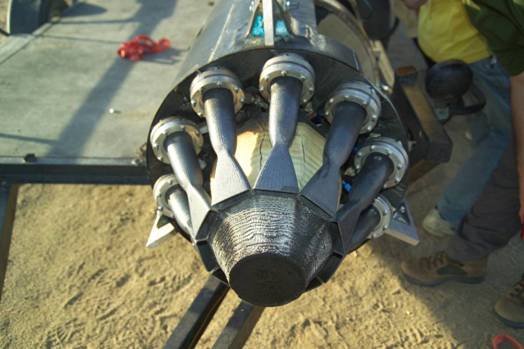
the picture of their aerospike engine at the top of
this page.) They have particularly focused on reusable
(or, at least, refurbishable) rockets and supporting
technology. The training from this has sent many students
into aerospace careers.
This history
of the collaboration shows them developing the Kimbo
series of rockets from late 1990s to 2003 when they
started the Prospector sereies. A general goal has been
developing low cost reusable technologies. The series
began when John Garvey of Garvey
Spacecraft Corporation sought to continue the progress
made by the DC-X project but on an even lower budget.
A long term goal is the two stage Nanosat
Launch Vehicle (NLS) that would put small payloads
(up to 10kg) into orbit.
The group also works with the Reaction
Rocket Society and uses the Society's facilities
for engine tests and rocket flights.
The program receives support from a the California
Space Authority as a new program called the California
Launch Vehicle Education Initiative (CALVEIN):
Cornell
ASTRO
This project, which currently involves about 35 students
along with faculty support, plans
"to build a reusable, autonomous, rocket powered
vehicle that can lift off under its own power, hover
at a low altitude to display its stability, and land
safely without damage. After the completed testing
of the first generation ALV [Autonomous Launch Vehicle],
a new ALV will be designed and fabricated each year,
building upon prior versions and improving ALV performance.
ASTRO will build and launch its first functional ALV
by the Spring of 2004."
JAMSTARS
"A group of amateur rocketeers who are donating
their time to assist University and High School Students
in the implementation of Rocketry Projects. The numbers
of involved Amateurs and Students grows every year.
We began with a small project in 2000 with a rocket
using only 360 Pound-seconds of thrust to the 2003 JAMSTAR
booster with 18,000 Pound-seconds of thrust."
JAMSTAR
- JAMSTAR (Joint Aerospace & Meterology Stratosphere
Analysis Rocket) is student project at the Florida
Institute of Technology and in cooperation with Ozark
Propulsion Labs (see above)
and Loki
Research.
The goal is to build a high altitude sounding rockets
to carry scientific payloads such as meterological
experiments. The group has built a P-class motor
- "the largest amateur motor ever built & successfully
fired on the East Coast."
The group launched in April of 2003 a sounding
rocket with a P motor booster and an unpowered second
stage Dart .
SOAR
(Suborbital Amateur Rocket) student rocket project
at the Florida Institute of Technology plans to send
a two-stage solid motor powered rocket to 122km (76miles).
MaCH-SR1 Hybrid
Rocket Launch Vehicle
"MaCH-SR1 hybrid rocket launch vehicle is a student-driven
project that is currently under development at the University
of Colorado in Boulder."
The project's goal is by 2008 to build a sub-orbital
rocket capable of:
Altitude goal of 75 miles (125 kilometers) sub-orbital
space flight
Aeroscience Program
at Fredericksburg High School, Texas
The Aeroscience Department - Fredericksburg HS
offers a 2 year high school course, created by teacher
Brett Williams, that has been widely praised for its
successful rocket building efforts. The U.S. Congress
officially recognized their launch in 1998 as the first
high school rocket to break the sound barrier with a
2 meter rocket that was designed and built by the students.
They have had assistance from the Marshall Spaceflight
Center, which has now started a similar
program with high schools in the Huntsville, Alabama
area.
In August of 2000 their Redbird
9-H, 185kg, 7m solid fueled rocket, reached over
10km in altitude.
The program Ignite
- Education in Motion is based on the Fredricksburg
High School rocket program. There is also this
report on two Fredricksburg High rocket projects
in 2008:
High School Rocket-Building Course Takes Off
in Texas - Space News - April.2.2001
NASA Student Advanced Rocketry
Programs
NASA
MSFC Student Launch Initiative(SLI) -
Inspired by the success of the Fredericksburg
High School rocketry projects, see above, MSFC began
a program to involve high school students in nearby
Huntsville Alabama in high power rocket projects.
CERTA
is a "new, not for profit organization which
promotes math, science and techology education through
hands on experience and participation in experimental
rocketry."
FITSat
III - This project at Florida
Tech involves "the design and construction
of a rocket, deployable vehicles, and a control and
wireless communications system. The rocket will carry
the vehicles in its internal cargo bay and release
them at a predetermined altitude. The vehicles will
collect data, which then will be transmitted to a
ground station for storage and analysis."
ERFSEDS
(Embry-Riddle Future Space Explorers' and Developers'
Society) plans to launch a sounding rocket of its
own design to 122km (76 miles ).
The
MIT Rocket Team - "formed in an effort to
become the first student group to launch a rocket
into space. Begun in 1998, the team has developed
a new type of rocket engine, and is currently in the
process of testing the engine design."
Rockets4Schools.org
- - ths program at "Spaceport Sheboygan has been
Wisconsin's home of Rockets for Schools since its
inception in 1995. May 14-15, 2004."..."Student
teams construct a rocket equipped with a powerful
motor that lifts it into high altitudes."
SOAR
(Suborbital Amateur Rocket) student rocket project
at the Florida Institute of Technology plans to send
a two-stage solid motor powered rocket to 122km (76miles).
These groups fall in the grey area between
advanced amateur and full blown rocket companies. They
make and sell commercial products & services (or plan
to) but they also involve volunteers and students in their
projects and use advanced amateur facilities, such as
the Reaction Research Society's Mojave test site.
Armadillo
Aerospace John
Carmack, co-founder of Id
Software and a key programmer for its games such
as Doom and Quake, became an amateur rocketry enthusiast
in the late 1990s and subsequently became highly proficient
at building innovative rockets for very low costs. For
many years his small but highly competent team consisted
mostly volunteers. However, after winning several contracts
with NASA, Air Force, and some private companies, AA
transformed into small business operation.
Armadillo followed an incremental "build a little,
test a little" approach in which trial and error
has given them a strong grip on the practical aspects
of building extremely robust yet low cost rocket engines.
The initial goal was to develop vertical takeoff/vertical
landing (VTVL) vehicles and to pursue the X PRIZE. After
the latter was won by Burt Rutan's SpaceShipOne, they
regrouped and started a systematic approach to developing
low cost, fully reusable high altitude VTVLs with the
long term goal of a reusable orbital system.
In 2008 they began to work with the Rocket
Racing League and put their rocket engines into
a Velocity Aircraft airframe. Eventually, this vehicle
was chosen as the RRL's primary racer design.
In the summer of 2013, John Carmack put Armadillo
Aerospace into "hibernation". He wanted
to focus on his software jobs and also try to attract
outside investment. The three Stig high altitude sounding
rocket type projects had not gone very well, i.e. they
didn't reach space as intended and did not have soft
landings, and had been much more expensive than previous
projects.
Subsequently, some former members of Armadillo formed
the Exos
Aerospace to continue the rocket development started
at Armadillo.
The Armadillo
Aerospace web site provides a long series of postings
from Carmack about their activitieis. Carmack's reports
became less and lessfrequent over the years but there
is still many remarkably detailed reports in almost
an open source style for hardware.
JP
Aerospace
This northern California group actively pursues a number
of projects including high altitude record attempts with
balloon launch, low-cost microgravity experiment vehicle,
micro-satellite design, orbital transfer vehicle design,
etc.
The group has "small core staff of about four
people and nearly 50 volunteers". John Powell,
the founder and head of the company, wants to include
both paid and volunteer workers in their group to carry
out a wide range of commercial, educational, and technology
research projects.
The group has had Air Force contracts but generally
pursues its own long term goal of a high altitude station
from which rockets and perhaps even airships could be
sent to orbit.
This group, involving 10 core staff members and another
20 volunteers, is led by Bill Colburn and "started
in 1995 based on the earlier work from 1947 to 1965
of the Rocket Motor Research Society."
They are developing hybrid motor powered rockets with
the initial goal of reaching an altitude of 62 miles
( 100km).
The groups also collaborates with Micro Aerospace Solutions
on a contract from NASA to study Gelled Propellants.
They also have three other contracts from "Stanford
Research Institute for Gas Generators and research on
Thermitic Materials".
Mark
Goll runs this advanced rocketry company that "provides
suborbital space launch services, and continues research
in both low cost suborbital and orbital launch vehicles."
Environmental
Aeroscience (eAc) - "manufactures hybrid
rocket motors for scientific, amateur, and hobby applications,
and conducts R&D for governmental applications. We
manufacture our hobby rocket motors under the Hypertek®
trademark." They also work closely with Cesaroni
Technology on these projects:
AeroPac -
Association of Experimental Rocketry of the Pacific
N1 project
- 22 ft model of the Soviet N1 moon rocket, including
42 first stage motors. The successful 3
stage launch on July 21, 2001 reached 1650
ft. Site includes lots of historica info on the
N1.
Amateur
Rocket Launch Assist (ARLA) - Glen Olson and friends
are creating a combination pneumatic tube launcher
and ramjet second stage. The tube launcher would provide
the initial speed of ~1300mph (2200kph) at which the
ramjet could fire. The ramjet
stage would then reach up to 20mi ( 32km) and 3600mph
(5900kph) where it would release a rocket third stage.
This Tri-Mode
Launch Assist concept was developed by
Glen Olson.
Stratofox
Aerospace Tracking & Recovery Team - "
team of Amateur Radio operators mostly in or near
Silicon Valley who perform or participate in tracking
and recovery operations for amateur rocketry and high-altitude
balloon ("amateur aerospace") flights."
Rocketry seems to be a growing in popularity
in the Great Britain. Several groups are pursuing advanced
amateur rocket development and going for altitude records
as well as the X-Prize.
AspireSpace
The "British Amateur Space/Rocket Program" works
on several high power and high-altitude rocket projects.
They have worked considerably on hybrid motors.
The Deimos
Project uses hybrid rockets to challenge altitude
records. The Deimos 3 is a 2-stage rocket that is 7meters
high. Both stages are recoverable.
Starchaser
Steve Bennett, a lecturer at Salford University, leads
the Starchaser project that has launched several advanced
rockets. The recent launch of the 11m, 747kg Nova rocket
received considerable media attention sucha as an article
at the BBC.
The project has developed into a commercial company
but still seems to involve students and volunteers.
The group's primary goal was the development of the
Thunderbird rocket for the X-Prize contest but they
did not get a flying vehicle buitl in time. Another
BBC
article describes the Thunderbird project.
Starchaser is now also holding a contest for a ride
on the Thunderbird.
Peter Madsen, a co-founder of Copenhagen Suborbitals,
founded this group, which also aims to launch
a person to suborbital space in a capsule.
Danish
Space Challenge
A Danish amateur group seeking to send the first home
grown rocket into space. Their current project is
the Aurora sounding rocket.
DARK
- Danish Amateur Rocketry Klub
This club was founded in 1975 as a forum for rocket
development, astronomy, spaceflight and related topics.
Norwegian
Experimental Amateur Rocketry
This group in Norway designs and builds every kind of
rocket from model rockets to very high power rockets with
hybrids and liquid fueled engines.
REXUS - Sweden/Germany
The REXUS program (Rocket-borne Experiments for University
Students) involves Swedish and German students who put
science payloads on a Orion
rocket supplied by the Swedish
Space Corporation.
SPL
- Swiss Propulsion Laboratory
SPL is a non-profit group in Langenthal, Switzerland that
works with universities and commercial organizations to
further Swiss R&D in rocketry. Their projects include:
X-Bow I - sounding rocket
X-Bow II - 2 stage reusable suborbital with lift-off-mass
of ~1500kg, powered by LOX/kerosene engines on both
stages.
X-Bow III - 3 stage reusable vehicle of placing
small payload in LEO
Aquarius:
Hot Water Rocket Propulsion Systems - project
led by students at the Institute of Aeronautics and
Astronautics at Berlin University of Technology to
develop steam rockets for take-off assist systems.
ASRI
- Australia Space Research Institute is a
not-or-profit organization that has several projects:
AUSROC
- advanced rocket development project at the
Australian Space Research Institute, a non-profit,
volunteer organization. The group also provides
a sounding
rocket service for small research payloads.
ATHA
Aerospace Group (formerly Team O'Canada) succeeded
at launching the largest amateur rocket 300lb
(~140kg), 16 1/2 foot (~5m) in Canadian history
on June.28, 2003
ASR
(AeroSpace Research) - seeks to develop an
orbital vehicle based on the RSA-3
vehicle under development by the South African
government until the project was stopped in 1994.