April
26, 2005
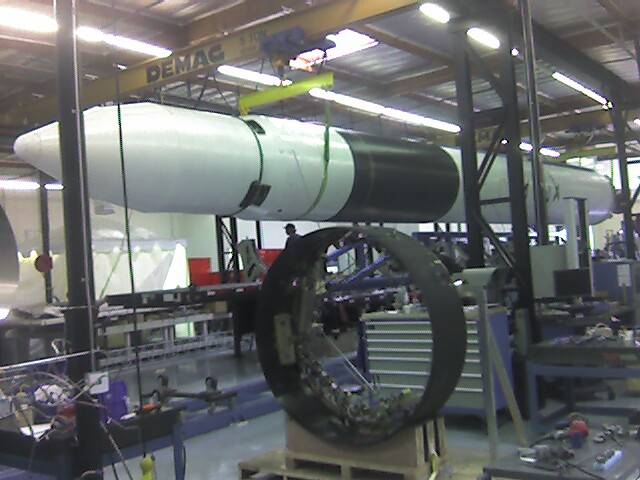
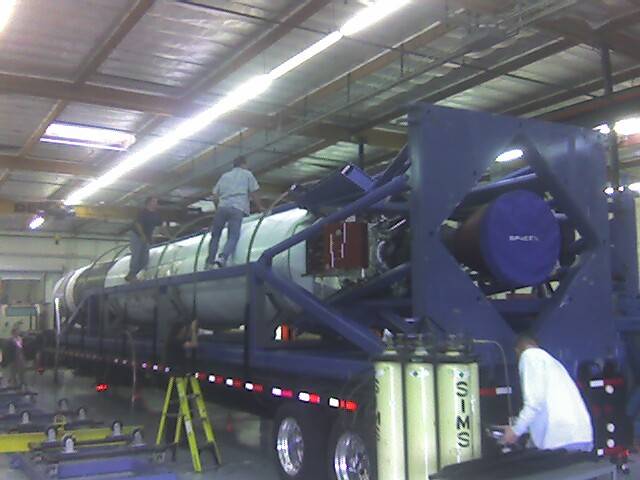
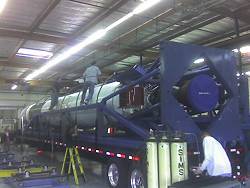
1:20 am: Falcon I shipped to Vandenberg:
 |
 |
|
Click
on the pictures for larger versions.
My thanks to SpaceX
for these images
|
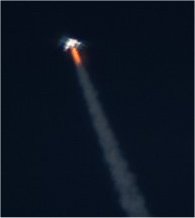
SpaceX shipped
the Falcon
I to Vandenberg this past Sunday morning for the hold down hotfire
test, which will take place in ten days.
1:20 am:
AF half-RLV... This week's Space
News (print version) reports on a program started by the Air
Force to develop a satellite launcher with a reusable, fly-back
first stage and an expendable second stage. The goal for the ARES
(Affordable Responsive Spacelift) is to launch satellites in the
2300kg-6800kg range to LEO for one-third to one-sixth the price
of current launchers. The vehicle could launch with just two days
notice.
The program, however, does not exactly rocket along. Study contracts
will be awarded this summer and then detailed design contracts would
go out in 2006. These would lead to development of a demonstrator
by 2010 for a total outlay of about $250M. They want an operational
system by 2018.
Jeff Foust, wearing his Futron
cap, was interviewed and expressed skepticism that $250M was sufficient
for a demonstrator by 2010 that could prove both first stage reusability
and two day launch notice capability. Some very pessimistic Congressional
staffers questioned whether launch rates will be high enough by
2018 to warrant development of a new rocket.
I wonder what will happen to this and other launcher programs if
the Falcon I and V vehicles succeed? They may not offer two day
launch response but they would certainly set a completely different
standard for development time scale and cost.
Anyway, here are some ARES related links I found by googling around:
1:20 am: News briefs ...
Rand Simberg offers his counterpoint
to Sam Dinkin's space transportation subsidy proposal and Sam responds.
...
... I certainly think a large
scale subsidy program for private launch services would be a fine
way to encourage large scale space settlement. But I doubt it will
happen before the private developers first prove with their own
money that more and more people will go into space if the costs
drop lower and lower. ...
... Of course, true mass transportation
to space will require new approaches like laser launch or space
elevators. Here's a long article about space elevators and NASA's
prize motivators: NASA
offers prize for 'space elevator' / Beams of light could propel
cargo, humans - SFGate - Apr.25.05.
...
... Keith Cowing wonders
about the need for missile defense expertise on NASA's exploration
systems advisory committee. (I see there is at least a little
bit of intellectual diversity and rebellion in the arts community:
Jeff
Skunk Baxter Profile * Jeff
"Skunk" Baxter: Balancing Music and Military Technology)
April
25, 2005
2:00 pm: News brief ... Recent
SpaceShow
interviews include those with Professor Allan Paull, program leader
for thje HyShot
scramjet test program at the University of Queensland, Australia,
and Alfred
Zaehringer rocket engineer since the 1940s and a author of several
books on rocketry. Both dispute the possibility of significantly
lower launch costs via chemical rockets.
11:15 am: ZERO-G flying high...
The parabolic flight business seems to be doing well so far according
to this article: Space
Tourism: Other states ready to challenge Florida in new frontier
- South Florida Business Journal/MSNBC.com - Apr.24.05.
Since opening for commercial operations in September, Zero-G
has done 40 flights carrying more than 1,000 tourists for $3,750
each. It has flown reality show contestants during episodes of
NBC's "The Apprentice" and Fox's "The Rebel Billionaire," and
also helped film stunt scenes for movies in the "Matrix" trilogy.
1:50 am: The latest Space
Review has
three space transport related articles: Sam Dinkin proposes a government
space transport subsidy program on the scale of the interstate highway
system: Don’t
wait for cheap orbital access by Sam Dinkin.
[Update 11:15 am: Sam has posted follow up remarks
at Transterrestrial where you can also comment on the article.]
...
... Jeff Foust analyzes last
week's House hearing
on commercial spaceflight: Two
scenarios and two concerns for personal spaceflight
...
... John Jurist looks at Human
factors in commercial suborbital flight: The limits of supplemental
oxygen.
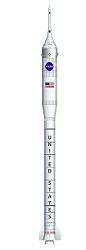
CEV launcher with a shuttle rocket booster first stage.
(Image from ATK Thiokol.)
1:05 am:
Boosting CEV development ... The latest issue
of Aviation Week contains an article
(subscription only) about Mike Griffin wanting to close the "shuttle
replacement gap". AvWeek says that although the CEV proposals
from industry are due next week, CEV procurement will be slowed
down for now so as "to speed it up later." Griffin said
in his press conference last week that NASA would rethink the entire
program.
Much of the article deals with the study - Extending
Human Presence Into The Solar System - sponsored by the Planetary
Society and co-authored by a team of space notables led by Griffin
and Owen Garriott. Griffin referred
to the report in his press conference.
A key proposal in the report is to do the CEV development incrementally.
An initial "Block 1" version would only be intended for
LEO operations. In one proposal, a 13-15 ton Block 1 capsule would
ride a shuttle rocket booster (see above figure) and "a new
cryogenic upper stage based on existing rocket engine technology."
The reasoning is that this system could be developed more quickly
than a CEV on a Delta IV or Atlas V since the SRBs are already "human-rated".
A "Block 2" CEV would provide deep space transportation
capabilities.
AvWeek points to the following recommendation from the Planetary
Society study:
Orbiter retirement would be made as soon as the ISS U.S. Core
is completed (perhaps only 6 or 7 flights) and the smallest number
of additional flights necessary to satisfy our international partners’
ISS requirements. Money saved by early Orbiter retirement would
be used to accelerate the CEV development schedule to minimize
or eliminate any hiatus in U.S. capability to reach and return
from LEO.
The study also recommended that the CEV be compatible with "as
many launch vehicles as possible."
These ideas for the CEV, and also the question of a heavy-lift
launch vehicle (HLLV), will be studied further by "a program
evaluation and analysis 'shop' in [Griffin's] office headed by Scott
Pace, a veteran space policy analyst."
1:05 am: News briefs ...
Florida Today thinks the state should get back into the commercial
space race: Space
Innovators go eleswhere: Loss of X Prize Cup and red tape are making
Cape irrelevant to cosmic barnstormers - Florida Today - Apr.24.05
...
... Rutan continues to spread
the good word on space tourism: On
the edge of space tourism - The Register-Guard (Eugene, Oregon)
- Apr.24.05. (via spacetoday.net)
April
23, 2005
2:45 am: News briefs ...
The Space Access
Society 2005 conference semi-final agenda is included
in the latest update.
It's a great lineup from start to finish ...
... The daVinci
Project is testing engines but no flights this year: Rocket
developer pledges space travel by next year - The StarPhoenix/Space
Race News! - Apr.22.05 ...
... Is NASA still in its old
pre-Columbia, non-transparent culture mode? Report:
NASA changing shuttle risk standards - spacetoday.net - Apr.22.05.
NASA management doesn't think so: NASA
Disputes Claims of Lowered Risk Standards for Shuttle - space.com
- Apr.22.05.
April
22, 2005
2:35 am: News briefs ...
Michael Huang has
spotted a photo showing Burt Rutan meeting with Mike Griffin. Go
to the NASA
home page and click on Gallery: On the Job in the Administrator's
Corner. In the popup window click on image number 8. Michael
has one suggestion for what they are looking at but I think it is
a passenger contract for a ride on the SpaceShipTwo. ;
- ) ...
... Here is some background
info regarding Burt Rutan's complaints about AST spending too
much time processing a license for another company that he didn't
name. (Hint: his brother has been one of their test pilots.) ...
... I had missed this article
about Readdy's Senate Committee testimony in which he said NASA
would accelerate development of an ISS-capable CEV: NASA
to Accelerate Plans for Shuttle's Replacement - Space.com - Apr.20.05
(via Transterrestrial)
...
... And the White House science
advisor trusts Griffin to solve the "gap": Bush
Science Chief: Griffin Is Solution to NASA Human Space Flight "Gap"
- Frank Sietzen / SpaceRef -Apr.21.05
April
21, 2005
8:45 pm: Kistler updates...
Kistler Aerospace
has updated their website. They've added several recent press
releases dealing with the Chapter 11 situation. There is also
this AIAA conference paper: Commercial
Acquisition Strategies for Space Exploration - Kistler - February
2005 (pdf).
10:55 am: News briefs ...
Robert
Zimmerman notes the real possibility that there will be no visible
light/UV space telescope after Hubble and that ground based telescopes
can't replace its capabilities: Space
Watch: Is there life after Hubble? - UPI/WashTimes - Apr.21.05
...
... MSFC is rewarded for all
those successful launch vehicle development projects it carried
out in the past couple of decades: Marshall's
launch role is secure, chief says: New NASA administrator eased
concerns, King says - Huntsville Times - Apr.21.05. Guess this
puts NASA on a Fastrac
to the CEV ...
... The CEV will make work
in Louisiana too:
Michoud facility to craft prototype: Spaceship will replace shuttle
- Times-Picayune - Apr.21.05 ...
... Jeff Foust reviews Burt
Rutan's testimony to Congress yesterday: Mr.
Rutan goes to Washington - Space Politics - Apr.21.05 ...
... More about the hearing:
Private-space
vision shared with Congress: Burt Rutan says flights won' be just
for billionaires - MSBN - Apr.20.05 * Rutan:
Space Tourism Will Thrive, But Regulations Already Interfering -
Space.com - Apr.20.05 ...
... Check out these excellent
pictures of the Shuttle Discovery: D2X
at NASA KSC - Digital Photography Review - Apr.15.05 (via Boing
Boing). Up close it sure looks like it has been through some
rough rides.
April
20, 2005
2:25 pm: News briefs ...
NASA Watch has posted the written statements submitted for both
the Commercial
Space hearing and the Space
Station hearing held today on Capitol Hill ...
... Here's Reuters
on the Commercial Space hearing ...
... Irene Mona Klotz reports
on the X
PRIZE Cup event: Space
Race 2: The X Prize revisited - UPI/WashTimes - Apr.20.05. ...
.... The April
edition of the Rockets
Away! newsletter focuses on Spacedev
and includes an interview with Jim Benson. (Item via spacetoday.net)
12:15 pm: Commercial
space hearing ...
If you didn't see it live, I recommend watching the hearing
from the archive
(the video is not posted yet but I expect it will be soon).
The second panel discussed possible future applications for space.
Wolfgang Demish gave the skeptics viewpoint and said only space
communications businesses will be viable since he doesn't expect
launch prices to fall below current levels. He believes only radical
technology such as the space elevator will lower them.
Mr. Musk disputed that, saying that Falcon I will provide a factor
of five reduction below current US small launcher prices and another
reduction by five or so will come with the Falcon V. He noted that
with the Falcon I, SpaceX won a Malaysian satellite launch contract
over a Russian competitor. Even further cost reductions will come
with the SpaceX heavy lifter, the design of which will be presented
later this year. He said SpaceX was not a hobby and it will be cash
flow positive by 2006.
11:15 pm: Commercial
space hearing - update ...
Elon Musk also urges reform of ITAR ...
He said that super heavy lift and manned operations are the
ultimate aims of SpaceX. Falcon I provides a testbed to develop
technologies for these goals. ...
NASA won't be able to achieve its long term exploration goals
without a significant decrease in launch costs. ...
NASA has given little or no support to SpaceX but Musk expects
increased interest now that Mike Griffin is in charge.
10:45 pm: Commercial
space hearing - update ...
ITAR export controls are interfering with the technical exchanges
between Scaled and Virgin Galactic in Britain. Rutan says that on
the short term they are getting around the problem, if I understand
it correctly, by getting design funding from US sources.
In the longer term, Rutan believes that once vehicles are flying
routinely in the US, they will be able to convince regulators that
the vehicles can be exported just like airliners are exported without
fears of giving away technology of potential military interest.
10:20 pm: Commercial
space hearing - update ...
Will Whitehorn, president of Virgin Galactic, says 100 people have
agreed to pay the full $200k for the SS2 flights. ...
Burt Rutan is not happy with AST; prefers a FAA certification process.
He wants passenger safety to get a high priority in the regulatory
framework. ... He wants
to franchise SS2 to operators rather than sell the vehicles.
... He says he has gotten
lots of requests to fly the SS1 for science missions but he wants
to focus on the SS2 work.
10:20 pm: News briefs ...
Mike Griffin talks about CEV development and other topics in his
press conference yesterday: Transcript
of Press Conference - Spaceref - Apr.19.05 * NASA
Administrator Mike Griffin Hits the Ground Running - SpaceRef -
Apr.19.05...
... With regard to the topic
of heavy lift mentioned yesterday, Dan Schrimpsher says that we
should avoid "paralysis by analysis" and decide the issue one way
or the other and not waste a lot of time.: Heavy
Lift vs Multiple Lift : Why I write this blog - Space Pragmatism
- Apr.19.05 ...
... RtF looks to slip a bit:
Delays
Predicted for NASA's Next Shuttle Launch - Space.com - Apr.20.05
9:40 pm: Commercial space hearing ...
The webcast
of the House
Subcommittee on Space and Aeronautics Hearing: Future Market for
Commercial Space is now underway.
April
19, 2005
6:45 pm: Insuring launches ... Following
up the discussions on April
14th and April
15th about launch costs, I wanted to clarify some aspects
of insurance.
I'm obviously no expert on this but from talking with a couple
of vehicle builders, here is how I understand the three broad categories
of insurance involved in the launch business:
- First party insurance covers the loss of a vehicle. This obviously
isn't very relevant to expendables but reusable vehicles will
need such coverage.
- Second party insurance covers the loss of a payload. It is typically
obtained by the payload owner and not included in the launch price.
The big comsat operators, for example, pay 10%-20% of the value
of their spacecraft to obtain coverage both for the launch and
for the estimated operating lifetime of the spacecraft.
If you were launching bulk cargo to the ISS or fuel to an orbiting
depot, you probably would not get payload insurance.
Coverage for passengers comes under the second party insurance
category.
- Third party insurance covers damages if the rocket crashes onto
property or people outside of the launch site. E.g. Mr. Musk says
third party insurance will cost Falcon I customers about $200k.
It turns out that the price of third party insurance doesn't increase
very much with the size of the vehicle. Essentially, insurers are
saying that the probability of maxing out the insurance claim if
a rocket falls on or near a bus or cruise ship isn't sensitive to
vehicle size.
This means that small vehicles are penalized by third party insurance
costs. Combining several small payloads onto a larger vehicle would
substantially reduce the cost of the individual third party insurance
payments.
Suborbital RLVs will encounter this third party insurance penalty
on small vehicles. The RLVs will also need vehicle insurance and,
if they are launching people, there will be the requirement for
liability insurance.
The Commercial Space Launch Amendments Act attempts to reduce the
liability risk of vehicle builders/operators for passenger injury
or death. Passengers will be fully informed of the dangers of rocket
flight and will sign waivers. However, with the US tort system there
is always the threat of a large award to a family claiming there
was some sort of negligence by the vehicle builder or operator.
We can hope, though, that insurance companies can be convinced to
provide coverage at a reasonable price.
6:45 pm: Virgin Galactic deposits ...
Sam Dinkin reports
that Virgin Galactic will soon be taking deposits for SS2 flights.
You can reserve a seat with a $20k
deposit for the $200k tickets. Here's the latest newsletter....
... Will Whitehorn, president
of Virgin Galactic, along with Burt Rutan, Elon Musk and others
will testify at tomorrow's House
Subcommittee on Space and Aeronautics Hearing: Future Market for
Commercial Space. It will be available via webcast.
6:45 pm: News
briefs ... Rand Simberg points to an interesting
article on heavy lift vehicles - Heavy
Lift: Big Lever or Large Diameter Pipe Dream by Jon Berndt - AIAA
Horizon - March/April 2005 (3MB pdf) - and he also briefly discusses
Zubrin's New
Atlantic article mentioned earlier: It
Ain't Heavy, It's My Lifter - Transterrestrial Musings - Apr.19.05....
... From the AAIA article
I followed a link to the AIAA
Space Logistics Technical Committee (SLTC) website. This section
provides several interesting papers presented at a recent conference...
... The FAA/AST COMSTAC
meeting is scheduled for May 25-26 ...
... Here's more about the
HyShot
scramjet test program at the Univ. of Queensland, Australia: UQ
puts the wind up US in rocket race - The Courier-Mail - Apr.20.05
(via spacetoday.net)
. Don't forget that Allan Paull will be on the SpaceShow
this Thursday. ...
... Starchaser does some outreach:
Rocket
on flying visit to school - BBC - Apr.19.05.
10:50 am: News briefs ... John
Carmack reports on X
PRIZE Cup plans and development of bi-propllent engines: X-Prize
Cup, LOX Engine Work - Armadillo Aerospace - Apr.18.05....
... Here's your chance to participate
in space advocacy in Washington DC with the National Space Society:
Space Blitz
2005 - NSS Washington legislative conference, May 17-18, 2005
...
... The shuttle may leave the
station before Stafford and Covey get there:
Griffin: NASA leaders to make shuttle launch decision - spacetoday.net
- Apr.19.05 ...
... The mud is splashing out
from the Walter Anderson mess: $200,000,000
- Telecom Tycoon Used International Financial Labyrinth, Washington
Post - Washington Post - Apr.18.05. Note that FINDS (Foundation
for the International Non-governmental Development of Space) gave
money to a number of worthwhile leading edge projects such as laser
launch and IEC
fusion (e.g. see acknowledgments in this peer
reviewed paper) that couldn't easily get funding elsewhere.
FINDS stopped giving out money after 2001. Here's an archived
FINDS site (via NASA
Watch).
2:40 am: Spaceshows...
There are two interviews this week on the SpaceShow
that deal with space transport topics:
Thursday, April 21, 2005, 7:00-8:30 pm (Pacific Time) - Professor
Allan Paull, international program leader for HyShot
scramjet test program from Univ. of Queensland, Australia. .
Sunday, April 24, 2005, 12:00-1:30 pm (Pacific Time) - Jim Benson,
CEO and Chairman of SpaceDev.
Discussions of the shows can be found on the Spaceshow
Forum at Space
Investor.
2:40 am: News
briefs ... Congrats to Andews
Space on their NASA contract: Wins
$18.7M Contract to Build and Fly Technology Demonstration Spacecraft
- Andrews Space - Apr.18.05....
... I missed this earlier announcement
of a CEV contract: Andrews
Space, Inc. Wins $2M Contract Extension To Assist Nasa In Refining
Its Space Exploration Vision - Andrews Space - Apr.1.05 (pdf)...
... Robert Zubrin gives his
advice on the CEV: Getting
Space Exploration Right - The New Atlantis -Spring 2005
...
... Space travel for leisure:
The
Outer Limits: Once the stuff of science fiction, recreational space
travel is now a burgeoning industry. M. G. Lord straps in for a
spiritual, if stomach-churning, Zero-G ride - Travel + Leisure -
Jan.05 (via Transterrestrial.)
April
18, 2005
12:15 pm: News briefs... The
new NASA administrator should check out the list of space policy
options ranked by Sam Dinkin according to their benefit/cost ratios:
Ranking
space policy alternatives - The Space Review - Apr.18.05
...
... Eric Hedman wonders if
the VSE
came too late to tip the US space program in the right direction:
Is
the Vision for Space Exploration ten years too late? by Eric Hedman
- The Space Review - Apr.18.05 ...
... If the damage to a shuttle's
thermal protection system meant that it was too risky for a crew
to fly back to earth, it could still be worth a trying to bring
the vehicle back while the crew remained on the ISS: Could
shuttle land without crew aboard? NASA looks at how to get the orbiter
back if astronauts took refuge on the space station - OrlandoSentinel
- Apr.18.05
1:35 am: News briefs ... This
article reports on space tourism and Burt Rutan: A
vision in flight: Burt Rutan, the genius behind SpaceShipOne, believes
space tourism is destined to become a huge industry in the next
decade or so - OCRegister.com - Apr.17.05 (via spacetoday.net)
...
... And this article reports
on space tourism along with a general overview of commercial entrepreneurial
projects: Rocket
race - US News - Apr.25.05 (via spacetoday.net)
...
... I had not heard of this
Shuttle-ISS disaster scenario: Shuttle
thrusters potential hazard: 'Must fix' could destroy station - Florida
Today - Apr.17.05 ...
... I believe this headline
is an understatement: ESA
In No Hurry To Fund Russia's Project Kliper - RIA Novosti - Apr.17.05
...
1:35 am: Practice DARTs ...
It's part of the space business, or any tech business, that tests
of new systems often fail. You just keep working at it till you
get it right. However, DART costs so much - $110M - that multiple
repetition is not an option: DART
mission ends prematurely - spacetoday.net - Apr.17.05.
So I suggest that it would be more cost effective to fund student
nanosats instead. Projects like Bandit
at the Univ. of Washington and Fastrac
at the Univ. of Texas will achieve fairly sophisticated autonomous
operation. (See also this paper
on Bandit). With budgets in the $100k range, they could try 1100
times to work up to full autonomy for the price of one DART.
OK, I'm joking since I'm leaving out the price of the launches.
But don't forget that many student nanosats get free, or low priced,
piggyback rides.
April
17, 2005
2:10 am: A positive sign...
Space tourism market studies are fine but there is nothing like
seeing customers putting real money on the table. According to this
article - Space
available, for a price - DenverPost.com - Apr.17.05 (via spacetoday.net),
Eric Anderson of Space
Adventures says:
Space Adventures has taken $10,000 deposits from 150 people who
hope to ride on the first commercial suborbital space planes.
Anderson predicts these flights will become available in 2008.
I've previously heard that the number of people who had place
significant deposits at SA was less than 100. Great to see a specific
number posted and that the deposit is as high as $10k.
Note that these people have placed deposits before a commercial
suborbital space tourist vehicle of any kind has appeared. It doesn't
take a huge leap of faith to assume a lot more customers will step
up as soon one or more such vehicles begins to operate.
2:10 am: Armadillo XP Cup demo ...
The recent announcement
of an X PRIZE Cup event this October stated there would be "[d]emonstration
flights of reusable space vehicles by future X PRIZE CUP contenders
at the Las Cruces International Airport".
Well, we now know that one of these will be Armadillo
Aerospace. John Carmack posted at the Official
Armadillo Q&A - Space Race News that they will fly the "new
biprop vehicle" at the event. They plan "to perform several
15 second boosted hops to demonstrate rapid turnaround. They won't
go high, but on a biprop they will be very exciting!"
(See also his comments on the death of the "Black Armadillo" .)
2:10 am: News briefs ... Jeff
Foust reports that next Wednesday, April 20th there will be a House
Science Committee hearing on the "Future Market for Commercial
Space": House
hearing on commercial spaceflight - Space Politics - Apr.15.05.
It will sure be interesting to hear what Burt Rutan tells the assembled
Congresspersons. ...
... Alan Boyle comments on
the recent news releases from XCOR
and Beyond-Earth
Enterprises: Space
marketplace expands - COSMIC LOG /MSNBC.com - Apr.12.05
April
15, 2005
2:00 pm: More about orbital access costs
... With regard to the discussion yesterday about cost
estimates for orbital flights, I've been informed by Elon Musk that
Falcon I flights from Vandenberg will include the following charges:
- $5.9M base price
- + $600k range fee
- + $200k 3rd party insurance fee for commercial payloads (government
customers self-insure.)
There was an initial range qualification process on which SpaceX
spent several million dollars but the recurring range price is the
$600k number.
Range prices from the Marshall Island site may be lower but logistic
costs are higher so it isn't clear there will be a net savings.
(It is still a good site for equatorial launches.)
One additional item with respect to the fixed costs discussed by
the Kuennen
et al. paper. The "launch agency" fee they mention is what RSLP
(Rocket Systems Launch Program at Kirkland AFB) or other group charges
for overseeing a launch. That's not a charge that a commercial payload
on a Falcon I launched from a commercial spaceport would see. It's
the extra charge that, say, DARPA would pay to RSLP for overseeing
a launch.
Range and insurance costs will increase somewhat for the Falcon
V but not dramatically. ...
... So for the SpaceX
vehicles, the costs look more optmistic that what Jurist et al.
estimated. If the Falcon V development goals are achieved, launch
costs will be quite close to $1000/pound.
Of course, the authors can argue that they made reasonable assumptions
as to how a rocket business would be run that don't apply to SpaceX.
Mr. Musk wants to help expand the market and encourage space development
so SpaceX is charging less than a conventional aerospace company
would.
2:00 pm: News briefs ... The
AIAA issues a press release about The
Rocket Company: New
Book Inspired by the X-Prize Competition - FindLaw/AIAA PR - Apr.14.05.
I think it is a great idea to promote the book to students. The
presentation of the technical and business details within a novel
should make it quite appealing to them. ...
... And here is another rocket
education related item: X-Prize
education events coming - Alamogordo - Apr.14.05 ...
... Robert
Zimmerman profiles the new NASA administrator: Space
Watch: The right man for the job? - UPI - Apr.14.05
April
14, 2005
2:20 pm: Orbital access challenge ...
I found the paper When Physics, Economics, and Reality Collide:
The Challenge of Cheap Orbital Access by Jurist,
Livingston,
and Dinkin
to be quite interesting and informative. (The abstract and TOC were
posted here earlier
and the text is available in full at Transterrestrial
Musings).
It will be the subject of a session at the the Space
Access '05 Conference and will no doubt inspire a spirited discussion.
A number of the regular attendees have for many years been studying
and dealing directly with the topics covered in the paper and will
certainly offer some alternative views.
Here are some miscellaneous comments of my own:
- The paper does a good job of making the point that overhead
costs, particularly range fees and insurance, will come to dominate
no matter what assumptions one makes about hardware development.
- They reference a paper by Kuennen et al. presented at last year's
Utah Smallsat meeting and described by Jeff Foust in Reducing
launch costs: a lower limit? - TSR - Sept.27.05. Those authors
found that even if the cost of the rocket for their payloads went
to zero, there would still be a charge of around $7M for using
the launch facilities and the range system. And they were only
discussing unmanned government payloads and so didn't include
insurance.
- Note that SpaceX
does not include range fees in its price quotes. I believe lower
launch facility and range costs are the main reasons they are
looking to launch from the Marshall Islands. Reducing such costs
is also one of the reasons why some companies are going with air
launched systems.
- Obtaining "reasonably" priced insurance for commercial
RLV flights, especially those with passengers, will certainly
be a major challenge. (Pat Bahn of TGV
likes to say that amateur rocketeers discuss ISPs while pros discuss
insurance.)
- I think the paper takes too seriously the thesis
by G. Henry, who concluded that only a two-stage waverider system
would bring significantly lower launch costs. If Falcon I flies
this summer, a number of the major assumptions in that thesis
are immediately invalidated. He assumes, in particular, that there
are no fundamental flaws with the way NASA and mainstream aerospace
industry carry out hardware projects.
For example, he reviews the history of launch vehicle development
but ignores the DC-X. So he doesn't address the question of why
that project achieved its goals with a factor of ten less money
than if it had been carried out in a standard NASA / Aerospace
industry manner. Factors of ten should not be ignored.
He instead uses the Shuttle, X-33, X-34, etc as the standard benchmarks
and ignores the deeper problems with the way these projects were
handled.
It's as if in the 1970s, you ruled out the possibility of a low
cost, reliable, well performing small automobile because Detroit
had failed so badly with vehicles like the Corvair, Vega, and
Pinto. As we found out from the Japanese, there were, in fact,
profound flaws in the way the Detroit companies did things.
- I believe one should avoid the "if it could be done, it
would have been done by now" sorts of arguments. The "space
age" may be several decades old but the actual number of
serious attempts at developing low cost launch vehicles (i.e.
they got as far as bending some metal) is minuscule when compared
to, say, the number of different types of airplanes that appeared
before the DC-3 came along with just the right specs to make passenger
flights practical.
We need many more candidates to enter the evolutionary battle
before we will know the optimum set of features that wins the
struggle to provide the lowest launch costs.
2:20 pm: Alt.space advocacy suggestions....
Last year the alt.space community pushed successfully
for the passage of the Commercial Space Launch Amendments Act. Rather
than now sit back and watch how things go, I suggest the following
new campaign goals.
- Convince Congress to upgrade and subsidize the range and launch
facilities for use by commercial flights. As indicated by the
paper discussed above, this could have a major impact on launch
costs.
- Lobby Congress to allocate $100M for suborbital science at NASA.
The National Academy of Sciences recommended that this area be
revitalized but NASA has instead steadily reduced funding for
sounding rocket flights. We should push for a renewal of this
area with the understanding that payloads would shift over to
suborbital RLVs or, in the case of experiments that need to reach
very high altitudes, to expendable 2nd stages launched by the
RLVs.
This would be a win-win for everybody:
- Great science could be done at a much lower cost than with
sounding rockets. Plus there would be the new capabilities
and benefits of frequent flights and a person there to monitor
and adjust the experiment.
- The suborbital companies would have a second market of significant
size to supplement space tourism.
- It will be a boon for education since it's much easier for
students to carry out suborbital projects within the time
span of their programs.
9:20 am: News briefs ... More
about the X
PRIZE Cup announcement: X
Prize Cup will come in October - Alamogordo News - Apr.13.05
...
... Congrats to Dr. Griffin:
Senate
unanimously confirms Griffin - spacetoday.net - Apr.14.05. I
hope that he makes a speech soon outlining his major goals and policies,
especially with respect to space transport and commercialization.
April
13, 2005
8:10 pm: News briefs ... Orbital
Recovery is making progress towards its first flight in 2008:
Successful
Design Review Validates the Technical Feasibility Of Orbital Recovery
Ltd.'s CX-OLEVTM Space Tug - Orbital Recovery Corp. - Apr.13.05.
(Why not use one of their tugs to boost the Hubble to a long term
storage orbit?) ...
... Mark Whittington says that
under Griffin's management, NASA might arrange the CEV program in
such a way that "smaller, entrepreneurial companies like t/Space
would be included in a separate program to develop piloted space
craft.": The
Return of Michael Griffin - The Washington Dispatch - Apr.13.05
...
... Irene Mona Klotz this time
examines the DART
robotic orbital rendezvous mission: Space
Race 2: Hooking up in space - UPI/WashTimes - Apr.13.05
6:05 pm: X Prize Cup debut ... The
XP
Cup is on for this year: X
Prize Cup Ready For October Liftoff - Space.com - Apr.13.05.*
Governor
Bill Richardson Announces X PRIZE CUP Events - X Prize Foundation
- Apr.13.05.
This part is particularly interesting:
"... demonstration flights from at least eight of X Prize
Cup team competitors. Also to be previewed will be the Tier-1
X Prize Rocket Racer ..."
So I wonder who these eight competitors are and what Rutan's Rocket
Racer will look like?
6:05 pm: Constellation rising ...
Iridium does the
phoenix trick: Iridium
Talking With Satellite Makers About Constellation Replenishment
- Aviation Week - Apr.13.05. Looks like a potential customer
for a low cost launcher:
Iridium Satellite LLC is profitable and is experiencing 20-25%
annual growth, with more than 114,000 subscribers as of the end
of last year. Lloyd expects subscribers to double by the end of
this decade, with revenues sufficient at that point for the company
to self-finance its satellite replacement effort.
12:05 pm: News briefs ... Henry
Vanderbilt has posted the Latest
Info on Our Upcoming Conference, Space Access '05, April 28-30,
Phoenix Arizona. Note that the availability of reduced rates
for the hotel rooms has been extended...
... I forgot to mention that
Griffin wants to speed up development of the CEV to reduce or eliminate
the gap in US human spaceflight capability. Also, he may reverse
O'Keefe's decision to cancel the Hubble repair mission. Here's more
info on his testimony: Griffin
promises to revisit Hubble decision - spacetoday.net - Apr.13.05
...
... XCOR announced
this week a NASA contract to develop a composite LOX tank. In the
coming years I expect we will see many advances in the use of light
and super-strong materials for use in spaceship structures: 'Extreme
Textiles' Come of Age - NY Times - Apr.12.05. ...
... Dan Schrimpsher likes
the "firm fixed-price contract" aspect of the XCOR contract.
It think it is perhaps an approach the old aerospace giants will
fail to appreciate.
2:10 am: News briefs ... Jeff
Foust describes the confirmation hearing for Mike Griffin as not
exactly hard-hitting: A
lovefest - Space Politics - Apr.12.05. More at Senate
Seeks to Expedite Vote to Confirm Griffin as NASA Administrator
- SpaceRef - Apr.12.05 ...
... Keith Cowing doesn't recommend
Alan Binder's big
book, but you can get a free abbreviated version of Binder's
views on NASA, and his surprisingly critical take on Mike Griffin,
in this interview
at the SpaceShow. I listened to it yesterday while jogging (with
the warm weather I'm catching up on the broadcasts) and Binder certainly
expresses a level of anger towards various NASA managers that sometimes
goes a bit overboard. On the other hand, he did succeed in getting
the Lunar Prospector
from a concept to an actual spacecraft orbiting the Moon, and for
a modest price as well. So it seems to me he is someone who deserves
a hearing. ...
... More Kliper
news: Russian
Kliper Could Fly into Space in 5 Years - RIA Novosti - Apr.12.05
...
... Because of some technical
advice given to China by two American comsat companies, Congress
applied onerous export regulations to the entire US space industry.
And what did this accomplish? A bonanza for the European space industry:
China
launches commercial communications satellite - spacetoday.net -
Apr.12.05 ...
... Aviation Week begins a
series on the RtF: Shuttle
To Debut Repair Technologies - Aviation Week - Apr.10.05
April
12, 2005
11:45 am: News briefs ... John
Jurist offers a list of warning signs when dealing with new space
ventures: Jurist’s
16 Commandments of Space Investing - Space Race News! - Apr.11.05
...
... Starchaser
has a new business structure - Starchaser PLC - and a new website.
Here are some pictures
of their Starchaser
4 under construction.
12:40 am: News storm ... Gee,
I take Monday off and sure enough, a whole bunch of great stuff
comes out. Firstly, in addition to the Beyond-Earth
agreement, there is more good news for XCOR:
12:40 am: XCOR lands NASA contract:
XCOR Aerospace Wins
$7 Million NASA Contract
Company to Develop Cryogenic Composite Tank
Mojave, CA, Monday, April 11, 2005: - Today, XCOR Aerospace
announced it has signed a contract with the National Aeronautics
and Space Administration (NASA) to develop a composite cryogenic
tank to hold liquid oxygen (LOX). This contract is part of NASA's
Exploration Systems Research and Technology (ESR&T) program to
develop key technologies for manned exploration of the Moon, Mars
and beyond. The value of this firm fixed-price contract is $7
million with all options included, and will pay $1 million in
the first year.
"This is a wonderful opportunity for NASA and for XCOR," said
XCOR's president, Jeff Greason. "NASA is reaching out to small
businesses and this contract is an excellent example. Both private
industry and the government will benefit from this project, as
well as future users of space vehicles."
During the past two years, XCOR has researched cryogenic composite
materials and processes that will have immediate application to
this contract. XCOR will use its patented technology to build
a demonstration LOX tank for NASA. The LOX tank will be designed
to show dramatic weight savings by demonstrating the ability to
serve as both an insulated tank and vehicle structure. The materials
used in this tank retain their flexibility and toughness at cryogenic
temperatures and are inherently non-flammable, an important safety
feature for LOX tanks on future human spaceflight vehicles.
XCOR Aerospace, Inc. is a California corporation located in Mojave,
California. The company is in the business of developing and producing
safe, reliable and reusable rocket engines and rocket powered
vehicles. Additional information about XCOR Aerospace can be found
at www.xcor.com.
12:40 am: More storming... And
then Livingston,
Jurist,
and Dinkin
release what looks to be a significant paper on space access that
is getting a good buzz
( (I'm still working through it myself):
When
Physics, Economics, and Reality Collide
The Challenge of Cheap Orbital Access
Abstract:
Engineering problems are only part of the problem of achieving
a price per pound of less than $1,000 to low earth orbit (LEO).
Insurance and range costs alone prevent breaking that barrier
without substantial investment in demonstration flights and lobbying.
Achieving low cost to LEO also requires solving problems associated
with limitations of chemical rockets, lack of business planning,
and failure to identify a workable path that will take us from
an immature to a mature launch industry. A mature launch industry
would exhibit low cost to LEO and significant flight rates by
reusable vehicles with long lifetimes. When today's factors, limitations,
and reality denials are combined, we believe that they prolong
the difficulties of achieving low cost, routine flights to LEO.
In other words, we end up inadvertently supporting the status
quo.
I. Abstract
II. Introduction
III. Basic Concepts
IV. Methodology
V. Expendable Launch Vehicles
VI. Reusable Launch Vehicles
VII. Discussion
A. Merging the rocket and the payload
B. Market decision-making and economic factors
1. Interest
2. Insurance
3. Research and Development
4. Lobbying to reduce range costs and obtain regulatory relief
5. Potential threats
D. The due diligence process
1. Subjective factors
2. Objective factors
3. Venture capitalists
4. Reality versus speculation
5. Polluting the pond
VIII. Conclusions
IX. References
X. The Authors
XI. Appendix 1: Baseline Models
XII. Appendix 2: Propellant Costs
Paper
(MS Word Doc file) available via Transterrestrial
Musings.
12:40 am: More news... Plus
there were the usual set of great articles on the latest issue of
the Space Review:
- Michael Huang
has written one of the most cogent articles in support of human
spaceflight that I've seen for a long time: The
top three reasons for humans in space. Individually the three
reasons are well know to space advocates, but he has packed them
into a short, articulate format here that really gets the message
across. In fact, space advocates should repeat his "To work,
To live, To survive" mantra in all human spaceflight discussions
from now on. (I see the article has aroused a vigorous response
on Slashdot.).
- In the "To Work" category, Sam Dinkin has an article
on solar power from the Moon: Rectifying
the case for beaming Lunar solar power and an interview with
the concept's main proponent: Reaping
powerful ideas from a luminary.
(Note: Instead of pushing now for full deployment for $300B-500B.
I would emphasize incremental steps, e.g. demo systems that prove
the concept and offer benefits such as providing abundant lunar
power for lunar bases and for other space based users.)
Check out also the interview
with Criswell on the SpaceShow from Dec. 7, 2004.
- Taylor Dinerman meanwhile reports on the trustworthiness of
the price quotes for the European Galileo GPS system: What
will Galileo cost?.
12:40 am: More news briefs ...
The SpaceShow
interview with Henry Vanderbilt of the Space
Access Society is now available online...
... Check out the Space
Pragmatism blog from Dan Schrimpsher who tells me he wants to
try to convince regular folks to get "on board with our journey
into the solar system".
April
11, 2005
1:25 am: Beyond-Earth and XCOR collaboration:
Beyond-Earth Enterprises
and XCOR Aerospace Announce Agreement to Produce Small Payload
Launch Vehicles for Sub-Orbital Travel
Colorado Springs, Colorado, April 11 Studies show that 70 percent
of Americans would buy a flight into space if they had the chance
and the cost was reasonable. Now a cooperative agreement between
Beyond-Earth
Enterprises and XCOR
Aerospace will develop greater accessibility to space for
everyone in a safe, reliable, and affordable manner. The agreement
will allow Beyond-Earth to purchase manufactured components from
XCOR for standardized production of small payload launch vehicles.
Beyond-Earth Enterprises is a commercial firm dedicated to providing
small payload launch capabilities at affordable rates. XCOR Aerospace,
Inc., is a small, private company with proven expertise in the
production of high quality rocket engines and rocket powered vehicles.
Joe Latrell, CEO of Beyond-Earth Enterprises, says, "This is the
first step toward making space accessible for commercial ventures.
We want to be instrumental in creating standardized production
components. When an airline company or package delivery service
needs a new vehicle, they don't build it, they buy it from a company
who specializes in airplane or truck production." Latrell says
Beyond-Earth is highly motivated to encourage the average American
to reach for space again. "We want the public to realize that
they could go to space someday very soon."
"Now is a great time for cooperative arrangements like this,"
says Jeff Greason, CEO of XCOR. "The commercial applications from
scientific research to space tourism are within reach. Cooperation
such as this is essential to making that happen. Beyond-Earth
and XCOR will each focus on their areas of expertise while expanding
the overall market for space related products."
The agreement lets XCOR focus on rocket engine development, one
of its core strengths, while allowing Beyond-Earth to concentrate
on developing inexpensive alternatives to existing space launch
systems and help revitalize the American public's interest in
space. Beyond-Earth and XCOR expect this unique alliance to prove
the reliability, safety, and affordability of complete rocket
systems. The goal is profitable, low-cost transportation vehicles
to Earth orbit.
About XCOR Aerospace, Inc.:
XCOR Aerospace develops and produces safe, reliable and reusable
rocket engines and rocket powered vehicles. Test pilot Dick Rutan
has flown its operations demonstrator, the rocket-powered test
vehicle "EZ-Rocket" in recent demonstration flights at the EAA
AirVenture convention at Oshkosh, WS. XCOR holds the second FAA
issued Reusable Launch Vehicle License and continues to be engaged
in private and government research projects for rocket engines
and rocket engine components. XCOR Aerospace is a California corporation
located in Mojave, California. For more information, visit www.xcor.com.
About Beyond-Earth Enterprises:
Beyond-Earth is leading the way to the commercialization of space
by providing small payload launch capabilities at affordable rates.
The Beyond-Earth officers are committed to revitalizing the American
public's interest in space. They encourage space development by
conducting educational demonstrations and lectures at area schools.
The company's headquarters are in Colorado Springs, Colorado.
Additional information can be found at www.beyond-earth.com.
1:25 am: Orbital Access Workshop announcement:
Orbital Access to Space
Workshop
7:30-9:30 pm Central Daylight
Time, Monday, April 11, 2005
A special University of North Dakota School of Space Studies
webcast will take place at: www.asn.und.edu:7070/ramgen/encoder/live.rm.
Questions during the actual workshop can be emailed to Professor
Eligar Sadeh at esadeh@gmail.com.
Space Studies Workshop: When Physics, Economics and Reality
Collide: The Challenges of Cheap Orbital Access to Space
Interactive workshop:
Workshop presenters and leaders: Dr. David Livingston (The
Space Show), Dr. John Jurist (Space Consultant, Human Factors),
and Dr. Sam Dinkin (The
Space Review).
The workshop is open to all faculty and students, and it will
be highly interactive. The workshop leaders have worked out various
launch industry segments for the participants to role play with
- that is to view cheap orbital access to space from the perspective
of a government regulator, the large aerospace industry, the parent
of a space flight participant, the participant, etc...
The leaders will invite the questions largely from the perspective
that each participant is assigned. The intent is to get some good
thought behind the issues from a broad view perspective across
many segments of the traditional plus the alternative space industry
and developing industry.
The workshop will also involve a series of short presentations
and it will be 2 hours in duration, including questions and the
role playing activities.
1:25 am: Space elevator news ...
Blaise Gassend reports on the 2005
Space Exploration meeting last week in Albuquerque, New Mexico
that included a number of space elevator presentations: Notes
from Space Exploration 2005 - Blaise Gassend - Apr.05 ...
... Los Alamos will assist
Carbon Designs,
a Brad Edwards company (see also this site - www.nanotubecomposites.com),
with research on carbon nanotubes: Los
Alamos National Laboratory Signs CRADA and License Agreement with
Carbon Designs, Inc. - SpaceRef - Apr.8.05 ...
... Here is a space elevator
bulletin board: The
Space Elevator Reference - SpaceRef.
1:25 am: News briefs... Leonard
David reports on the changes in exploration policies driven by the
VSE
and affecting every part of NASA: Space
Exploration Overhaul: Next Five Years 'Critical' - Space.com - Apr.8.05
...
... Blue Origin as seen by
the Guardian: Billionaire
picks one-horse town to start space empire - Guardian - Apr.10.05
...
... New Scientist offers a
page with lots of resources on the RfF:
Special
Report on Return of the Space Shuttle.
April
8, 2005
12:05 pm: News briefs ... Russia
keeps talking up the prospects for the Kliper
ship:
Russia to pursue new space shuttle -UPI/WashTimes - Apr.8.05.
Perhaps it can become a joint Russia/Europe project. ...
... Check out the impressive
list of alt.space speakers
at the upcoming 24th
International Space Development Conference, ISDC 2005, “Your Ticket
to Space”, Washington, DC on May 19-22, 2005. ...
... The airships in this video
update from JP
Aerospace are impressively gi-normous ...
... Gee, I wish when I was
a student I got to work on nuclear powered spaceship systems and
fly on a zero-g plane: OSU
students work on plasma rocket - Corvallis Gazette [Oregon] - Apr.8.05
(via spacetoday.net)
...
... People in the Eugene, Oregon
area might want to mark this on their calendar: SpaceShipOne
Designer to Speak at UO [April 25th] - Univ. Oregon - Apr.8.05
(via spacetoday.net).
Great that Burt Rutan is making all of these talks to student groups
around the country.
2:15am News briefs ... NASA
is apparently getting serious about contracting for cargo delivery
to the ISS: NASA
Special Notice: International Space Station Commercial Cargo Services
- SpaceRef - Apr.7.05. ...
... Of course, if the agency
had taken the Alternate
Access to Station program seriously when it was forced
on it by Congress back in 2000, it would already have a cargo service
in operation. Kistler, for example, is getting out of bankruptcy
because it is considered to have a viable chance to go after the
ISS cargo contract. They will pursue it with the same K-1 that was
75% built in 2000. ...
... The Space
At The Crossroads one day meeting on May 18, 2005 has an interesting
lineup of speakers.
...
... Alan Boyle reports on some
well deserved recognition given to the Discovery
Channel's Black Sky program about the SS1: Bravo
for 'Black Sky' - Cosmic Log/MSNBC - Apr.7.05.
2:15am Calvert praises commercial manned
spaceflight ... Rep. Ken Calvert (R-CA), a featured speaker
at the Space
Foundation meeting, had a lot to say about space policy and
some of it was very positive towards private ventures: Rep.
Ken Calvert Calls for New Rules and Tools for the Second Space Age
- SpaceRef - Apr.6.05.
For example,
The commercial space program has been reinvigorated by the recent
success of Burt Rutan's SpaceShipOne. It is amazing what a small
group of people could accomplish for a mere $20 million. But just
as important as the accomplishment of putting a man into suborbital
space is that the X-Prize competition validated the incentive
concept for commercial space. Congress strongly supports a prize
program and we are developing a program to be included in the
NASA authorization bill. I'm very pleased that NASA is starting
now with a small prize program based on its current authority.
As we saw with the success of SpaceShipOne, there is even a chance
of having commercial human space flight sooner than was thought
even 20 years ago. There are companies like Constellation Services
International, who have innovative ideas for taking cargo to the
International Space Station; Kistler, who is developing a fully
reusable two-stage unmanned space launch vehicle; and Elon Musk's
company SpaceX, which is developing a simple, reliable, low cost
launch vehicle. We need to take advantage of these great minds
and to help NASA to take advantage of these commercially developed
ideas as it plans for the future of exploration. By leveraging
the power and freedom of the market Commercial sector has the
potential to revolutionize space access, making it reliable and
efficient.
As Chairman of the House Space & Aeronautics Subcommittee, his
views carry some weight.
April
7, 2005
5:10 News briefs ... Robert
Zimmerman argues that NASA's management culture needs to change
but the way Congress manages (or mis-manages) the agency also needs
to change: Space
Watch: How politics drives NASA - UPI - Apr.7.05 ...
... Meanwhile, James Oberg
reports that the Return
to Flight Task Group is split over whether and NASA and Discovery
are in shape to fly in May: NASA's
Shuttle panel divided over NASA compliance: A case of late paperwork
or something more serious? - MSNBC.com - Apr.6.05.
2:00 pm: News briefs ... Leonard
David reviews the entrepreneurial space discussion panel held yesterday
at the Space
Foundation conference: Entrepreneurial
Muscle Ready For Flexing - Space.com - Apr.7.05.
...
... Leonard also reports on
a session dealing with NASA's exploration program: Experts
Grapple With Exploration Agenda - Space.com - Apr.7.05
...
... NASA will test two 20 meter
solar sails in vacuum chambers at Glenn Research Center: NASA's
Marshall Center to Begin Test of 20-Meter Solar Sail Technology
That Could Use Sun's Energy for Future Space Missions - NASA - Apr.7.05
...
... Robert
Goehlich of Keio University in Japan reports that he will soon
begin a new space tourism course plus a second course on "cost
engineering":
Space Tourism II is a master’s course but also part of the “Open
College” Program in the course of “Germany in Japan 2005/2006”
events. Link: www.doitsu-nen.jp
and www.robert-goehlich.de
(this class is also live broadcast via internet for free by using
yahoo messenger, login also at my homepage)
Cost Engineering II (Economics of Satellites, Rockets and Space
Organizations) is a new Ph.D. course in this semester and part
of Keio’s COE Program. Link: www.robert-goehlich.de
Copies of his lectures
and papers
are available online.
1:55 am: News briefs... Alan
Boyle points out the sponsorship opportunities that NASA is offering
to companies that support its web bandwidth needs during the upcoming
shuttle flights: This
space for rent - Cosmic Log/MSNBC - Apr.6.05. (Here's the NASA
bulletin: NASA
Presolicitation Notice: Sponsorship Opportunity for Bandwidth Support
to Return to Flight Missions (STS-114, STS-121) - Commercial Space
News - Apr.5.05.) I hope the commercialization bug spreads to
the rest of the organization. ...
... Alan points also to Richard
Branson's commercializing of the SS2 around the world and even in
the movies: It's
a bird! It's a space plane! - Cosmic Log/MSNBC - Apr.6.05 ...
... The shuttle shuffles to
the launchpad: Shuttle
nears pad, backs up after problem - Florida Today - Apr.6.05.
A crack discovered in the ET insulation doesn't appear to be serious
...
... But the insulation is still
a big worry: Tank
foam remains threat to shuttle in worst-case - Spaceflight Now -
Apr.5.05 ...
... JAXA's wish list gets another
round of publicity: Japan
unveils plan to send humans to moon - MSNBC/AP - Apr.6.05 ...
... An item on top of my wish
list is that NASA will contract out for LEO/lunar transport and
concentrate its energy on developing long term technologies like
this: NASA's
Prometheus: Fire, Smoke And Mirrors - Space.com - Apr.6.05
April
6, 2005
2:15 am: News briefs... Irene
Mona Klotz reports on the Pentagon's Falcon
program and on the companies competing to win its contracts: Space
Race 2: Falcon taking wing - ScienceDaily/UPI - Apr.5.05 (link
via Ken Schweitzer)
...
... Northrop/Boeing announces
their CEV A team: Northrop
Grumman, Boeing Announce Companies Supporting Crew Exploration Vehicle
Team - Northrop Grumman Corporation - Apr.5.05 ...
... Alan Boyle gives an update
on the Space
Transport team: Return
of the ‘rocket boys’ - Cosmic Log/MSNBC - Apr.5.05.
April
5, 2005
3:50 pm: Korean suborbital project ...
The C&Space
company that Henry mentions below is new to me. Their website includes
a video
and a powerpoint
presentation about their Proteus single-stage vehicle, which
will fly a crew of three to 100Km using a LOX/LNG engine. It takes
off vertically and then lands on a runway. Note that the wing tilts
out slightly during descent in a manner somewhat like the feathering
for the SS1.
Very encouraging to see an entry from Asia into the private space
launcher arena.
3:45 pm: News briefs... The
latest update from Henry Vanderbilt of the Space Access Society
is a big one with lots of info, especially on happenings in the
entrepreneural space community.
Space
Access Update #111 04/05/05
Copyright 2005 by Space Access Society
_________________________________________________
Contents this issue:
- SA'05 Notes
- Low-Cost Launch:
The Concept Is Spreading
- What We Want From
NASA:
-
Low Cost Hardware/Flight Demos
- Pay
for Results, Not Process
- Industry News Roundup
__________________________________________________
SA'05 Notes
First a few quick notes about our upcoming Space Access '05 conference,
April 28-30 in Phoenix Arizona: - The latest SA'05 info will be
posted from now till the conference at http://www.space-access.org/updates/sa05info.html
- Our $79 hotel room rate is guaranteed available through April
6th - we'll very likely be able to negotiate extensions as the
conference approaches, but book by the 6th to be sure.
- If you have trouble getting our rate or booking the type of
room that you want, try calling our hotel (Four Points by Sheraton
Phoenix Metrocenter, 602 997-5900, mention "space access") between
8 am and 4 pm weekdays Mountain Standard Time (EDT-3) since outside
those hours calls automatically get switched to the Sheraton national
reservations center, which seems to have occasional problems with
local hotel details.
- If you still have any difficulty booking a room at our rate
for SA'05, drop us a note at sa05@space-access.org ASAP. Thanks!
And now back to our irregularly scheduled Update...
_________________________________________________
Low-Cost Launch: The Concept Is Spreading
It's a good thing this is America, where "may you live in interesting
times" is still more blessing than curse. Kudos to the X-Prize,
Scaled Composites and their subs, and Paul Allen - a lot of people
are now aware that there are alternatives to the Government-Space
Industrial Complex, paths off the planet that don't cost major
slices of a national budget. The consequences have started arriving
one after another.
One we should get out of the way immediately: Watch your wallet,
the quick-buck artists are here. The email we saw about the Nigerian
astronaut stranded on the Space Station until we take our 15%
cut of an international funds transfer to pay for his return trip
(please provide our account info) was actually pretty funny, but
we suspect that the SEC wouldn't be at all amused by some of the
outfits that have popped up peddling stock lately. Caveat investor...
Not that every outfit around before the field got hot was a good
place to put money either, but at least most actually meant well.
Thomas Olson, Paul Contursi, and David Livingston have a short
article in The Space Review with eight things to watch for when
you're thinking of investing in a space startup, at http://www.thespacereview.com/article/329/1.
Strongly recommended.
Another thing we've seen is multiple announcements of brand-new
conferences and/or newsletters. Our rule of thumb is, if all the
promoters seem to know is "X-Prize", "Scaled", and "SpaceDev",
they probably have a way to go before they're worth much attention.
One new entrant in the conference field we are paying attention
to is Esther Dyson, of computer journalism fame, with her "Flight
School" one- day new-aviation/new-space event, debuting last month
tagged onto the end of her long-time influential "PC Forum" IT
industry conference. At $1492 "Flight School" was a bit steep
for our budget (though one way to look at that is that the price
succeeded - it kept the riff-raff out!) but response we've heard
has been positive - introducing her field to our field is generally
seen as a good thing. Given Dyson's reputation as one of the sharper
tools in the shed, her extensive information industry contacts,
and her considerable resources, we expect we'll be hearing more
from her.
One of the bigger space conferences around, the Space Foundation's
National Space Symposium annual gettogether of everybody who's
anybody in Big Aerospace (in Colorado Springs this week) this
year features an "Entrepreneurial Spirit" panel with Courtney
Stadd, Eric Anderson of Space Adventures, Jim Benson of SpaceDev,
David Gump of T/Space, and George Nield of FAA AST, plus an appearance
by SpaceX's Elon Musk on a New Directions In Launch panel. It's
a good start. Also of interest on their schedule, a live broadcast
on NASA TV of "The Vision For Space Exploration: Getting There
From Here" (we wonder where that phrase percolated up from...)
set for 11 am to 12:15 pm mountain time on Wednesday April 6th.
(As conference organizers ourselves, we'd advise allowing for
a bit of schedule slop if you're setting up to tape it.)
Another major player that is starting to pay attention: NASA.
We don't have much detail yet, but Explorations Systems Mission
Directorate, ESMD, the large slice of NASA HQ tasked with making
the Vision For Space Exploration happen, seems to be at least
thinking about some sort of "non-traditional" Earth-To-Orbit development
path in parallel with their main effort, the multi-billion dollar
Crewed Exploration Vehicle (CEV) that is planned as the mainstay
of post-Shuttle NASA manned spaceflight.
No further detail of what ESMD has in mind available yet, but
we speculate this may have something to do with the schedule gap
between Shuttle shutdown in 2010 and CEV operations start in 2014
- both SpaceX and Kistler (whose reorganization plan was just
approved by the bankruptcy court) plan on having suitably-sized
"non-traditional" boosters flying well before 2010, and there
are a number of "non- traditional" parties who are more than willing
(and quite possibly able) to put basic crewed ships on top. Add
in Bigelow's "America's Space Prize" ($50 million for just such
a basic crewed ship) as extra development leverage, and a plausible
picture begins to emerge. However speculative it is at the moment,
of course.
One thing we do know for sure: Rick Tumlinson of the Space Frontier
Foundation arranged for David Gump of T/Space, Tom Taylor of Lunar
Transportation Systems, and Jim Muncy of PoliSpace to brief NASA's
Lunar Exploration Roadmap Committee last Thursday, and by Friday
the committee had a new Commercial Subcommittee, consisting of
those four gentlemen plus Jeff Taylor of the University of Hawaii.
Our congratulations to all concerned - we expect they'll bring
in some fresh ideas.
_________________________________________________
What We Want From NASA:
Low Cost Hardware/Flight Demos
- Pay For Results, Not Process
On a related subject, something we'd like to see happening at
NASA (but don't really expect out of Exploration Systems) would
be a whole series of low-cost (a few hundred thousand to a couple
tens of millions max) hardware and/or flight demonstration projects,
from non-traditional vendors, done under a reduced-paperwork pay-for-results-not-process
regime. We think this could usefully expand the repertoire of
known-to- work engineering solutions available and on the shelf,
and usefully expand the space industrial base of experienced vendors
ready to apply those solutions for NASA and for the US space industry
in general.
Why don't we expect it out of Exploration Systems? To be frank,
because ESMD already have their hands full developing CEV. Admiral
Steidle, before he became ESMD's boss, did succeed in getting
a flyable Joint Strike Fighter out of the established major aerospace
contractors via the established defense procurement process, but
we expect he's very aware that he's at NASA now, where the procurement
process and contractors makes DOD's equivalents look simple efficient
and reliable.
Anything that doesn't contribute directly and immediately to meeting
the transportation needs of NASA's new space exploration program
is likely to be seen as a distraction and a drain on scarce funds
- funds quite likely to get scarcer in future years, while future
year costs all too likely climb. The natural inclination is going
to be for ESMD to focus primarily on its major objectives at the
expense of lesser projects.
We may already be seeing a symptom of this (necessary) focus:
Cries of pain, public and private, over how thoroughly HQ is applying
traditional NASA paperwork requirements to the smaller bidders.
Whether ESMD actively wants the small outfits to just go away
or merely lacks the time and attention to cut them the appreciable
amount of slack available within the rules is moot - the effect
is the same either way. Small companies end up taking NASA money
to produce reports and viewgraphs, not testable hardware.
As for the viewpoint that if this level of paperwork is OK for
the established majors, the startups should just suck it up and
deal with it too, do we really want to foster new companies whose
core expertise is dealing with NASA process, not delivering functional
product quickly and affordably? Haven't we already got enough
of those?
We suspect moving such minor industrial-base/engineering repertoire
expansion efforts out of ESMD could be a good thing for all -
less distraction for Exploration Systems, and steadier support
for the small vendors involved. Looking around for a suitable
home for such, we note that significant parts of NASA have considerable
in-house design- support and engineering-test capabilities sitting
around begging for customers - indeed, in danger of being shut
down - and might well be suitable hosts for such work. We speak,
of course, of the various NASA aeronautical centers - aeronautics
is in fact a major element of the transit between ground and orbit
we at SAS are primarily concerned with.
This arrangement could have a number of benefits, among them leveraging
of existing underused NASA resources and a built-in Congressional
constituency separate from the major NASA space operations centers.
We think the greatest advantage of all would be the competitive
aspects, however. Nothing gets the creative juices flowing like
a little healthy competition, whether between companies or between
NASA field centers.
But our bottom line is: NASA should be doing low-cost hardware
and flight demonstration projects from non-traditional vendors
under a reduced-paperwork pay-for-results-not-process regime,
*somewhere*, if the agency is ever to break out of the high-overhead
low-flight-rate high-cost cul de sac it's in now.
________________________________________________
Industry News Roundup
Enough editorializing - on to a quick sampling of some things
going on recently in the industry.
Armadillo has decided to pursue bipropellant liquid oxygen engines.
They haven't been able to obtain commercially the high-concentration
hydrogen peroxide they'd need for acceptable monopropellant performance,
and their pursuit of "mixed monopropellant" - lower-concentration
peroxide premixed with fuel just before flight - ran into problems
with limited engine catalyst-pack life. They could make the engines
perform reliably, but only by rebuilding them far more often than
practical for the sort of routine operations they're pursuing.
Armadillo has been developing liquid oxygen preburner technology
in parallel with their peroxide work for a while, and now they've
announced they're making their main propulsion development path
engines based on that technology.
X-Prize has announced their planned X-Prize Cup rocket races and
Personal Spaceflight Expo, to take place annually in early October
at the Southwest Regional Spaceport in New Mexico. The first Personal
Spaceflight Expo will take place over four days this year, with
exhibition rocket flights added in 2006 and the first X-Prize
Cup rocket races in 2007.
TGV Rockets remains reticent about announcing much publicly, but
they have seen some government funding these last few years, and
they will admit they'll be hitting some development milestones
in the coming months.
Not directly related to our industry but an old friend of the
family, Bill Stine, G. Harry Stine's son, is reviving Quest Aerospace,
his educational model rocket company, shut down after a motor
manufacturing accident several years ago. Kit manufacture will
now be in China, motors in eastern Germany. The Stine family project
to set up a scholarship program and a library to house Harry's
extensive collection of space books and papers is still in the
works.
Len Cormier's PanAero is bidding on an NRO BAA for an Operationally
Responsive Launch Vehicle, and is proposing the Space Van '09
concept for it; he'll be telling us more at SA'05.
XCOR should have an interesting announcement sometime Tuesday
- look for the press release at http://www.xcor.com.
There's a company in South Korea call C&Space working on an LNG-LOX
engine for their Proteus suborbital ship - details are scant;
we've had limited correspondence with them and their website (www.candspace.com)
is in Korean. They tell us they've conducted ground firings of
a water- cooled test chamber, and are working toward a ten-ton
thrust LNG-cooled operational version. This does bear out something
we've been saying for a long time - rocketry may involve high-performance
engineering but it's no longer ultra high-tech; the rest of the
world is catching up, and may well leave us in the dust if we
don't start doing the things we need to do to move ahead again.
Dr. Jordin Kare has spoken at our conference several times in
recent years about his relatively low-tech approach to laser launch,
using commercially available semiconductor lasers and heat-exchanger
liquid propulsion. He tells us that the technology needed to do
this is essentially available off-the-shelf now, and he'll be
telling us about his plans at this year's conference. (We really
are into the 21st century - we just typed the words "a relatively
low-tech approach to laser launch" in complete seriousness!)
The Space Launch Amendments Act passed last winter with numerous
mandates for how FAA AST should regulate commercial passenger-carrying
space transports. That was the easy part - now the FAA needs to
translate those broad mandates into detailed regulations. We're
working with FAA AST to have someone at SA'05 to talk about how
that process works, where it's gotten to so far, and what to expect
down the line, plus we'll have feedback from various of the regulated
parties about what they hope to see, and a talk from Tim Hughes,
majority counsel to the House Science Committee and heavily involved
in the drafting of the Amendments Act, on what the intentions
behind various provisions are.
Rocketplane Ltd got full funding for their Rocketplane XP development
last year and are currently moving ahead building a practical
suborbital transport around various existing aircraft components
- to oversimplfy considerably, a Learjet fuselage, engines, and
landing gear with new wings, thermal protection, and an Orbitec
"Vortex" rocket engine in the tail. They're aiming at completing
the flight test program in '07, and currently seeking funding
for the passenger-carrying commercial operations phase to follow.
We spoke with David Gump, President of the T/Space consortium
(Scaled Composites, Airlaunch LLC, CSI, USL, Delta Velocity, and
Spaceport Associates among others) about the report in New Scientist
the other week that due to the massive paperwork burden, T/Space
would not bid on the next phase of NASA CEV. David told us that
he had discussed the merits of a low-overhead rapid-prototyping
approach versus the traditional NASA paperwork-intensive development
process with New Scientist, but that T/Space has not yet made
any final decision on whether they'll bid the next phase of CEV.
Scaled Composites is of course busy developing the suborbital
passenger- carrying SpaceShip 2 for Richard Branson's Virgin Galactic,
with passenger service schedule to commence in '07. Burt Rutan
punctuates this routine by travelling to receive various (well-deserved)
awards. Latest we hear is he'll be in DC to accept the prestigious
Collier Trophy at the National Air & Space Museum April 19th.
Rumor has it, by the way, that SpaceShip 2 may well use an all-EAC
engine rather than the mix of SpaceDev fuel casting and EAC plumbing
SpaceShip 1 flew with.
Airlaunch LLC, Microcosm, SpaceX, and Lockheed-Martin are competing
in the DARPA/Air Force FALCON small launch vehicle program and
are not currently talking much. The next phase of the program,
one or more contractors building flight prototypes, will be decided
this summer.
Meanwhile the Air Force ARES program, to build a reusable rocket
spacelift first-stage demonstrator, is getting underway. We'll
have a briefing on FALCON and ARES at SA'05.
SpaceX meanwhile is still working toward first flight of their
Falcon 1 launcher - they've completed all structural testing,
but are still working on main engine qualification. The latest
delay now is a matter of site scheduling at Vandenberg AFB - the
final Titan 4 launch has pushed them back to Q3 '05 at earliest,
longer if the Titan launch (as has happened before) is delayed.
SpaceX says they may consider doing their first flight out of
a site being developed on Kwajalein Atoll, if the VAFB delay goes
on long enough.
Blue Horizon meanwhile continues to reveal their plans very slowly
- the latest new info is from a Jeff Bezos interview with the
local paper in west Texas where he owns close to 200,000 acres
of ranchland. He plans eventually to fly from that land, and what
he'll be flying will be vertical-takeoff, vertical landing rockets
- first a suborbital ship, then eventually orbital.
And that's only a fraction of what's been going on lately. The
best single site for day-to-day coverage of this fast-moving field
is still Clark Lindsey's www.hobbyspace.com "RLV News" section,
but even Clark can't get it all. We also recommend Jeff Foust's
www.spacetoday.net
and www.thespacereview.com,
Keith Cowing's www.nasawatch.com,
and of course the Space News, Space.com, and Aviation Week sites
all come up with good stuff. Over the last year Alan Boyle at
www.msnbc.com
has written a lot of good space pieces - Alan was responsible
for MSNBC cable's coverage of the SpaceShip 1 flights being far
more technically informed than the other networks there. Space
coverage is showing up in the most unlikely places these days,
though; it's impossible to keep with it all.
Interesting times!
________________________________________________
Space Access Society's sole purpose is to promote radical reductions
in the cost of reaching space. You may redistribute this Update
in any medium you choose, as long as you do it unedited in its
entirety. You may reproduce sections of this Update beyond obvious
"fair use" quotes if you credit the source and include a pointer
to our website.
________________________________________________
Space Access Society
http://www.space-access.org
space.access@space-access.org
"Reach low orbit and you're halfway to anywhere in the Solar System"
- Robert A. Heinlein
12:40 pm: News briefs ... This
page
at the Poker Flat
Research Range website describes the various sounding rockets
used for their suborbital science missions. Perhaps someday a manned
suborbital vehicle will be added to the list. ...
... The SpotBeam
California for April 1, 2005 gives a whole bunch of California
related space articles.
11:40 am: News briefs ... Mark
Shuttleworth answers questions
at Slashdot mostly about his software projects but some about
his flight to the ISS. I especially liked this response:
"The actual flight itself is such a gift I can well imagine
that people will be queuing for sub-orbital flights when they
really come onto the market. The sight of the earth from space
is breathtaking, and life changing. 3 minutes in space will change
your perspective, I guarantee, on the way we treat one another
and the world..".
(item via P. Smeddle) ...
... Sessions today and tomorrow
at the National
Space Symposium will be broadcast by NASA
TV starting at 1:00 pm EST....
... Virgin
Galactic will run space tourism services worldwide (assuming
that it can get permission to move the SS2 out of the US): Branson's
Aussie space plan - The Australian - Apr.04.05 ...
... Possible delays in RtF:
Task
force delay could affect shuttle launch - spacetoday.net - Apr.4.05.
...
... Meanwhile, NASA tries to
transform itself: NASA
Transformation White Paper - SpaceRef - Apr.4.05 ...
... Not sure if it's world
launch prices at risk or those of other Russian launch companies
that compete with Kosmotras: Russian
Space Agency to Prevent Cut-Price Launch Services - MOSNEWS.COM
- May.4.05 ...
... Check out the cool satellite
mapping imagery now available at maps.google.com.
Select the satellite option in the top right and then enter an address
of interest in the top box. I was able to zoom in on our condo in
Maryland and on my Mom's place in Tennessee. The DigitalGlobe
images are very sharp. (I think this is currently only available
for US and Canada.)
2:30 am: News briefs ... SpaceDev
announced that it has begun development of its "low-cost expendable
small launch vehicle called SpaceDev Streaker", which uses
the company's hybrid
propulsion technology SpaceDev
Begins Development of its Small Launch Vehicle SpaceDev Streaker
- USATODAY.com - Apr.4.05 (link via R. Boozer).
The company expects to derive the manned Dream
Chaser launcher from the technologies developed from the Streaker.
...
... Wyle
Laboratories joins the LockMart CEV team: Wyle
Laboratories Joins 'All-Star' Team to Propose New Crew Exploration
Vehicle - Wyle PR/Yahoo - Apr.4.05
...
... According to the ISS
Panel Report, Integrated Space Operations Summit - SpaceRef - Apr.4.05,
current requirements mean that "the cargo vehicle flight rate
after Shuttle retirement does not meet the projected re-supply and
return needs of ISS" and that the "ISS Program should
continue to pursue alternate means to deliver cargo to and from
the ISS". (Via NASA
Watch).
So maybe circumstances and oncoming deadlines will force NASA to
contract out cargo delivery to new commercial launch services.
...
... I've not had a chance to
run a translator on this article
in Russian but I'm told that it describes an agreement between Khrunichev
and the Kazakhstan government to build a new space facility at Baikonur
for the Angara
launchers. (Link via F. Novozhilov.)
April
4, 2005
2:45 am: The latest Space Review includes
the final installment of Sam Dinkin's interview with David Urie
of Rocketplane Ltd.: Rocket
plane venture star (Part 3) - The Space Review - Apr.4.05.
...
... Taylor Dinerman looks at
possible disaster scenarios from the conflict between the US and
Russia over the Soyuz taxi flights to the ISS: Thinking
the unthinkable about the ISS - The Space Review - Apr.4.05.
While Dwayne Day looks at the enormous challenges ahead for NASA
in flying 28 shuttle missions to the ISS by 2010: Some
simple, yet not-so-simple math - The Space Review - Apr.4.05
...
... And Jeff Foust reviews
Tom Hill's
new book: Space:
What Now? - The Space Review - Apr.4.05.
1:05 am: News briefs ... SpaceX
says it has completed "qualification and acceptance testing
of all primary structures for the Falcon I launch vehicle"
: SpaceX
Completes Falcon I Structural Qualification For Flight - SpaceDaily
- Apr.4.05 ...
... Keith Cowing reports on
a recent NASA meeting that looked "at current human space flight
capabilities and how they would need to be changed or 'transformed'
in the coming years to implement the President's new space policy."
: Apollo
Times Three: NASA Integrated Space Operations Summit - SpaceRef
- Apr.3.05.
April
3, 2005
2:50 pm: News briefs ... Also
according to AvWeek, SpaceX
will have to delay the launch of the Falcon 1 till this summer due
to conflicts with the upcoming launch campaign for a Titan IV at
Vandenberg. A hot-fire pad test, though, should occur this spring
...
... The Florida Today editors
propose some ways that Florida can do more to attract and nurture
the new commercial space industry: Florida
is losing new space race: Florida squandering future by not moving
to meet changing reality - Florida Today - Apr.3.05.
2:50pm: More on Kistler in
the latest Aviation Week. As reported earlier, Kistler
Aerospace will emerge from bankruptcy proceedings. The company
has a number of goals and challenges ahead of it according to AvWeeK:
- Currently the company has $15M in cash but needs to to raise
$450M-$500M to finish and fly the fully reusable two-stage K-1.
(The K-1 is reported to be about 75% completed.)
- If Kistler finds the money soon enough, the K-1 will fly by
the the first quarter of 2007.
- Demo launches will take place from Kistler's Woomera
facilities but the company is also looking at Cape Canaveral
and a couple of sites in Nevada as alternatives.
- The K-1 needs a one mile (1.6Km) diameter area for its recovery
operations.
- The K-1 can deliver 7000lbs (3180Kg) to the ISS and return 2000lbs
(910Kg) to the ground.
- The company will have to compete with other companies for the
ISS business since a previous sole-source award from NASA was
successfully challenged by SpaceX.
- The company expects ISS transport to provide around 25% of its
business. Other markets include small comsat launches to GEO (using
the Active
Dispenser expendable module), military, science, and CEV payloads.
- They expect to achieve 9 day turnaround and to be a capable
of launching with 3 days warning.
2:50 pm: More on Alan Binder... The
leader of the Lunar Prospector project was a guest on the Space
Show last week (March
30th). There is also a show from March
21, 2004 ...
... Keith Cowing thinks Binder
overdoes the rhetoric: Alan
Binder Seeks Revenge and/or Vindication - NASA Watch - Apr.3.05.
(Note that Spaceref offers a permanent link to the press release:
New
Book Reveals That Private Lunar Mission Succeeded Despite NASA Roadblocks
- SpaceRef - Apr.2.05)
4:05 am: News briefs ... John
Carmack returns to the Armadillo Aerospace forum: I'm
back - Space Race News - Apr.2.05 ...
... NASA struggles to overcome
legislative restrictions that will soon block access to Russian
transport to the ISS: Time
running out for space station deal: Russians stage ‘strike’ to send
NASA a message - MSNBC - Apr.1.05. I have a suggestion. NASA
should contract with Space
Adventures, a US company, for ISS transport. Space Adventures
will then hire a subcontractor that just might happen to use a Russian
Soyuz.
4:05 am: Lowering aerospace costs is for
real ... Via Transterrestrial
comes this description of the book Lunar
Prospector: Against All Odds by Alan Binder: New
Book Reveals That Private Lunar Mission Succeeded Despite NASA Roadblocks
- KenPress.com/Yahoo - Apr.2.05.
As I discuss in the Space
Activism section, Lunar
Prospector began as a private project in the 1980s and very
nearly got to space without government backing. Unfortunately, it
efforts to raise a few million dollars fell short. Dr. Binder describes
how the project eventually received funding from NASA's Discovery
Program and says the spacecraft achieved all its goals at "a
fraction of the cost of normal NASA missions."
Using innovative management and procurement methods, government
space projects like the Lunar Prospector, Clementine,
and the DC-X
succeeded with budgets that were as much as a factor of 10 less
than what they would have been needed if run in a conventional NASA
/ aerospace industry manner.
Innovative private sector aerospace projects are also proving that
extremely high costs don't have to be the norm. For example, who
can argue with Burt Rutan when he says that SpaceShipOne, which
cost around $30M, would have needed a budget of at least several
hundred million dollars if it had been run by NASA or even by Boeing
or LockMart?
In aviation, the Eclipse
light jet project is providing yet another example of aerospace
hardware that will cost much less than what it would have if developed
and built with standard industry practices.
When the alt.space community says that space development could
be accomplished with much less money than what is given to NASA
(or that much more development could be achieved with the NASA budget),
there is real data to back up those claims.
April
1, 2005
5:35 pm: NASA - alt.space meeting ...
Space activist Charles Lurio reports that the Robotic
& Human Lunar Exploration Meeting (which I mentioned yesterday
after hearing about it from Michael Mealling) apparently went well.
Rick Tumlinson, chief of the Space
Frontier Foundation told Charles, “We didn’t know what a big
deal it was going to be [in NASA’s eyes].”
The meeting included a group of people involved in the "new
private space sector" (see the list
at Rocketforge) and top NASA officials with the NASA Exploration
Office, including Gen.
Craig Steidle who heads the office.
Tumlinson participated along with Jim Muncy of ‘PoliSpace,’ who
played a central role in getting legislation passed last year
to allow private commercial human space flight. Also included
in the meeting were persons representing companies and groups
working in the new private commercial sector.
Participants focused on what NASA program management and contracting
changes and political actions would be necessary to work with
the new private sector to radically improve the results per dollar
from the Exploration program.
As a result of the meeting, the participants were asked to create
a special committee to address these issues further and report
directly to the top Roadmap and Exploration program officials.
Charles sent out the news last night and he gives "'his apologies
for any errors caused by the late (early!) hour at which [he] composed"
the note.
4:40 pm: Kistler K-1 still lives ... According
to a story at Space
News (subscription required), Kistler
Aerospace will emerge from Chapter 11 bankruptcy after the court
approved its reorganization plan on Tuesday. Several of its creditors,
including K-1 component builders such as Aerojet Corp., Northrop
Grumman, Honeywell and Lockheed Martin, will become shareholders
in the company.
Kistler's main backer, Bay Harbour Management LLC, will lead an
effort to find several hundred million dollars to finish the K-1.
The primary goal is to win ISS resupply contracts from NASA. Since
the creditors (other than Bay Harbour) don't appear to be putting
any money into the pot, they won't lose any more if Kistler fails
to find the financing. So they have little to lose in letting the
company continue and potentially a lot to win if the K-1 does fly.
(Space News link via spacetoday.net.)
1:30 pm: An April 1st milestone...
The company Tuberat
Aerospace, which not only has a cool name but a really snazzy
headquarters facility, has managed to land a probe on the Moon.
The first group to retreive a token on the probe will win $100M!
See the dramatic
video of the landing.
1:30 pm: ; - )
12:50 pm: Rutan on space regs ... Burt
Rutan gives his views on the regulatory framework for commercial
space vehicles and space tourism: "It's
Mainly Just for Fun": Space entrepreneur Burt Rutan on how private
space flight policy should emphasize innovation, safety—and having
a helluva good time - Reason - Mar.31.05.
As Jeff Foust points out, Burt surprisingly would like the FAA
to expand regulations to focus on the passengers rather than the
non-involved public: Rutan
on regulatory issues - Space Politics - Apr.1.05. He believes
that proving to the public that suborbital spaceflight is very safe
is key to the success of the industry and that such regulation would
encourage that.
12:50 pm: JP Aerospace
near space ... Here's the latest press release from JP
Aerospace on its high altitude projects:
Star Wars toys to fly
to the edge of space.
On April 9th, the droid R4-G9, a Wookiee Warrior and General
Grievous will travel where no Star Wars toy has gone before: to
the edge of space.
For this mission, these Star Wars action figures will trade in
their spaceships for a balloon. This flight, called “Away 26”,
is a high altitude balloon research mission flown by JP Aerospace.
It will be launched from the Black Rock desert in Nevada. The
vehicle is a carbon fiber and foam diamond carried aloft by a
single large helium -filled balloon. The balloon will reach a
height of over 100,000 feet, nearly twenty miles high. Away 26
will test telemetry systems for high altitude airships and platforms.
R4-G9, Wookiee Warrior and General Grievous are from the “Sneak
Preview” action figures for the upcoming "Star Wars: Episode III”
movie.
Videos clips from previous JP Aerospace missions to the edge of
space can be found online at www.jpaerospace.com.
Upon landing, the figures, ‘droids and Wookiees alike, will be
sold on eBay?. The proceeds will go toward the PongSat(c) student
education program. The figures will experience temperatures of
-90F, vacuum and speeds of over 600 mph on descent.
“It’s a chance for the characters to stretch their legs before
their debut in ‘Star Wars: Episode III, Revenge of the Sith,’”
said John Powell, President of JP Aerospace.
In addition to the celebrities, this flight will carry 140 student
experiments.
Away 26 is the eighty-sixth mission flown by JP Aerospace. JP
Aerospace is a volunteer-based space program which builds and
flies low-cost space systems.
Photos and videos are available at www.jpaerospace.com.
Away 26 Mission Details:
• Mission Type: Unmanned High Altitude Balloon
• Maximum altitude: 110,000 feet
• Vehicle weight 25 pounds
• Total Flight Time: Four hours
• Additional payload: 140 student experiments
• Flight systems include: Command control telemetry system, Dual
GPS tracking, Live video downlink, digital still camera and environment
measuring sensors.
2:35 am: Space Access '05 update
arrives from Henry Vanderbilt, chief of the Space
Access Society:
Space Access Update #110
03/31/05
Copyright 2005 by Space Access Society
Latest Info on Our Upcoming Conference,
Space Access '05, April 28-30, Phoenix Arizona
Space Access '05 gets underway four weeks from today - if you
haven't already made your travel arrangements, do it soon! Cheap
airfares won't get easier to find if you wait, and our $79-rate
hotel room block is only reserved for us through April 6th, a
week from today - after that it'll be opened up for general sale.
Program:
Our program for this year's conference is shaping up - the list
of
confirmed speakers now includes:
David Anderman, Constellation Services
Eric Anderson, Space Adventures
John Carmack, Armadillo Aerospace
Len Cormier, PanAero LLC
FAA AST
George Herbert, Retro Aerospace
David Hoerr, author of "The Rocket Company"
Tim Hughes, majority counsel to the House Science Committee
Jordin Kare, on "Laser Launch: It's Steamship Time"
Chuck Lauer, Rocketplane LLC
Jim Muncy, PoliSpace
Gerry Nordley, Tethers Unlimited
Charles Pooley, Microlaunchers
Dr. Jerry Pournelle
John Powell, JP Aerospace
Bill Stine, Quest Aerospace
Henry Spencer, on "Sustainable Spaceflight Beyond LEO"
Andrew Case, The Suborbital Institute
Pat Bahn, TGV Rockets
Dennis Wingo, Orbital Recovery
XCOR Aerospace
X-Prize/X-Prize Cup
We expect that by the time the conference starts we'll have lined
up well over two dozen presentations and panels with a wide variety
of progress reports, technical backgrounders, viewpoints, and
new ideas from a cross-section of players in this burgeoning field.
Schedule:
Conference sessions run 2 pm - 10:30 pm Thursday, and 9 am - 10:30
pm Friday and Saturday, with half-hour breaks midmorning and midafternoon,
hour-and-a-half lunch breaks, and two hour dinner breaks - an
intensive twenty-four hours of programming over our two-and-a-half
days. (We run a single program track throughout, so you don't
have to miss a thing.) Intensive, but also relaxed and informal
- dress is casual, speeches are kept to a minimum, and we don't
do formal banquets. All meals are on- your-own, so you can get
together with the people you want to be talking to at one of the
many good places to eat and drink, in the hotel or within a few
minutes walk. Plus of course, there's our world-reknowned Space
Access Hospitality suite, serving fine finger-food and a variety
of beverages (non-adult per agreement with the hotel, but you
can always bring something up from the hotel bar) open from 8
am till the small hours of the morning for your relaxation and
conversation. (Registration and Hospitality open noonish on Thursday.)
[Continue to the Space
Access Update #110 for more info about the hotel, conference
registration, etc.]
2:35 am: News briefs ... The
California government honors the SpaceShipOne team in a ceremony
at the State Capitol: SpaceShipOne
Honored by California Legislature and Governor - CSA Joins in Applause
- CSA - Mar.31.05. Hope this means more recognition and support
there for entrepreneurial space projects in general. ...
... Branson says the plan is
now in place for passenger flights two and half years from now:
Virgin
says space flight plan complete, airline expansion planned - SpaceDaily/AFP
- Mar.31.05 ...
... Here's one more good reason
to have some additional residences for the human race:
Planet Earth Is Overdue For The 62 Million Year Extinction Cycle
- FuturePundit - Mar.30.05
Continue
to March 2005