March
31, 2005
12:50 pm: NASA misses the point ... Robert
Zimmerman argues that NASA has failed to heed the main criticisms
of the Columbia Accident Investigation Board. Space
Watch: A cultural change at NASA? - UPI - Mar.31.05.
Though the board did criticize NASA's safety culture, its critique
was far more fundamental, describing in detail the long-term and
widespread failures of NASA's entire management -- not just its
safety management -- resulting not only in an inability to face
squarely the important technical problems that directly caused
both the Columbia and Challenger accidents, but also a failure
to build an effective shuttle replacement, as well as properly
manage the entire U.S. manned-spaceflight program.
He goes on to point out several management failures such as leaving
a gap in human spaceflight capability between the end of the shuttle
program in 2010 and the first CEV crew flight in 2014 despite the
fact that buying Soyuz rides to the ISS is prohibited.
Furthermore,
... there is NASA's current plan to replace the shuttle with
the CEV. In an effort to manage construction as closely as possible,
NASA would require the contractors that build the spacecraft to
submit 129 different monthly, quarterly, annually, and continuously
updated reports, covering everything from safety to how each contractor
organizes its workforce.
What makes NASA's approach disturbing is how much it resembles
NASA's past dependence on "bureaucratic accountability," as noted
by the CAIB report. Rather than allow contractors the freedom
to work and innovate, NASA has decided to burden them with endless
paperwork under the assumption NASA must review their work in
tedious written detail to determine whether the work is being
done correctly.
There's one way to fix the situation but it hasn't happened yet:
Put simply, organizations are made up of people, and if the people
do not change, it is almost impossible to change the organization.
Without an aggressive housecleaning of the mid-level and upper-level
NASA staffers who -- as the CAIB remarked -- spent "as much time
making sure hierarchical rules and processes were followed as
they did trying to establish why anyone would want a picture of
the orbiter," nothing significant is ever going to change.
Unfortunate, but such a housecleaning at NASA has not yet occurred.
Most of the people in charge today at all levels also were in
charge prior to the Columbia accident.
He hopes Michael Griffin will refocus NASA from managment by powerpoint
to the technical work of engineering.
12:05 pm: News briefs ... Just
heard that a NASA Robotic
& Human Lunar Exploration Meeting is currently happening at
the University of Maryland and will continue through tomorrow. (See
the agenda.)
Guess it is too late to arrange to pack the audience with people
wearing LEAD
t-shirts ...
... Only 28 shuttle flights
remain before the program ends. Already the ET and SRB production
lines are shutting down: Notes
from the NASA Integrated Space Operations Summit 2005 - NASA Watch
- Mar.30.05 ...
... Yesterday was supposed
to be Kistler's
big day in court but have heard yet if it's plan to get out of bankruptcy
was accepted.
12:05 am: Teacher near space adventure
... X-Rocket
starts its suborbital spaceflight service with high altitude supersonic
jet flights for its own "Teacher in Space Program":
Teacher In Space Candidate
Completes Proficiency Flight
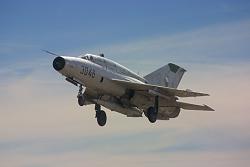
Photo copyright X-Rocket
Maching Bird 1,
a former Czech Air Force MiG-21UM
trainer, takes off from Reno's Stead Field.
Reno, NV – March 30, 2005 – For pilot Bob Ray, it was a routine
proficiency flight, but for teacher Pam Leestma, it was the flight
of a lifetime and the first step toward realizing her lifelong
dream of traveling into space.
Ray and Leestma, a 30-year-veteran teacher from Valley Christian
Elementary School in Bellflower, California, took off from Reno
Stead Field at 12:15 pm in a two-seat MiG-21UM supersonic jet
trainer owned and operated by commercial spaceflight company X-Rocket,
LLC. Leestma was selected as a spaceflight candidate in X-Rocket’s
Teacher in Space program.
The former Czech Air Force MiG-21UM, now dubbed Maching Bird 1,
is one of the highest performance civilian aircraft in the US
and the first step in X-Rocket’s plan to open space to all Americans.
Leestma’s flight was no tourist ride, like the MiG flights sold
to American tourists in Russia. “During today’s flight, Pam filled
important crew functions,” said pilot Bob Ray, “including helping
to monitor instruments and perform traffic watch.”
For Pam Leestma, today’s flight seems only natural. Her cousin,
David Leestma, is a NASA Shuttle astronaut, and she has had a
long-time fascination with spaceflight. “This is the adventure
of a lifetime,” Leestma said. “To see God's Earth from such a
vantage point makes me think of the teachers who inspired engineers,
scientists, and mathematicians to achieve things such as this.
I hope to continue to inspire the next generation to find their
dreams, achieve them, and make a difference in our world.”
“X-Rocket’s Teacher in Space program will help teachers like Pam
Leestma realize their dreams,” said company president Edward Wright.
X-Rocket plans to operate a fleet of suborbital aerospace trainers
that will serve multiple functions, from advanced test pilot training
to adventure tourism experiences to Teacher in Space flights.
The company’s motto is “Spaceflight for the rest of us.”
During the 1980’s, NASA created its own Teacher in Space program,
which was later replaced by the NASA Educator Astronaut program.
Problems with the Shuttle program have prevented NASA from actually
flying any teachers in space, however, and the planned replacement
of the Shuttle with a Crew Exploration Vehicle will reduce the
number of available flight opportunities for all NASA astronauts.
Newspaper articles have spoken of possible layoffs in the NASA
astronaut office, so opportunities for NASA to fly educator astronauts
will remain scarce.
“This is where private enterprise can play a role,” Wright said.
“Suborbital vehicles now under development will carry people into
space much more affordably than the Shuttle or CEV. For under
twenty million dollars, we could fly 200 teachers a year, four
from every state in the union. Imagine thousands of astronaut
teachers in schools all across the country, within the next decade.
For decades, we’ve told students that if they studied math and
science, they could grow up to become astronauts and go into space,
but in reality, kids had a better chance of growing up to become
NBA basketball players. What message does that send? Suppose we
could turn that around, and show kids that they have a realistic
chance of going into space? How cool would that be?
“X-Rocket is currently seeking sponsors to help make that happen.
Today’s flight is only the beginning.
“Pam Leestma has shown that America’s teachers have the Right
Stuff. We don’t intend to let them down.”
Several photos are available in the X-Rocket
press area.
March
30, 2005
5:45 pm: More AERA ... Alan
Boyle reports on the AERA announcement and on a conversation with
Bill Sprague, the company's chairman, who says the project is on
schedule: Take
a virtual space ride - Cosmic Log/MSNBC - Mar.30.05.
5:25 pm: AERA ... The AERA
Gallery now provides animations and still images of the Altairis
vehicle design. As expected, the Altairis looks very similar to
their Liberty vehicle entry in the X PRIZE (under their previous
American Astronautics name).
The AERA site doesn't yet provide any specifications on the vehicle
or views of the return phase. The Liberty uses a booster with a
single pressure fed liquid bi-propellant engine with LOX/Kerosene
that fires for 81 seconds. The crew module separates from the booster
after the engine shutdown and the crew module ascends to over 100
Km. The booster and crew module each returns via parafoils for landings
on airbags.
There's no indication yet as to what stage the Altairis vehicle
design has reached. For example, has it passed a preliminary design
review, critical design review, etc.? If they plan to fly by next
year, it sure seems they would need to be past or very close to
the CDR by now. The Press-Enterprise
article says that there were hardware components in the AERA
facility in Temecula, California, so maybe they have started construction.
The Press-Enterprise
article also states that AERA currently has $1.2 million but
needs to raise $15 million to $20 million to build the vehicle.
Before flying passengers they would also, of course, need to get
an AST license, which presumably would require several test flights.
I hope they can do it but it sure seems ambitious to plan on flying
ticketed passengers in 2006.
5:25 pm: News briefs ... Tom
Hill reports on a presentation by Burt Rutan at the National Air
and Space Museum's Udvar-Hazy Center: An
Evening with Burt Rutan - Space What Now? - Mar.26.05 ...
... Via Transterrestrial
comes links to some new space blogs including the Space
Law Probe, which says it is "Not for lawyers and astronauts
only". The blog is associated with the site Spacelawstation.com:
The planet's space law portal, which offers a lot of interesting
space law related resources such as a list of
Space Lawyers, Space
Law Cases, and
Space Law Books. (No section yet with space lawyer jokes ...
Sorry, I couldn't resist.) More space
law links. ...
... Note that I maintain a
list
of space related blogs and bulletin boards on a separate
page.
11:05 am: News briefs ... The
AERA animation of their vehicle design will be posted on their website
at 1:30 pm EST today. In the meantime, see the description here:
Space
tourism propelled by rocket science: PREVIEW: A television feed
shows a five-minute trip on a spacecraft from AERA Corp. -PE.com
(Riverside CA) - Mar.30.05 (via spacetoday.net)
...
... The return-to-flight program
reaches a milestone with the rollout of the Discovery to the VAB:
Discovery
rolls toward a return to flight - collectSPACE - Mar.29.05 *
Discovery
rolls closer to launch: Revamped orbiter arrives at VAB to prepare
for trip to launch pad - Florida Today - Mar.30.05.
...
... Spaceflight Today offers
regular updates on the Discovery mission here: STS-114
Shuttle Report | Mission Status Center.
March
29, 2005
12:20 pm: AERA announcement just
arrived:
AERA Corporation Releases
Animated Presentation of Altairis Rocket
Which will Begin Taking Tourists into Space in 2006
Video News Release will be available globally
via satellite Wednesday March 30 and will also be posted to the
www.aeraspace.com
website
(Temecula, CA) An animated presentation of the AERA Corporation
Altairis rocket, which will begin taking tourists into space in
2006, will be available via satellite to news stations across
the globe on March 30. The same animation will also be made available
on the www.aeraspace.com
website.
The video animation will allow anyone to see what the future of
space tourism will look like.
"We wanted as many people as possible to be able to see the near
future where the wonder and awe of space travel will become a
reality for many not just a select few," said Bill Sprague, Founder,
CEO and Chief Scientist of AERA Corp.
The release of the design of the rocket closely follows AERA's
recently signed agreements with the United States Air Force and
the Florida Space Authority to use Cape Canaveral for launch,
flight operations and landing.
"As companies work to make space accessible to the masses the
Florida Space Authority will work with them to make individuals
dreams of space flight come true," said Paul Altier, Manager of
Spaceport Operations at the Florida Space Authority.
The United States Air Force will also be working with AERA and
added that they will be "providing oversight to ensure flight
and public safety attention is maintained," said Rick Blucker,
Chief of Plans and Programs with the 45th Space Wing at Patrick
Air Force Base in Florida.
The agreements with the Florida Space Authority and the United
States Air Force are critical elements to having a legitimate
and ongoing outer space tourism program.
"Having those agreements signed for us is like a large commercial
carrier opening a hub at a major airport without a hub you have
no airline and without an agreement like this you have no space
program," said Sprague.
Television news producers please contact Mike Garcia for satellite
feed coordinates. Individuals will be able to view the presentation
beginning at 5:00 EST on March 30th at www.aeraspace.com.
11:25 am: News briefs... Masten
Space Systems reports on progress with their igniter and other
projects: Update
- MSS blog - Mar.26.05 ...
... Recent Space
Show interviewees who discussed topics related to space transport
include Sam
Dinkin, a columnist for the Space
Review, John
Jurist who writes about medical issues related to space tourism,
and regular guest Robert
Zimmerman who talked
about the recent AST
meeting and the FAA
guidelines for commercial suborbital spaceflight. ...
... Speaking of the AST, today
through Thursday it is holding a public
meeting "on the draft regulatory language including changes
to the commercial space transportation regulations governing licensing
and safety requirements for launch. The meeting will take place
at the Holiday Inn-Capitol, 550 C Street SW, Washington, DC in the
Discovery I Conference Room." ...
... Today Kistler
is supposed to find out if its plan for emerging from Chapter 11
bankruptcy is accepted by the court.
March
28, 2005
2:30 pm: News briefs... To
obtain engines that can last for "hundreds of flights, not
just a few", Armadillo Aerospace is shifting its engine development
away from hydrogen peroxide fuels to LOX/Methanol biprops according
to the latest update from John Carmack: Pyrolusite,
peroxide, Lox - Armadillo Aerospace - Mar.27.05 ...
... Sam Dinkin continues his
interview with David Urie of Rocketplane
Ltd: Rocket
plane venture star (part 2) - The Space Review - Mar.28.05.
Urie reports that the company just completed its preliminary design
review. The critical design review will take place this fall and
then construction of the vehicle will begin with the goal of passenger
operations by 2007. Total cost of the project is in the $40M+ range....
... Rand Simberg examines the
potential plusses and minuses of a Michael Griffiin administration
at NASA: Rocket
Man - Tech Central Station - Mar.28.05 ...
... Jeff Foust looks at the
complexities of the global launch industry: Stagflation,
overcapacity, and the commercial launch industry - The Space Review
- Mar.28.05 ...
... From his experience on
the Moon-Mars Commission, Neil deGrasse Tyson has become more optimistic
about prizes as motivators and about commercial space development
in general: Blue
Ribbon Buoyancy - Astrobiology Magazine - Mar.23.05. (Via a
posting on the Space
Arena forum.)
2:15 am: Alt.space moves on ... It
is a shame that perhaps the first ever mention of the phrase "alt.space"
in the Washington Post came in an article like this: Telecom
Mogul's Lofty Dreams Plummet: Fun-Loving Space Aficionado and Eccentric
Rebel Accused of Tax Evasion - Washington Post - Mar.26.05.
However, the Anderson situation seems more of an embarrassment
than a setback for the movement. After all, with the SS1 going into
the Air & Space Museum this summer and over a hundred million
dollars committed to the SS2, it is hard to portray private space
development as nothing but the fanciful dreams of a small scattering
of wacky, feckless eccentrics.
If Anderson's arrest had occurred a few years ago when MirCorp
was one of the biggest and most visible entrepreneurial space firms
around, I think it would have made a much bigger impact. Paul Allen,
Richard Branson, and others
might not have come to support private space projects if such an
event resulted in a widespread public impression that such endeavors
were not only crazy but also tainted with illegality.
As I tried to argue with the timeline
exercise, private space development has now grown beyond
any one person or company. It is hardly invulnerable and there are
major challenges ahead, but there is a robustness and a growth to
the movement that will allow it to pass quickly over this small
bump in the road to space.
2:15 am: Support your favorite rocket
projects such as those at Rocketforge
by shopping at the Rocketforge
CafePress site, which includes a store
section for Masten
Space Systems.
Be sure to attend NASA sponsored conferences while wearing LEAD
T-Shirts to express your preference for Option D in the NASA
Lunar Roadmap.
See also the links to other Rocket
Company shops.
2:15 am: News briefs ... ...
As shown with the SS1, composites will play a significant role in
many RLV designs. Boeing and Airbus are going bigtime with composites
in their airliners and this will push the development of these materials
and expand the industrial infrastructure supporting them: Evolution
and Revolution- Aviation Week - Mar.27.05. This should in turn
help to support their use in RLVs. However, there do seem to be
some problems to work out: We
Don't Know As Much As We Think We Do - Transterrestrial Musings
- Mar.14.05 ...
... Another update on the Cosmos
1 project: First
solar sail continues methodical launch checklist - Spaceflight Now
- Mar.26.05 ...
... Well, for starters it helps
to be Boeing or LockMart: Want
to succeed as a space contractor? Here's how - Florida Today - Mar.27.05
...
... NASA once talked about
keeping the shuttle program running till 2020 or longer. Looks like
it will be a challenge even to keep it going until 2010: Report
criticizes shuttle workforce planning - spacetoday.net - Mar.27.05...
... Keith Cowing is finding
lots of problems and raising many questions regarding the GWU Astronaut
Space Safety 2005 study: How
to Waste $300,000 (Substantially Updated and Expanded) - NASA Watch
- Mar.27.05
March
26, 2005
1:55 am: News briefs ... Leonard
David reviews the issue of medical requirements for people who want
to take suborbital space tourism flights: Doctor's
Orders: The Right Stuff for Space Tourists - Space.com - Mar.25.05
...
... The FAA and the Air Force
move to coordinate their policies and practices with respect to
commercial expendable vehicle launches: FAA
Announces Next Step in Commercial Space Launch Partnership - FAA
- Mar.24.05 ...
... Rand Simberg is not a fan
of uncrewed shuttle flights, which were recommended in the study
from George Washington University: Clueless
At GWU - Transterrestrial Musings - Mar.25.05 - as recommended
March
25, 2005
1:15 pm: News briefs ... A
hot gas blowback during a SpaceX engine test damaged some wiring
on the test stand. This will cause a delay of a week or so for the
pad hotfire test at Vandenberg: Minor
Damage to SpaceX Engine Test Stand - SpaceRef - Mar.25.05 ...
... Speaking of rocket engine
tests, NASA did a firing of a subscale version of the shuttle solid
rocket boosters: Marshall
booster rumbles, smokes: Engineers work with model to improve reusable
shuttle part - Huntsville Times - Mar.25.05 ...
... A crowd of Marshall employees
and their families came out to see the test. Rocket
Test Draws a Crowd - WHNT-TV, Huntsville, AL - Mar.24.05. I
like the comment "They came to the East Test Area because the
test was loud, and it was exciting." Something for the X
PRIZE Cup promoters to consider. They better emphasize the boom,
fire and flash if they want to get a couple of hundred thousand
people to drive out into the desert to see the event ...
... The announcement of the
Volvo/Virgin
Galactic contest winner has gotten quite a bit of press (via
spacetoday.net):
... The
Vega may have twice the payload of the Falcon
I, and neither is flying yet, but it still seems to say something
about government vs. private development that the Vega is taking
much longer (it began in 1998) and a lot more money (US$300M)
to build it: Vega
on track to meet 2007 deadline - ESA - Mar.16.05 ...
... More about the Shuttle
safety study carried out by a group at George Washington University:
NASA
Needs Shuttle Replacement as Soon as Possible - Bloomberg - Mar.24.05.
(I don't see the report posted yet at the GWU
Space Policy Institute). It urges NASA to use uncrewed shuttle
flights for the ISS missions and to restart the X-38
project.
2:15 am: Japan news briefs ....
Yoshifumi
Inatani, leader of the Japanese RVT
project, argues in support of the pursuit of reusable rocket vehicles:
"The
Next Goal for Rockets" or "The World of the Swindler?" - ISAS/JAXA
- March.2005 ...
... To encourage interest in
space tourism in Japan, Patrick
Collins has created the website SF/J
Space Future Japan (English).
(Links via a HS reader in Japan.)
2:15 am: News briefs ... The
Crosslink
magazine, published semiannually by Aerospace
Corporation, offers lots of interesting articles. See, for example,
the issue Rocket
Science - Crosslink - Winter 2004, which includes the articles
History
of the Dyna-Soar and Future
Launch Systems ...
... This well written piece
by Ben Berry nicely describes the Virgin Galactic Press Conference
in New York City where the Volvo
XC90 V8 contest winner was formally introduced yesterday: Branson
and Volvo announce Virgin Galactic Spaceflight winner - Space Race
News!/Rockets Away - Mar.25.04
March
24, 2005
5:00 pm: News briefs... Robert
Zimmerman observes that it is Congressional earmarks, not the
VSE,
that is grabbing money away from the approved science projects:
Space
Watch: NASA impeded by science lobby - UPI - Mar.24.05 ...
... Alan Boyle on the Volvo
space tourism contest: Ticket
to ride ... in space - Cosmic Log/MSNBC - Mar.24.05 ...
... I assume this it is the
Cosmopolis
C-21 mockup that is being exhibited, along with the Kliper
mockup, and not an actual vehicle: Russia
Exhibits Space Shuttles At Expo'2005 - RIA Novosti - Mar.24.05
...
... Russia and Kazakhstan are
discussing a collaborative project involving the launch of small
satellites (160kg range) via a second stage rocket carried by a
MIG-31. Most of the elements of the system and infrastructure already
exist according to the article: www.spacenews.ru
article in Russian. (Link via F. Novoshilov) ...
... I wonder if Griffin will
consider uncrewed flights? Safety
report calls for uncrewed space shuttles - New Scientist - Mar.24.05
...
... Mark
Whittington discusses how NASA might employ a commercial approach
to lunar development: A
New Way to Explore the Moon - The Washington Dispatch - Mar.24.05.
11:25 am: Space contest news....
The winner of the Volvo/Virgin Galactic space
tourist contest winner has been revealed as Doug Ramsburg of
Colorado:
(Links via spacetoday.net.)
...
... More about the Centennial
Challenges announcement: NASA
announces prizes for space breakthroughs - MSNBC - Mar.24.05
* NASA
Details Cash Prizes for Space Privatization - Space.com - Mar.23.05
...
... Since I would prefer a
pummeling with a tire iron to watching "The Apprentice",
I'll have to find out from someone else what kind of space prize
will be contested for there: Space-Related
Prize on "The Apprentice"? - NASA Watch - Mar.23.05
.
11:25 am: Zero Gravity opportunities ...
Xero will
begin offering rides on its parabola flying plane this summer in
northern Sweden: Zero-Gravity
Flights to Take Off From Sweden This Summer - Space.com/AP - Mar.24.05.
It will be interesting to see if they can make it a successful
business with $9.6K ticket prices. If so, that certainly would make
the case stronger for suborbital spaceflights tourism. People who
can afford that much to experience weightlessness during a 90 minute
ride in a plane will probably pay $100K-200K for an actual ride
into space.
I got a feeling, though, that many wealthy European space enthusiasts
will prefer to spend the $9.6K to buy a plane ticket to Miami and
to ride twice on the Zero-G
plane.
11:25 am: Flight School news....
Alan Boyle reports that Freeman Dyson was a big hit at the Flight
School meeting: Dyson's
sphere of influence - MSNBC - Mar.24.05
...
... Alan also passes along
the news that the launch of the Cosmos
1 solar sail will be delayed till late May and that the next
ISS tourist will likely be a Japanese citizen: Space
dreams deferred - MSNBC - Mar.24.05
...
... Progress in the development
of Very Light Jets (VLJ), or Microjets, was the other topic of the
meeting: Personal
Travel on 'Microjets' Expected to Grow - LiveScience - Mar.23.05
11:25 am: News briefs ... The
April issue of National Geographic will include an article about
the SS1: SpaceShipOne
- National Geographic Magazine - April.05 issue
...
... The GAO recommends improvements
in NASA's Prometheus
1 nuclear powered spacecraft development program: GAO
Report: NASA's Space Vision: Business Case for Prometheus 1 Needed
to Ensure Requirements Match Available Resources - SpaceRef - Mar.23.05
...
... There will be a number
of new procedures and restrictions on the next shuttle flight: Up
and Down: NASA Plans for Discovery's Launch and Landing - Space.com
- Mar.24.05.
March
23, 2005
8:00 pm: Centennial Challenges announced:
NASA
Announces First Centennial Challenges' Prizes - NASA - Mar.23.05.
As expected, NASA will collaborate with the Spaceward
Foundation to sponsor tether
material and power
beaming competitions in 2005 and 2006. Prizes will be $100K,
$40K, and $10K for first, second and third place finishers, respectively.
See also NASA
Follows X Prize Footsteps - Wired - Mar.23.05. (Links via spacetoday.net.)
4:30 PM: Robust waverider?
I'm gradually reading through the thesis The
Decision Maker’s Guide To Robust, Reliable And Inexpensive Access
To Space by Gary N. Henry, Lt Col, USAF - Air War College - Feb.2003
- pdf (link via Sam Dinkin). It provides a lot of interesting
background info on rocketry, vehicle design, and launch industry
economics. In looking ahead to the collision, however, I'm wondering
how in the world he concludes that a
"two-stage-to-orbit space launch system using a first stage
waverider design leveraging combined cycle engine technology is
the best and fastest route to R2ISA [robust, reliable,
and inexpensive space access]"
And he is not talking about $50 per kg to LEO but simply breaking
the limit of $2000 per kg. I hope some knowledgable aerospace types
will critique his analysis.
12:50 pm: Attracting capital ... Ester
Dyson's "Flight
School" conference is happening today and it has an impressive
list
of speakers from the worlds of both alt.space and VLJ (Very
Light Jet) aviation.
As mentioned before,
the registration price was very high and it was not, as claimed,
the first gathering where both entrepreneurial financiers and engineers
from startup space companies could interact. However, the meeting
certainly offers an opportunity to educate potential new investors
about the industry and that's clearly beneficial to its growth.
Alan Boyle, who is attending the meeting, reports on efforts to
go beyond angel investors and attract institutional investors to
the space startups. In the article - Spaceflight
industry ready for takeoff: Startups reach out to investors interested
in money, not just glory - MSNBC - Mar.22.05. - he talks with
XCOR spokesman Rich
Pournelle and two investors in XOR, Joe Pistritto and Lee Valentine.
Pistritto has noticed a change in the attitude of financial people
after the SS1 flights: "The industry has suddenly become real."
Valentine wants to help advance his own personal space vision but
another reason he got "involved with XCOR in the near term
is to make money." Perhaps now there is a better chance to convince
others as well that the entrepreneurial space industry is a place
to make money. ...
... This article also discusses
the Flight School meeting and says that "Jeff Bezos and numerous
other CEOs and representatives of venture capital firms" are
attending: 'Seeds
of a Revolution' Could Help Change NASA - Space.com - Mar.23.05
...
... Alan reports on the Centennial
Challenges announcement this evening: Space-elevator
boosters play role in challenge - Cosmic Log/MSNBC - Mar.23.05
...
12:50 pm: News briefs... Glenn
Reynolds hopes that Mike Griffin can do the tough things necessary
to get NASA into shape. He believes that space exploration is more
than just for pure science but is vital to the long term prospects
for humanity. "Let's get those space settlements going":
A
New Captain for the Titanic? - TCS: Tech Central Station - Mar.23.05
...
... Meanwhile, NASA will try
to keep the shuttle as far away from people as possible during both
takeoff and landing: NASA
to enhance public safety around shuttle - spacetoday.net - Mar.23.05.
Here is a Media
Advisory that expresses NASA's concern for the public safety
even more emphatically (and humorously). ...
... Understanding the full
extent of the debris problem continues to be a challenge: Defining
the debris threat: What can shuttles withstand? - Spaceflight Now
- Mar.22.05 ...
... For the SS1 archives. Here
is a set of articles at Popular Mechanics I happened to come across:
'SpaceShipOne'
X Factors: How backyard engineering won the private space race.
- Popular Mechanics - Dec.14.04.
2:20 am: Near space for kids... JP
Aerospace continues their pongsat program, this time with a
high altitude balloon:
Ping Pong Balls to the
Edge of Space.
On April 9th, JP Aerospace will carry 140 student projects from
around the world to the edge of space on a high altitude balloon.
These experiments are part of JP Aerospace’s PongSat®
program.
A PongSat is an experiment that fits inside of a ping pong ball.
Students as young as eight are running their own space programs.
Experiments range from plant seeds to computers with sophisticated
sensors. For several months, students from Belgium, California,
and Texas have been mailing their PongSats to JP Aerospace. In
a couple of weeks these ping pong ball "satellites" will be flown
to the edge of space on a research balloon platform. During the
flight, the PongSats will experience cold down to -90 degrees
Fahrenheit, vacuum, cosmic rays, and zero gravity during the descent.
After landing, the PongSats are returned to the students along
with a video of the mission. The student will then inspect their
experiment and study the results.
This high altitude balloon mission, “Away 26,” is being flown
to test telemetry systems for high altitude airships. Whenever
JP Aerospace flies to the upper atmosphere, space is set aside
for PongSats. The students get to go along for the ride.
Even the youngest students can be space scientists, flying real
missions to a place where few “real” scientists get to go. JP
Aerospace has flown 1600 PongSats involving over 6000 students.
Away 26 is the eighty-sixth mission flown by JP Aerospace. JP
Aerospace is a volunteer-based space program dedicated to building
and flying low-cost space systems.
The PongSat program is open to everyone and is free of charge
to schools and individuals. For more information or fly your own
PongSat visit www.jpaerospace.com.
Photographs available at www.jpaerospace.com.
Mission Details:
• Mission Name: Away 26
• Mission Type: Unmanned High Altitude Balloon
• Maximum altitude: 110,000 feet
• Vehicle weight 25 pounds
• Total Flight Time: Four hours
• Number of PongSats: 140
• Flight systems include: Full command control telemetry system,
Dual GPS tracking, Live video
downlink, digital still camera and environment measuring sensors.
March
22, 2005
10:45 pm: Challenging space elevator tech
... Ed
Wright tells me that NASA will reveal the first two Centennial
Challenge contests on Wednesday: NASA
Announces First Two Centennial Challenges - NASA - Mar.22.05.
The partner for the contests will be the Spaceward
Foundation, whose "flagship project" is Elevator2010.org.
This project had previously announced its sponsorship of the "Space
Elevator Climber Competition" and the "Space
Elevator Tether Competition". I presume that NASA will
be increasing the size of the awards from the current $50K for the
top prizes.
Ed isn't impressed: "Never let it be said NASA doesn't support
*practical* approaches to space access". I'm rather more positive
about the contests and think they will be interesting and fun competitions
for students in engineering and material sciences. I hope, though,
that more near term technologies will be focused on in subsequent
competitions.
10:45 pm: Homer's advice ... Too
bad that Homer
Hickam's Tuesday Wall Street Journal editorial - Shuttle
Fatigue - is not in the free section. The author and former
engineer at NASA has some strong advice for Mike Griffin. He urges
the incoming administrator to "put the Space Shuttle in the
museum where it belongs and implement with urgency the design, construction
and flight of a new crewed space vehicle before every good engineer
you've got walks away in disgust."
He says that it just isn't possible to "keep [the shuttles]
flying on schedule and safe" and that "most NASA engineers
in the trenches know it."
He advocates concentrating on the CEV and notes that most NASA
engineers
"have never worked on a program that produced a spacecraft.
Never! Can you imagine being an aerospace engineer and spending
an entire career designing and designing again, but never being
allowed to actually build and fly anything?"
I would note, however, that this lack of experience doesn't seem
to be preventing NASA from specifying in great detail how the contractors
should develop the CEV system.
10:45 pm: News briefs... The
latest space race article from Irene Mona Klotz reports on the space
tourist contest sponsored by Volvo: Space
Race 2: Free tickets to ride - UPI/WashTimes - Mar.22.05. Nice
to hear that the winner is a "die-hard space buff", so
I assume he will actually take the space ride rather than cash.
...
... Space
Race News! notes that the Romanian ARCA
rocket team has recently posted a couple of news items about
their project.
1:05 pm: The Rocket Company
is now available for preorder
from AIAA and will ship on July 15th. (Sometime between now
and then it will become available at Amazon and other online stores.)
Congratulations to Patrick, David and Doug. It will be great to
see it in print. Two
sample chapters are still available here.
1:05 pm: News briefs... Rand
Simberg posts some comments on my recent item
about NASA and on my private space development timeline:
Alienating
Constituencies - Transterrestrial Musings - Mar.22.05 ...
... Speaking of rocket companies
and private development, we shouldn't forget that one startup in
the past did in fact succeed in becoming a major aerospace firm.
Here is a description of how Orbital
Sciences got its start: HBS
Working Knowledge: Entrepreneurship: Let's Start a Rocket Company!
- Harvard Business School - Mar.21.05. (After implying otherwise,
I was once firmly reminded by an OSC person that the Pegasus
was the first privately developed orbital rocket.) ...
... At the Orlando
meeting in January, Dr. Anatoly I. Kuzin, deputy director of
Khrunichev, discussed the VSE and how Russia might participate in
the effort. He shows, for example, a design for a new manned vehicle
: Preliminary
analysis of "The Vision for Space Exploration" program and estimation
of the role of Russian space firms in its realization - (pdf) (Via
HS reader F. Novozhilov)...
... Speaking of Russian manned
vehicles, the Kliper
will be on display at a meeting in Japan: New
Russian Shuttle To Be Displayed For The First Time In Japan - RIA
Novosti - Mar.21.05 ...
... The Shuttle Discovery has
built an impressive resumé: Discovery
returns to center stage: Shuttle's epic legacy grows as rollover
nears - Florida Today - Mar.21.05 ...
... This article assumes the
worst about a shuttle rescue mission and its aftermath: The
mission NASA hopes won't happen - USATODAY.com - Mar.22.05.
But Keith Cowing thinks a rescue mission would hardly mean the end
of manned spaceflight in the US for "decades" or kill
the ISS: USA
Today's Doomsday Scenario - NASA Watch - Mar.22.05. Here's more
on the shuttle rescue scenario: Shuttle
Rescue: Four Astronauts Train for the Unthinkable - Space.com -
Mar.21.05
1:55 am: Private space progress ... I've
posted a new, improved version of my timeline for private space
development: Climbing
a Commercial Stairway to Space: A Plausible Timeline? Vers 2.0.
Don't know if any of it will actually come true but in creating
the timeline I've become very impressed with the breadth and depth
of the alt.space movement. The number of entrepreneurial projects
is large and growing. The technical sophistication of the projects
is typically quite high. The number of rich
investors has grown significantly and the movement doesn't
depend on the generosity of any one space mogul. (Though clearly
a lot is riding on the continuing support of Robert Bigelow for
space habitat development and the America's
Space Prize.)
So unless there is a major recession or other huge disaster, I
think we will witness a lot of exciting accomplishments in private
space development in the coming decade.
March
21, 2005
12:30 pm: NASA priorities and process
... Gil Moore has spent several decades in the space
education field and currently leads the Project
Starshine student satellite program that has successfully launched
three spacecraft from the shuttle and involved "over one hundred
thousand students in 43 countries" in the projects.
He has sent an open letter to Michael Griffin lamenting the cancellation
of the Shuttle Get Away Special (GAS) program and the general failure
of NASA to support access to space for student projects: Remarks
at the funeral of NASA's Get Away Special Program - An open letter
to Dr. Michael Griffin - SpaceRef - Mar.20.05.
He recognizes the challenges facing NASA with the return to flight
program and in finishing the ISS but argues that there are other
priorities as well:
But what is the educational community supposed to do...just forget
about the space program? Are only the physical and intellectual
elite to have access to space, once again? What about the outstanding
legacy GAS flight programs at Utah State University, the University
of Michigan, and the University of Louisville, to name but a few,
that were turning out generations of space-wise students, before
the Columbia accident changed the entire landscape of educational
space experimentation? Does NASA have a plan to provide an alternative
avenue for students to do their own enthusiastic, creative and
unfettered experiments with their own space hardware, as they
have done for the past twenty years in the SSIP, GAS and Hitchhiker
programs?.
He has heard rumors that
...NASA is working DARPA to fly one or more Falcon expendable
launch vehicles from the Wallops Flight Station, and that there
will be an opportunity to fly educational satellites, like Starshine
4/5, for example, on at least one of those missions. That sounds
like a great start, but how about making that an annual event?
NASA needs to do more than just talk about education:
It's all well and good for NASA administrators and Air Force
generals to make speeches deploring the "greying of the space
industry" and delineating in great detail the workforce crisis
that is nearly upon us, due to the rapidly looming waves of retirements
of space employees. They warn us in sepulchral tones that our
nation is in imminent danger of losing our technological leadership
in space, following which everything else will go to pot. ...
but it's now time for the leaders of our country to put their
monies where their mouths are. There is no, repeat no, substitute
for actually letting students fly their own hardware in space.
Giving them lectures and letting them follow government employees
around in the workplace and showing them Earth images and webcasts
of astronauts working in space and rovers working on Mars are
all marvelous things to do, but they are not sufficient to motivate
today's youth to join us in the president's announced program
to go back to the Moon and on to Mars. They need to be able to
fly experiments of their own.
It's not as if huge costs are involved.
How about your subsidizing a program to deploy Cubesats
from converted camera pods on the outside of government and commercial
ELVs, as proposed by a former GAS student who now runs his own
aerospace company? Or how about the aerospace
industry providing machining support to Cal
State Long Beach and its struggling, small aerospace company
partner to help them build a very small, nanosat
launch vehicle to orbit Cubesat-class satellites. [My links]
He suggests some new approaches to substitute for the GAS such
as
sponsoring development of a stabilized ELV bus with self-contained
power, telemetry and video transmission, and maybe even a payload
retrieval system, so the students can adapt their GAS experiments
to the ELV world, and then giving them frequent repetitive launch
opportunities, like they had in the GAS program. "Stop and start"
just doesn't cut it in the educational world, especially when
graduate students are involved...
... This command to kill the
GAS follows similar "top-down" policies at NASA that seem
oblivious to any other input. NASA was also urged by a space science
committee to revitalize its sounding rocket program but instead
the program is steadily fading away. For relatively little money,
it could fund flights on the new RLV suborbital rockets and thus
help both science and the development of new launch technologies.
...
... It certainly seems strange
that NASA is initiating the VSE
by alienating virtually every natural constituency that it has.
In addition to this hit on space education, the science community
is becoming convinced that the VSE just means big cutbacks in its
funding (At
NASA, Clouds Are What You Zoom Through to Get to Mars - NY Times
- Mar.21.05), the aviation community is now sure that NASA wants
to eliminate all aeronautical research (Congress
Quizzes NASA On Cuts in Aeronautics Spending - Space News - Mar.21.05),
closing a research center or two will certainly reduce its circle
of friends (NASA
BRAC: a bad idea - The Space Review - Mar.21.05), and cancelling
the Hubble repair mission angered every astronomy fan in the country.
It's not as if NASA has a shortage of waste. It could clearly accomplish
much more with its 16 billion dollar budget. Often it appears, however,
that particular NASA programs are cut not because they are failing
or because they lack cost-effectiveness, but because they are small
and don't have the political clout to fight back. Meanwhile, the
huge Shuttle and ISS programs relentlessly suck up all funding in
sight.
I hope the new administrator will allow for rational input from
outside sources to make a difference in NASA policies and that he
will better communicate the reasons for cutbacks and convince people
that they are made for sound, long term strategic reasons rather
than just short term programmatic convenience.
12:30 pm: News briefs... In
the latest issue of The Space Review, Sam Dinkin surveys the Rocketplane
Ltd plans for a suborbital tourist service: It's
about engineering at Rocketplane - The Space Review - Mar.21.05
...
... Sam also interviews David
Urie, vice president and program manager at Rocketplane: Rocket
plane venture star (part 1) - The Space Review - Mar.21.05 ...
... Dr. John Jurist discusses
the oxygen requirements for passengers on a suborbital spaceflight:
Human factors in commercial suborbital flight: Getting adequate
oxygen - The Space Review - Mar.21.05
March
20, 2005
3:20 pm: CEV spiral ... Rand
Simberg corrects
the date given Friday
for the CEV downselect to two contractors. From the presentations
shown at the March 11th Exploration
Systems NASA/Industry Days, the schedule actually goes as follows:
- Proposals are due no later than 2:00 pm, May 2, 2005
- Source Evaluation will begin immediately after the deadline
- Contract award is planned for no-later-than 5 September 2005
... The presentations include
a timeline chart called "Spiral I Program" that shows
the various phases of the program NASA believes will lead to crewed
flights in 2014. Interestingly, there is a one bar simply labeled
"ETO [Earth to Orbit] ETO - Non Traditional Approach - Potential
Commercial Solution". In other words, all this other stuff
may be irrelevant if those entrpreneurial guys get there first.
...
... Henry Vanderbilt says
that t/Space
hasn't actually made a decision about whether to bid for the CEV
or not.
3:20 pm: News briefs... Much
of the commercial launch industry seems to be coalescing into two
camps: International
Launch Services (Lockheed-Martin, Khrunichev, and RSC Energia)
and Launch Services Alliance (ArianeSpace, Boeing and Mitsubishi)
: Launch
Services Alliance Holds First Press Conference - SpaceRef - Mar.17.05.)
...
... I don't have a subscription
to read the full article,
but apparently the Near
Space Maneuvering Vehicle project, of which JP
Aerospace was once a contractor, is being scaled back by the
Air Force. ...
... Speaking of JP
Aerospace, check out the videos
they are posting, especially this long fall
to earth. ...
... There are job
openings at Starchaser.
March
18, 2005
3:55 pm: News briefs ... Two
finalists in the CEV competition will be announced on May 2nd: The
future of space travel: The next space race is about to begin as
eight private consortia finalize their bids for the lucrative contract
to replace NASA's retiring space shuttle - The Advertiser - Mar.19.05
(via spacetoday.net)
[Mar.20: see correction above]
...
... Miscellaneous problems
are hindering the return to flight: ISS
gyro problem will not delay shuttle launch - spacetoday.net - Mar.18.05
* Shuttle
troubles: - Cosmic Log/MSNBC - Mar.17.05 * NASA:
Space Station Work Put Off for Now - MSNBC - Mar.17.05 ...
... The Shuttle Getaway Specials
program was intended to give low cost access to space for experiments
built by university and other research groups. Thought the waiting
times were long, some groups did successfully take advantage of
the opportunity The program is now being canceled: Farewell
to Getaway Specials - NASAWatch - Mar.18.05. I hope that Griffin,
who comes with a science background, will put a priority on helping
university groups get payloads into space in a timely and low cost
manner. ...
... NASA
Watch offers links to a couple of rapid prototyping projects
at NASA: ISFR
- Exploration Science & Technology Division and Electron
Beam Freeform Fabrication - NASA. The latter site offers an
interesting video
showing the buildup of layers for a metal frame.
1:15 am: News briefs ... You
will soon find out if you are the lucky winner of a ride to space:
Volvo
and Sir Richard Branson Unveil Winner of Trip to Space - PR Newswire/Volvo
- Mar.17.05 ...
... The upcoming 21st
National Space Symposium will include a discussion panel session
that includes some representatives from the alt.space universe:
Entrepreneurs
featured at space symposium - Space Foundation - Mar.17.05.
I find this rather encouraging, seeing as how the Space
Foundation is an organization sponsored primarily by the mainstream
aerospace industry. ...
... Here's a marvelous set
of photos from the recent Atlas V launch: Photo
Gallery: Atlas 5 rocket launches Inmarsat 4-F1 - Spaceflight Now
- Mar.17.05....
... An item here yesterday
mentioned rapid prototyping for space applications. Such a system
might actually be able to make copies of itself. A Slashdot
posting points to a NASA report from 1980 - NASA's
Advanced Automation for Space Missions - IslandOne - 1980 -
that looks at the possibilities of self-replicating
systems (SRS) for lunar industrialization.
March
17, 2005
2:15 pm: News briefs...
Robert
Zimmerman examines the heavy paperwork and regulatory requirements
that CEV contractors must endure: Space
Watch: Spacefaring by bureaucrats - UPI - Mar.17.05 ...
... The print version of Space
News recently published in its editorial section a three part essay
by Robert Zubrin on how NASA's Moon exploration progam should proceed.
The pieces have now been posted on the Mars Society website:
12:45 pm: News briefs ... Keith
Cowing points out that a spare parts making system could come in
quite handy for those living in space: Making
Spares - On-orbit? - NASA Watch - Mar.17.05. There has been
talk over the years of using rapid
prototyping technologies in space but, as far as I know,
NASA has never tried to develop a system to test on the ISS. As
Bob Zimmerman recently pointed
out, there are a lot of technologies and techniques like this
that need to be developed before long duration deep space missions
become practical and the ISS is the obvious place to test them.
...
... Starting to sink in at
KSC that it won't always take 10,000+ people to launch a crew to
orbit: Launch
work force likely to decline: Space panelists stress options - Florida
Today - Mar.17.05 ...
... Meanwhile, the struggle
to launch the next shuttle continues: Shuttle
launch schedule may slip: May 15 liftoff could be delayed - MSNBC
- Mar.16.05 ...
... Jeff Foust spots in this
article - JAXA
seeks to bodily go, and to go it alone - Daily Yomiuri - Mar.16.05
- a sign of Japanese interest in developing their own human spaceflight
capabilities: Japanese
space policy - Space Politics - Mar.17.05. Unfortunately, it
sounds like the usual government space agency PR fluff involving
grandiose 20 year plans and the launching of crews on $100M expendables.The
Japanese auto companies did not start on their road to catching
up with and surpassing the US auto industry by emulating Edsels
and finned
Cadillacs. If JAXA really wants to get on a practical path to
orbit, it should fund innovative projects like the RVT
and support private development of low cost space transports.
March
16, 2005
1:55 pm: News briefs ... The
third Minotaur-1 launch is in preparation: Steering
system work delays Minotaur rocket launch - Spaceflight Now - Mar.15.05.
It will launch the XSS
11, a 100Kg microsat that will demonstrate
rendezvous and proximity operations with other satellites.
The number of payloads in this mass range seems to have fallen
far short of what was expected back in the 1990s when launchers
like the Minotaur-1 and Athena-1
were developed. The Minotaur-1
from Orbital
Sciences offers similar capabilities as the Falcon-1,
which SpaceX says
will fly for around $6M per mission. It would be interesting to
know what Orbital is charging for this flight. Lower launch prices
might inspire a greater number of microsatellite projects.
...
... A reader sends me these
links to articles involving Russian launch systems: Russia
Wants To Build A New Extra-Heavy Launcher - Mar.8.05 * France,
Russia Ink Deal On Rocket Launchers - Mar.15.05 * The
Promise Of Modular Launch Vehicles - Mar.7.05.
March
15, 2005
2:20 pm: News briefs ... AERA
Space will unveil its vehicle design on March 30th: Firm
books launch services: The deal with the Air Force comes as the
local company prepares to unveil its spacecraft. - Riverside [Ca]
Press Enterprise - Mar.15.05 ...
... The latest article from
Irene Mona Klotz reports on the SS1 journey to Washington and the
status of some former X PRIZE projects: Space
Race 2: SpaceShipOne, post X Prize - UPI/WashTimes - Mar.15.05.
(Links via spacetoday.net)
10:35 am: News briefs ... Access
to the ISS is becoming a big messy problem for NASA due to political
restrictions on funding of Soyuz flights: No
plan B for outer space - Economist - Mar.10.05. Shuttles can
remained docked for only a couple of weeks at a time and so for
long term stays the astronauts need a Soyuz there as an emergency
escape vehicle. After expiration of an agreement with Russia in
2006, NASA will need to pay for the vehicles. Congress, however,
won't let NASA buy Soyuz flights as long as Russia is helping Iran
with its nuclear projects. My guess is that the Administration will
take advantage of a clause in the law that lets NASA get around
this limitation for dire situations. ...
... Here's the current schedule
for flights to the ISS. NASA
ISS Flight Program Launch Schedule 10 March 2005 - SpaceRef - Mar.14.05
...
... In discussing Walt Anderson's
arrest, I mentioned that MirCorp
had been one of the companies
supporting a commercial parabolic flight service called Xero
that would operate out of northern Sweden. Now comes news that Xero
will begin flights this summer: Zero-gravity
flights taking off this summer - USATODAY.com - Mar.14.05 (via
spacetoday.net).
Even with a weak dollar and the inclusion of lodging, the $9,615
package sounds pricey compared to Zero-G's $3750.
...
... Rand Simberg discusses
possible problems with composite structures in airliners and what
this might imply for their use on space transports: We
Don't Know As Much As We Think We Do - Transterrestrial Musings
- Mar.14.05 ...
... It would be interesting
to hear the comments on this issue from a famous composite air and
space craft builder in Mojave: Scaled
Composites set to expand - AV Press - Mar.14.05.
March
14, 2005
11:45 am: More about Griffin... Jeff
Foust provides additional info about Michael Griffin: Getting
to know Michael Griffin - The Space Review - Mar.14.05. It will
certainly be interesting to hear Griffin's first public statements
after his nomination to find out if he strays significantly from
any of his previously stated views on the Shuttle program, the future
of the ISS, the need for a heavy-lift vehicle (HLV), etc.
Though I'm still very skeptical that a HLV will get Congressional
approval anytime soon, it's possible that Griffin's anti-Shuttle/pro-Heavy
Lifter views could actually compliment each other. The shuttle constituency
in Congress might support a faster shut down of the program in exchange
for a shuttle-derived HLV as this offers the possibility that shuttle
related employment in their states could be maintained.
11:45 am: News briefs... Scaled
is growing: Spaceship
firm to expand: Rutan to add hangar, about 70 employees - L.A. Daily
News - Mar.13.05 ...
... Taylor Dinerman suggests
that a single organization should be set up to coordinate US government
space access R&D: Time
for a space access organization? - The Space Review - Mar.14.05.
(Note that Griffin may revitalize RLV efforts at NASA since he is
quite knowledgeable about why the X-33 and X-34 programs failed.)
...
... Yet another article claiming
that a crewed orbital vehicle (pun intended) is currently far beyond
the capability of private space developers:
The Vision for Space Exploration needs transformational technology
by Eric R. Hedman - The Space Review - Mar.14.05. We will see.
...
... Here's another version
of the AP article about Blue Origin and West Texas: Space
dreams boost tiny Texas town: Amazon.com founder wants to use ranch
as spaceport - MSNBC/AP - Mar.13.05
1:35 am: News briefs...
Henry Vanderbilt, chief of the Space
Access Society, will be on a special edition of The
Space Show this evening 7-8:30 pm (Pacific Time). They will
discuss the Space
Access '05 Conference, which will take place this April 28-30
in Phoenix, and, I'm sure, a range of topics dealing with the question
of how to lower the cost of access to space. Connection
info.
March
13, 2005
1:15 pm: News briefs...
Here's a long article in praise of Burt Rutan and private space
development: The
starship enterprise - Sunday Times - Mar.13.05
(via spacetoday.net)
...
... While looking for
Mike Massee's pictures of the ATV, I found these photo sets
of the SS1 flights:
... This seems like another
one of those - let's do something just to show we are doing something
- kind of bureaucratic bungles: Launch
schedule off Web - SantaMariaTimes - Mar.13.05 (via spacetoday.net)
...
... More kudos for Griffin:
Griffin
can 'get the job done' for NASA: Colleagues laud nominee's ability
- Florida Today - Mar.13.05 ...
... Florida Today supports
the RtF: 6
reasons why the shuttle's return to space is vital to human exploration
of the moon and Mars - Florida Today - Mar.13.05
2:50 am: News briefs... The
old Rotary
Rocket hangar has a new tenant so the ATV has been moved
out and there will be another attempt to move it to the Classic
Rotors museum: This
Week at Mojave - Alan's Mojave Airport Weblog - Mar.12.05. See
Mike Massee's photo
record of what happened the last time they tried to fly it out
by helicopter ...
... More about the impact of
Jeff Bezos and Blue
Origin on West Texas: Amazon.com
founder's space venture has West Texas county abuzz - DentonRC.com(Texas)/AP
- Mar.12.05 (via spacetoday.net)
...
... Michael Griffin has the
endorsement of Pete Worden, who was a favorite candidate of many
alt.spacers: Former
NASA Exploration Chief Gets Nod as Next NASA Administrator - Space.com
- Mar.11.05. A range of space advocacy groups, including Space
Frontier Foundation, the Mars
Society, and the National
Space Society, have praised the selection of Griffin.
2:50 am: A Japan and Euro scan... Surveying
a sample of Japanese and European space sites, I came across some
miscellaneous items of interest. For example, here is an innovative
hybrid engine powered sounding rocket in development in Japan: Hybrid
Rocket 'CAMUI' - ISAS/JAXA - Feb.7.05. Besides the technology
involved, I thought the intended application was quite interesting:
In recent years, chemical-weather interaction is attracting wide
attention because, for example, an atmospheric chemical model
experiment proved that the progress of global warming exacerbates
the descent of stratospheric ozone to the troposphere, which further
accelerates global warming (Sudo K., Takahashi M., Akimoto H.,
Geophysical Research Letters, Vol. 30, pp. 24, 2003).
Research on such phenomenon requires the collection of atmospheric
constituents in the stratosphere and the identification of the
composition of minor chemical constituents by analysis with high-performance
instruments on the ground. Sounding rockets provide the sole means
for such sample collection because neither aircraft nor balloon
can reach the upper stratosphere at 50 to 60km altitude. Sounding
rockets are also used as a means to produce a microgravity environment
extending for several minutes. The environment is created by ballistic
flights of small rockets at altitudes from 100 to 200km.
While none of the manned RLV projects I'm aware of will reach anywhere
close to 200km, they do go above 100km and so could sample the atmosphere
for some part of this range. Such vehicles could make more frequent
measurements and at lower cost, perhaps by piggybacking the instrumentation
on tourist flights ...
... I've not found any news
or reports regarding further development of the suborbital RVT
project. ...
.... Here's a report on an
investigation in Japan of the potential benefits of a dense fuel:
LNG
Propulsion System Flight Demonstration Project - JAXA - Nov.5.04
...
... There was a test last year
by Japan of a flexible reentry shield: Flight
experiment by a deployable flexible structure - ISAS/JAXA - Sept.9.04
...
... The German EADS
company carried out a successful drop test of the Phoenix
spaceplane prototype last year but, in general, Europe's current
plans for future launchers don't involve any near term hardware
development: ESA
- Launchers Home - Next generation launchers - Nov.22.04.
...
... They do offer future launcher
wallpaper image and screensaver at ESA
- Launchers Home - Screensavers and wallpaper
...
... Alan Bond's Skylon
website is looking spiffier than the last time I looked but
he is still waiting for $10B
to fall from the sky to build the single stage to orbit vehicle.
The Skylon's Sabre propulsion system uses a heat exchanger to cool
and collect oxygen during the ascent. An anonymous private benefactor
paid for development of a prototype test system that is shown in
some pictures here:
Heat Exchanger Research
March
11, 2005
8:55 pm: News briefs... John
Carmack reports that a recent tethered hover test resulted in a
broken "recovery strap" and the vehicle landing "hard
on its side." Broken
Vehicle - Armadillo Aerospace - Mar.11.05. The fall came after
the engine was cut off because of chugging. He said the last two
crashes "were due to engine problems, rather than electronics
problems. We need to get a truly reliable engine before we fly another
vehicle." ...
... Michael Griffin contributed
to a report, sponsored
by the Planetary Society, that laid out a long term plan for the
VSE: Extending
Human Presence into the Solar System: An Independent Study for The
Planetary Society on Strategy for the Proposed U.S. Space Exploration
Policy - July 2004 (pdf). (Summary
in HTML) ...
... Someone has pointed
out that this report includes the statement (p.29): "However,
no human-rated spacecraft has been developed in the past 20 years."
The report came out a month after "Mike Melvill earned his
FAA astronaut wings." I hope Mr. Griffin no longer agrees with
such a wrong-headed dismissal of suborbital spaceflight.
Such a statement well illustrates the "aerospace culture"
that ignores real progress that is happening outside the mainstream
companies. The SS1 offers substantial support to the possibility
of incremental development of low cost launch systems starting with
suborbital flight and eventually reaching orbit.
6:10 pm A good pick for NASA ... Michael
Griffin seems like an excellent choice for NASA - Griffin
to be new NASA administrator - spacetoday.net - Mar.11.05. He
has worked both at NASA and in the private aerospace industry and
yet has always seemed a bit of an independent sort.
He is certainly no alt.spacer but from what I've read about him
he has always been a "space guy" who really wants to make
spaceflight practical and lower cost and has been open to new ideas
on how to make this happen.
For example, in this report last year to Congress - Statement
By Michael D. Griffin - House Science Committee Hearing: "Perspectives
on the President's Vision for Space Exploration" - SpaceRef
- Mar.10.04 - he said:
For advocates of spaceflight, including myself, more money is
always better, and is certainly preferable to less money! But
I would submit that our first order of business is to examine
our culture, the aerospace culture, and ourselves, to understand
why we believe it costs so very much more to operate in space
than to perform almost any other human activity.
Here are more of his written presentations to Congress: Mike
Griffin - On The Record - NASA Watch.
He seems to be getting a good reception all round: Reaction
to Griffin Nomination - NASA Watch.
2:45 pm News briefs ... Check
out the webcast
of the ILS Atlas V launch of the Inmarsat 4-F1 satellite scheduled
for today between 4:42-4:57 p.m. EST...
... Space Frontier campaigns
for the Centennial
Challenges program:Congress
Should Fund Space Prize Now! – White House Budget for Centennial
Prize should be Raised to $200 Million - Space Frontier Foundation
- Mar.10.05. ...
... Another reason for a Moon
base: Could
a Lunar Gene Bank Save Our Species? - ABC News - Mar.10.05
1:25 am: News briefs...
Macho contractors like Boeing and LockMart fear not monstrous red
tape attacks for they will have trusty cost-plus contracts by their
sides: tSpace
Wimps Out - NASA Watch - Mar.10.05
...
... NASA will host a meeting
to discuss its "Advanced Docking Berthing System (ADBS) Project"
for the CEV program: NASA
Notice of Exploration Mission Docking Systems Forum ...
... Current and archived reports
on the Shuttle program's return to flight can be found at New
Scientist Special Report on Return of the Space Shuttle and
Spaceflight
Now | STS-114 Shuttle Report and NASA
- Return to Flight.
March
10, 2005
6:00 pm: Final journey for the X-Champ
... Alan Boyle reports on the tour that White Knight
and SpaceShipOne will take this summer on their way to Washington
D.C where SS1 will go into the Smithsonian.: SpaceShipOne
due for coast-to-coast trip: Rocket plane heading to air show, then
to museum - MSNBC - Mar.10.05.
9:15 am: News briefs... Illustrating
von Braun's famous dictum,
T/Space can
offer lower cost space exploration but NASA's demand for a river
of reports overwhelms it: Paperwork
stops space privateers building lunar lander - New Scientist - Mar.12.05.
...
... More on the SS1 and Smithsonian:
(News links via spacetoday.net)
2:30 am: News briefs... The
SS1 is officially donated to the Smithsonian: Smithsonian
Hails SpaceShipOne and Lands It for Display - Washington Post -
Mar.10.05....
... And the Smithsonian gives
an award to the SS1 project: Smithsonian
honors Paul Allen, private spaceship crew - AP/OregonLive.com -
Mar.9.05 (via spacetoday.net).
...
... Robert
Zimmerman says that the ISS offers an essential platform for
developing the methods and technologies for crewed missions to Mars:
Space
Watch: Going to Mars in Earth orbit - UPI - Mar.10.05
...
... Here's yet another article
on the AERA Space
project: Space
Tourism Group Picks Florida Launch Site - Space.com - Mar.9.05
...
... Backscattered X-Rays can
reveal problems in the ET tank insulation: STS-114
Shuttle Report | Detectors help guard against flaws in shuttle's
tank foam - Spaceflight Now - Mar.9.05.
March
9, 2005
2:20 am: News briefs ... AERA
Space is reviewed by Irene Mona Klotz: Space
Race 2: A new AERA in space:- UPI/NewKerala - Mar.8.05
...
... Alan Boyle discusses the
most important element required for commercial spaceflight: Fuel
for the space race - Cosmic Log/MSNBC - Mar.8.05. (SpaceX,
Armadillo
Aerospace, and TGV
Rockets should be included on the list of launch vehicle projects
with significant funding.) ...
... Volvo's space tourism contest
seems to be attracting a significant number of participants: 135,000
Want Volvo to Take Them to Space - Volvo/PR Newswire - Mar.3.05
March
8, 2005
9:40 pm: Amateur suborbital rocket
... The CSXT
project reports that subsequent analysis has confirmed an altitude
of 72 miles for the GoFast! rocket launched last May 17th: GoFast
Rocket Maximum Altitude Verification - CSXT - Mar.8.05 (pdf).
This makes it the "the first Civilian and Amateur rocket to
successfully exceed the 62 mile (100km) international definition
of space."...
... More info about the project
at Derek Deville's Civilian
Space eXploration Team and GoFast!
Rocket Earns Top Technology Award for 2004 in Aerospace Engineering's
Annual Review Magazine - Go Fast! - Jan.26.05.
9:40 pm: Heavy lift is a drag ... Rand
Simberg takes issue with Taylor Dinerman's assumption
that a consensus exists in support of a new heavy lift vehicle (HLV)
for the VSE
program: The
(Non) Case For Heavy Lift - Transterrestrial Musings - Mar.8.05
...
... Robert Zubrin has had a
three part series in the Space News editorial section in which he
also argues for a HLV. Here is a PDF file with the first two parts:
How
to Build a Lunar Base: Part 1: The Launch Issue - Robert Zubrin
- Space News - Mar.05 ...
... In my opinion, there is
no better way to kill the VSE program than to start it off with
a costly expendable rocket program. With the two EELVs underused
and more expensive than promised, legislators will be in no mood
to fund yet another rocket program. Congress is already lukewarm
and skeptical of the VSE. Proposing a HLV will support the critics
who claim that the program is just more make-work for the aerospace
industry.
Even if a HLV somehow got approved by Congress, it means the whole
VSE program becomes dependent on it and vehicle development projects
are typically plagued with delays and overruns. All those big modules
that it is meant to carry won't fit on any other launcher. So if
it is delayed, or if after development it is grounded for a long
period, so is the whole program.
If Bigelow
proves that large inflatable spacecraft are viable - Progress
Made on Inflatable Private Space Module - Space.com - Mar.8.05
- then that also undercuts the need for heavy lift. The currently
available launchers, as well as new commercial ones in development,
are capable of taking inflatables to orbit that expand to significant
size. They can in turn be combined to create very large structures.
NASA could contract with commercial companies to deliver fuel and
cargo to LEO for them at low cost.
This sure seems to me a much more robust and flexible approach
that putting all the VSE eggs in one HLV.
8:30 am: News briefs... Alan
Boyle reports on the AERA
Space project: Dark
horse makes bold claims in space race: Aera announces launch pact,
plans flights in 2006 - MSNBC - Mar.8.05....
... Even suborbital researchers
don't get all that many opportunities to fly so it's a major disappointment
when a sounding rocket fails: Poker
Flat rocket crashes - Fairbanks Daily News-Miner - Mar.7.05.
This mission was to reach 500 miles in altitude. Current commercial
crewed RLV designs will only reach 60 to 70 miles. However, for
some types of research, the higher flight rates should make up for
shorter flight times and lower altitudes.
March
7, 2005
5:15 pm: The new X
PRIZE Foundation web site offers a lot of great
info. For example, check out the X
Prize CUP and Personal Spaceflight Expo page. It provides much
more detail on the rocket competitions than previously released.
There is also a tentative schedule.
In 2005 there "will be a 4-day event and [it] will feature
our Personal Spaceflight Exposition and provide an introduction
of the overall XPC&PSE." So no flights at this year's event.
The 2006 event will offer some exhibition flights at White Sands
and then the full XPC&PSE with rocket races begins in 2007 at the
Southwest Regional Spaceport in Southern New Mexico.
( Link via Space
Race News)
4:55 pm: Falcon I delay ... This
week's print edition of Space News reports that the SpaceX
Falcon I launch will be delayed till at least May. The main holdup
is the need for additional testing of the thrust termination system.
This system is used rather than explosives to abort the launcher
if a problem occurs. It will offer lower operational costs and will
significantly reduce the time needed for launch preparation. However,
the initial cost is higher and more testing is required to meet
Air Force standards. SpaceX hopes to carry out a pad test at Vandenberg
in about 4 weeks with a 5 second firing of the main engine.
4:35 pm: Kistler
crunch time ... The bankruptcy court for Kistler
Aerospace will decide on March 29th whether to accept Kistler's
debt restructuring plan. If it doesn't, then the company may have
to liquidate. The company claims that if it gets the go-ahead, it
will get $15M from its main backer (Bay Harbour Management) to stay
in operation while it raises additional capital over the coming
months.
The company believes it can attract investors because it will have
a good chance to win at least part of the $160M NASA plans to offer
to commercial companies for ISS resupply (see March
2nd news). Last year SpaceX successfully challenged a
NASA launch service contract with Kistler because the award had
not been open to other bids.
The biggest creditors include Aerojet and Northrop-Grumman. The
company claims that after successful launches of the K-1 and after
winning an ISS resupply contract, it would be worth between $112M
and $175M. The current liquidation value is around $3.9M. Randy
Brinkley, a former NASA official who is CEO of Kistler, indicated
that the creditors had signaled their approval of the reorganization
plan. If things go according to that plan, the first launch of the
K-1 would occur in 2007.
12:50 pm: Suborbital surveying ...
Sam Dinkin points out that the basis for claims from
Virgin Galactic
of 7000 potential customers for its $200K tourist flights comes
only from the response to its online questionnaire: Banking
on £805 million of promises - The Space Review - Mar.7.05. Sam
says the press should have made this clear in their articles.
At this point, though, the big question is whether Branson is encouraged
enough by this response and by the various market studies to go
through with the $100M+ investment needed to get the SS2 vehicles
built and flying. Market surveying is hardly an exact science and
he will be making a big gamble no matter what. Most people today
will give answers to such surveys based only on a vague impression
of what a suborbital spaceflight would be like and how safe it will
be. Their responses will surely be quite different once they see
vehicles flying routinely.
12:50 pm: News
briefs ... John Jurist continues his series
on the physical effects of suborbital spaceflight: Human
factors in commercial suborbital flight: what do I breathe, and
why? - The Space Review - Mar.7.05 ...
... Taylor Dinerman looks at
the possibilities for a heavy lift launcher: Heavy
lift: examining the requirements - The Space Review - Mar.7.05.
And here's another view: The
Promise Of Modular Launch Vehicles by Josef Pinkas - Spacedaily
- Mar.7.05 ...
... SS1 engineer Jim Tighe
is voted Design News Engineer of the Year: Space
Cadet - Design News - Mar.7.05 ...
... The AERA announcement mentioned
here on Saturday is now posted on its website: Aera
Corporation Signs Launch Support Agreement With The United States
Air Force: Company to Conduct Spaceflight Operations from Cape Canaveral
, FL - AERA - Mar.7.05.
March
5, 2005
3:00 pm: News briefs ... The
following "Latest News" message is posted on the AERA
Space home page but the full news release is not yet linked: Aera
Corporation Signs Launch Support Agreement with the United States
Air Force - Company to Conduct Spaceflight Operations from Cape
Canaveral, FL. I think it will be released on Monday...
... The shuttle thermal protection
can also get a fatal hit while in orbit: Debris
is shuttle's biggest threat: Study: Junk can be catastrophic - Florida
Today - Mar.5.05...
... NASA preparations for
the next launch ramp up: Shuttle
mission simulation tests post-Columbia team - Spaceflight Now -
Mar.4.05....
... Alan Boyle comments on
the Walt Anderson situation: Behind
bars, in the stars - Cosmic Log/MSNBC - Mar.4.05. Good to hear
that Orbital
Recovery will go on regardless:
"Walt Anderson contributed to the early stages of the structure
of Orbital Recovery. He has not been involved in the operations
of the company for some time," Lenorovitz told me. "The recent
events are a personal matter for Mr. Anderson and have no relevance
to the company."
March
4, 2005
4:15 pm: Space money briefs ... Walt
Anderson reveals the grand plan behind his financial planning: Tax
Case Defendant Says Money Was to Do Good - Washington Post - Mar.4.05.
More links at NASA
Watch and comments
from Rand Simberg ...
... I maintain a list of what
I call "Space
Angels" , i.e. angel investors in space projects.
Even without Anderson, the list shows that some serious money is
going into private space development.
Robert Bigelow, for example, has indicated that his total expenditure
on space will eventually add up to as much as half a billion dollars.
He already has some impressive hardware
to show for it. Elon
Musk is spending several tens of millions on SpaceX.
Jeff Bezos appears to be planning investments in that range as well.
So the loss of Anderson from the list (assuming he is actually
convicted) may seem like a big setback to private space development,
but it is hardly a fatal blow. The telecom recession had already
greatly reduced his funding of space projects and there are a number
of other space moguls who are moving on with their own projects
...
... A HS
reader thought I went too far in criticizing
Ester Dyson's conference
on entrepreneurial space development. I thought I was quite mild
in my comments but I certainly agree that the alt.space community
should welcome new participants, especially those who can help bring
in new investment to a young and fragile spaceflight industry.
4:15 pm: News briefs ... Here
is another interesting FAA/AST
report: "The Commercial
Space Transportation: 2004 Year in Review summarizes U.S. and
international launch activities for calendar year 2004 and provides
a historical look at the past five years of commercial launch activities."
...
... I just heard about
the debut of a newsletter called Rockets
Away that is devoted to "adventures in commercial spaceflight":
Rockets
Away - Barnstorms Cyberspace - eMediaWire/PR - Mar.4.05 (via
spacetoday.net).
Here's the March
issue and the archive
page. ...
.. A market is opening in the
East for Space
Adventures : Space
tourism firm extends business to China - Travel Daily News - Mar.4.05.
March
3, 2005
3:10 pm: Congratulations to
Steve Fossett and the whole Global
Flyer team!
1:45 pm: News briefs... Robert
Zimmerman finds that NASA's data and analysis supporting the
cancellation of the Hubble repair mission seem very weak and to
have come after the decision was already made: Space
Watch: Backing a bad Hubble decision - UPI - Mar.3.05 ...
... Three anonymous participants
in the "commercial space flight industry have made a "$3
million pledge toward the campaign to ensure a fifth season for
the recently canceled Star Trek: Enterprise." Investors
in space flight industry contribute $3,000,000 to TrekUnited Money
pledged to fund a fifth season of Star Trek: Enterprise - Trek United
- Mar.2.05. Note that if the program does not return next year,
the contributors get their money back. ...
Rand Simberg notes that many Trekkers are not interested in real
space travel: Saving
Star Trek - Transterrestrial Musings - Mar.2.05.
...
... I wonder where Florida
Today got their cost estimate for NASA's lunar exploration plans?
Call
it moon glow: Growing global interest in lunar exploration makes
the time ripe for cooperation - Florida Today - Mar.3.05. I
don't think NASA has yet given an official estimate.
March
2, 2005
4:00 pm: News briefs... Whoa!
Anderson is in much deeper trouble than I first thought: Man
of Many Names Now Called No. 1 Tax Cheat - NY Times - Mar.2.05.
Could mean not only a huge penalty but a long prison sentence as
well. It will be ironic if Orbital
Recovery does well and he views his one space business success
from jail. ...
... Microgravity researchers
probably won't offer much of a market for suborbital RLV companies.
NASA is cutting them off at the knees: UCI-designed
research project won't reach orbit - KRT Wire - Mar.1.05 (Via
spacetoday.net).
Just not right for NASA to lure scientists into these fields with
the promise of sustained funding and then abruptly cut them off
due to a policy change. I'm sure there are many university groups
that have put in dozens of person-years of work into experiments
that will never fly. ...
... More about Shuttle TPS
repair techniques: Equipping
Discovery: New Tools to Return Shuttles to Flight - Space.com -
Mar.2.05.
1:05 am: NASA wants proposals ... NASA
has issued its formal "Request for Proposals" for the
CEV system:
NASA Issues Solicitation for Crew Exploration Vehicle - NASA - Mar.1.05.
The page at NASA
- Exploration Systems - Crew Exploration Vehicle (CEV) Procurement
gives the links to the documents.
1:45
am: Update: The doc files are listed at Crew
Exploration Vehicle, Solicitation. The Statement
of Objectives gives a readable overview of what NASA wants
in a CEV system. ...
... The
latest Aviation Week reports that NASA has allocated $160M in the
2006 budget request for commercial transportation to the ISS. There
will be "more in the pipeline, and [NASA} plans to start spending
it before the end of this calendar year." A RFP will be issued
this summer for "commercial crew and cargo" services and
the first contracts would be awarded by the end of the year.
NASA hopes that the commercial services could begin to supplement
the Russian and ESA cargo deliveries by 2010 when the shuttle program
ends.
Combining this with the Bigelow launch contracts to whomever wins
the America's Space Prize creates quite a substantial lure to attract
entrants into the commercial orbital spaceflight business.
1:05 am: FAA/AST news ... The
FAA Commercial Space Transportation
office will hold public meetings on March 29-31, 2005 to receive
comments on its draft "changes to the commercial space transportation
regulations governing licensing and safety requirements for launch:
FAA:
Licensing and Safety Requirements for Launch: Availability of draft
regulatory language - Notice of public meeting - SpaceRef - Mar.1.05
...
... I think I missed this.
AST's annual review of vehicles, spaceports, and other launch related
topics is now available. The 2005
U.S. Commercial Space Transportation Developments and Concepts
report is 60 pages long and includes a lot of great background info
on the state of the launch industry.
1:05 am: News briefs ... Andew
Case, acting chief of the Suborbital
Institute, gives his
views on the comments made by Boeing's Jim Albaugh that
were mentioned below.
...
... Burt Rutan continues to
spread the good word: SpaceShipOne's
Rutan: Space resorts in 25 years - CNET - Mar.1.05 ...
... And Branson does as well:
Thousands
keen for space flight - BBC - Feb.28.05 ...
... Sort of like one of those
small Mercedes versus a big old Buick: Soyuz
a Smoother Ride than Shuttle, Astronaut Tells Students - ARRL -
Mar.1.05 ...
... It would certainly get
interesting if the Chinese joined in: China
Will Propose That NASA Use Shenzhou for International Space Station
Duty - SpaceRef - Mar.1.05
March
1, 2005
2:30 pm: News brief... Irene
Mona Klotz profiles SpaceDev: Space
Race 2: SpaceDev's ride to orbit - Washington Times/UPI - Mar.1.05.
(Via a HS reader.) ...
... Jim Albaugh, president
and CEO of Boeing Integrated Defense Systems (IDS), sounds like
an alt.spacer:
The bottom line, Albaugh said, was that this industrial transformation
wasn't happening. "Any honest assessment of aerospace will conclude
that ours is a static industry. It took us 66 years to go to the
moon. By 2035, yet another 66 years will have passed. And where
will we be then? What is the next 'giant leap for mankind?' Where
is the innovation? What was the last real breakthrough technology
that transformed aerospace? Where is the next one?" Albaugh had
the courage to state publicly what many have been thinking. The
aerospace industry has become so risk-averse that it has lost
the power to innovate - a far cry from the trail-blazing days
of the first half of the 20th century, when risk-taking mavericks
and innovation were synonymous with the business.
- excerpt
of an article in Jane's Defense Weekly, Feb.25.05. (Via a HS
reader.)
12:30 pm: Follow the Global Flyer ...
The Virgin
Atlantic Global Flyer is off on its one man nonstop journey
around the world. You can follow its course via this tracking
page and get the latest news on the mission
log.
12:30 pm: News briefs... Armadillo
did some more hover testing last Saturday according to an entry
on the Official
Armadillo Q&A thread ...
... The RtF program moves along:
KSC
workers connect external tank, boosters: NASA: Work going smoothly
- Florida Today - Mar.1.05 ...
... Another discussion of shuttle
flight risks: Weighing
the risks of chasing a dream: Flights of discovery always require
element of danger, experts contend - Florida Today - Feb.27.05.
...
... Hailing the progress made
in private spaceflight development last year, Rick Tumlinson talks
about how to keep the momentum going: 2004:
A Historic Year (But Only If ...) - ad Astra/Space.com - Mar.1.05...
... Rand Simberg muses
some more about Dyson's space get together.
2:30 am: Emerging
alt.space ... Ester
Dyson edits the Release
1.0 newsletter, which has been quite influential in the cyberspace/dotcom
business world for many years. She also organizes the PC Forum,
a "premier gathering for technology-industry executives, investors,
entrepreneurs, thinkers and policymakers." (Her famous dad
Freeman Dyson
currently runs the Space Studies
Institute.)
Now she is showing an interest in entrepreneurial space and aviation.
The Release
1.0 / PC Forum / Flight School meeting in March will bring together
"pioneers and entrepreneurs " in both commercial space
and the Very Light Jet/Air Taxi movement. (The latter includes companies
like Eclipse
that I often mention in my SciTech
entries in the Space
Log.) Cyberspace
to Outer Space, Let's Have a Conference and Go There - NY Times
- Feb.28.05
She claims this will be a new kind of meeting, but as both Rand
Simberg (False
Advertising - Transterrestrial Musings - Feb.28.05) and Keith
Cowing point out (Esther
Dyson - Latecomer to Space Commercialization - NASA Watch - Feb.28.05),
there have been many such conferences for a long time.
In particular, the annual Space
Access Society meetings, organized by Henry Vanderbilt, have
done a great job for over a decade in focusing "on the technology,
politics, and business of radically cheaper space transportation
[and] featuring leading players in the field."
Skip the overpriced Flight School and head for the Space
Access '05 Conference, April 28-30, 2005 in Phoenix, Arizona.
2:30 am: News briefs ... Walt
Anderson, of MirCorp
and Rotary
Rocket fame, has been arrested for tax fraud: Space
entrepreneur indicted on tax fraud charges - spacetoday.net - Feb.28.05.
It has hardly been a secret that his Gold & Appel Transfer holding
company was based in the Bahamas for tax avoidance reasons. The
IRS and other authorities often do nothing about tax shelter schemes
for years and then suddenly pounce on them. Usually the cases are
fought in the courts for years and end in some sort of settlement
involving a large fine and perhaps a short prison sentence..
It will be interesting to see how Anderson's situation affects
Orbital Recovery
Corp. I doubt that it will have much impact since the company
seems to have become essentially a European firm run by a collaboration
that includes Dutch
Space, ArianeSpace,
and several other notable companies. ESA also funded
the "definition phases." Production of the first space
tug is supposed to start soon,
with the first flight in 2008.
Anderson is also a partner in a competitor to ZERO-G
called XERO to be
based in Kiruna, Sweden. The company seems to be alive since it
recently participated
in a tourism exhibition in Monte Carlo.
Anderson generally keeps a low profile (until this week, at least!)
but you can hear an interesting Spaceshow
Interview with him from April 25, 2004. An article from the
NY Times magazine in 2000 profiles Anderson and the MirCorp project
with hyperactive prose: American
Megamillionaire Gets Russki Space Heap! - New York Times Sunday
Magazine - July.23.00 .(This interview
with Rick Tumlinson gives another perspective on what happened
to MirCorp.)
2:30 am: News briefs ... Sam
Dinkin examines the costs of our space albatross: Return
the albatross to flight - The Space Review - Feb.28.05
...
... Burt sees an approaching
era of exciting space projects that will rejuvenate Mojave: Space
travel boosted: Mojave will benefit, Burt Rutan asserts - L.A. Daily
News -- Feb.26.05. ...
... Cosmos
1 gets more attention: Space
yacht rides to stars on rays of sunlight - Guardian - Feb.27.05
...
... The Space Review offers
a reprint of the article by by Thomas Olson, Paul Contursi, and
David Livingston on the “warning signs” for space enterprises that
may not be all they are promised to be: The
Space Review: The "signal-to-noise ratio" in financing
new space startups
Continue to February 2005