Feb.29.2004
Space News
News briefs... The Huntsville
Times talks to Dennis
Wingo about his proposal
that Orbital
Recovery rescue the Hubble: Huntsville
man's plan features a rescue tug: Craft would take telescope to
space station's orbit - Huntsville Times - Feb.29.04...
... Ben
Bova, sci-fi author and former president of the NSS,
now has a regular
column in a paper in Naples Florida: Ben
Bova: Entrepreneurs have opportunities in space - Naples Daily News
- Feb,29.04 (via spacetoday.net)
...
... Sounds like there will
be an announcement upcoming about water on Mars: Mars:
A Water World? Evidence Mounts, But Scientists Remain Tight-Lipped
- Space.com - Feb.29.04
Tech briefs... Here's a cool
wall mounted LCD from Philips call the MiraVision that can double
as a mirror: TV
set which doubles up as a mirror - New Scientist - Feb.29.04
and shown in this article: CES:
The Waiting Game - PC Magazine - Jan.21.04
...
... A 3-D display from Hitachi
uses images projected onto a rotating screen: Hitachi
develops omnidirectional 3D display - EE Times - Feb.27.04
...
... Micro android: First
robot moved by muscle power - New Scientist - Feb.28.04
...
... Radar transmitter/receiver
units just got a lot smaller and cheaper: Piercing
the Fog With a Tiny Chip - NY Times - Feb.26.04
Feb.28.2004
Space News
Astronaut autographs... Steve
Hankow of FarthestReaches.com
sent me a heads up about an autographs convention he is helping
to organize for this September: The
U.A.C.C. - 2004 Los Angeles, CA. - Convention & Autograph Show
- Sept.4-5, 2004 Several well known astronauts are confirmed
for the show.
Elevator news... Via a Slashdot
posting here are some space elevator links of interest:
News briefs... Sounds like
Kerry will keep NASA in low earth orbit: Kerry:
go to the Moon right here on Earth - Space Politics - Feb.27.04
...
... Check out the marvelous
Saturn image taken by the Cassini spacecraft: Approach
to Saturn - Cassini-Huygens - Feb.27.04 ...
...A soldier participates in
the Mars
Desert Research Station project and reports on his experiences:
Soldier
a stranger in a strange land - Army Space - Feb.25.04 (via T.L.
James) ...
... Visible comets coming soon:
Two
simultaneous 'naked-eye' comets expected - Spaceflight Now - Feb.27.04
Feb.27.2004
Space News

Sun
Set on Mars - video at JPL Mars Rovers
Science hobbyists can find
some interesting projects and info at Rick Boozer's Singular
Science web site. Projects include a low cost automated
system for detecting meteors, a
rocketry altitude determination program, an on line astronomy
book: The
Skygazer: Amateur Astronomy (A Guide) by Rick Boozer and some
advice on how to fight
light pollution.
News briefs... Alan Boyle
discusses The
politics of space - MSNBC -Feb.26.04 ...
... The Space
Show interview with Greg Klerkx, author of Lost in Space
: The Fall of NASA and the Dream of a New Space Age, (Amazon
commission links: US
UK)
is now available on
line.
Feb.26.2004
Space News
News briefs... John Updike
finds rhyme and reason on Mars: Duet
on Mars by John Updike - The New Yorker - Feb.23.04 (via
Martian
Soil)...
... The rover teams enjoy
their morning wakeup songs: Mars
Rocks! Eclectic Music Moves Rover Mission - Space.com - Feb.26.04
...
... Another GPS system will
bring more robustness and new features to satellite location finding:
US,
EU near agreement on Galileo - spacetoday.net - Feb.26.04 ...
... This article Greenhouses
for Mars - SpaceRef - Feb.25.04 discusses the interesting challenges
to growing plants on Mars. Also, check out SpaceRef's
Arthur Clarke Mars Greenhouse, which is a NASA/Spacref project
that is testing some of the operational issues involved in supporting
Mars explorers with fresh veggies.
Feb.25.2004
Space News
Space tourism course... The
eleven sets of lecture slides for the first semester of Robert Goehlich'
space tourism course in Japan are now available at www.robert-goehlich.de.
Space music video... Check
out the excellent video (Windows
Media Video wmv file) made by "award-winning independent
video producer Per Malm" for Julia Ecklar's performance of
Leslie Fish's classic Hope Eyrie (mp3),
available on the To
Touch the Stars album.
Satellite constellations survive...
Worldwide phone and messaging services by large constellations
of satellites in low earth orbit seemed to go the way of the dinosaurs
a few years ago when the companies went bankrupt . However, in fact
they continue to survive as privately held companies pursuing niche
businesses.
Orbcomm, for example,
provides messaging and tracking worldwide to companies such as General
Electric, Caterpillar Inc., and Volvo Trucks with a 30 satellite
system.
This week Orbcomm announced that the large satellite services firm
SES Global
had taken a 9% equity stake in the company as part of a $26M fund
raising effort: SES
GLOBAL makes strategic investment in ORBCOMM - SES Global - Feb.23.04
. Orbcomm says that SES "will assist ORBCOMM in deploying its
next generation satellites and will develop new applications"
(press
release pdf).
I think the growth of this kind of satellite messaging/tracking
services is one of those under the media radar developments
that will eventually get a lot of attention. It mostly involves
business-to-business services so the general public doesn't hear
much about it and the business is still relatively small. The SES
investment is a strong vote of confidence in Orbcomm and the public
commitment to a second generation of satellites is crucial for the
future of the company.
The two big telephone/data constellations are also still breathing.
Globalstar
recently announced it would expand its services in the Caribbean:
Globalstar
To Offer Enhanced Caribbean Region Satellite Phone Coverage - Globalstar
- Feb.11.04. And though Iridium
makes most of its money from the US military, it is also pushing
into niche businesses such as maritime
and aviation
communications.
Marianne
Dyson, space advocate and author, offers some new
resources on her web site. Her Science
in Kids's Books section examines space & science fiction books
for accuracy. Check out the Animated
Moon Map to learn some lunar geography. A revised version of
her Space
Station Science book will soon be released.
You can hear Marianne discuss teaching young people about space
in this recent interview
on the Space Show.
Feb.24.2004
Space News
Space interviews...
The recent Space
Show about the To
Touch the Stars album is now available on line at:
Marianne
Dyson, Eli Goldberg, Dr. Jordin Kare, Kristoph Klover The Space
Show hosted by: Dr. David Livingston - Feb.22.04. (My thanks
to Eli and David for the nice comments about HobbySpace.)
...
... Thomas Hunter author of
The View from Zero:
A Science Fiction Thriller, based on a colonized solar system
scenario, tells me that he will be on a "one hour live web-radio
interview on Wednesday February 25, at 8 p.m. [EST]. The subject
will be my book, The View From Zero, and its relevance to
what is happening on the world scene."
"The web address for the interview is www.warpradio.com/POPTUNER.ASP?ID=13650
Just click on that and you’ll be taken directly to the interview
at broadcast time. After broadcast time, I’ll be posting the interview
on my site, www.spraag.com"
News briefs... Jeff Foust comments
on the article mentioned below
about Iowa educators and space: Space
vs. education - Space Politics - Feb.23.04 ...
... Space advocate Jim Muncy
holds the cause of freedom as a prime motivation to settle space:
Spacecraft,
statecraft - The Washington Times - Feb.23.04 (via Transterrestrial).
Feb.23.2004
Space News
The review of space initiatives
by Dwayne Day continues in Aiming
for Mars, grounded on Earth: part two - The Space Review
- Feb.23.04. (See part
one.) He focuses on the cost estimates made for the 1989 Space
Exploration Initiative. He addresses the alternate
version as given by one HobbySpace
reader.
Feb.22.2004
Space News
Science funding fiction...
A scientist discovers that the new space policy will,
in fact, greatly benefit astrophysics and space science: Our
Non-Expeditions to the Moon and Mars - Technology Review - Feb.19.04.
Well, duh, I'm glad he finally caught on. It's beyond me as to why
it isn't obvious that a vigorous human spaceflight program necessarily
requires an expanded robotic exploration program as well. The late
Carl Sagan frequently used to point out that space science funding
tracked that of the human spaceflight programs.
Not surprisingly, Dr. Muller can't possibly bring himself to show
any appreciation for an increase in science funding and so must
instead portray it as just another devious White House hoax.
Since the shuttle program will end by 2010 and the ISS program will
be cut back significantly before a new crew vehicle will be ready,
and before the Moon and Mars exploration projects really get going,
then the plot is actually to kill the human spaceflight program.
This is, of course, just wishful thinking on his part. The shifting
of money from these programs is necessary to keep the total cost
of the initiative projects within a realistic NASA budget that will
only get modest increases. The ISS construction will be winding
down anyway and the money for shuttle flights can be spent far more
constructively on new vehicle(s) that will cost significantly less
to build and operate (well, at least they will if NASA takes advantage
of vehicles developed by private companies.) Lower cost access to
space will benefit both human spaceflight projects as well as science
programs.
Dr. Muller also displays the common conceit of many scientists
who take it for granted that any dollar cut from human spaceflight
will necessarily go to their favorite projects. He should read this
article:
No space for schools? - Daily Nonpareil - Feb.22.04 (via spacetoday.net)
Here we find supposedly educated education officials ridiculing
not only human space exploration but science projects like the Mars
rovers and the Hubble telescope.
It should hardly be surprising that people who don't see a need
for spending billions on humans in space also don't see a need to
spend billions on robots in space. There is no trivially understandable,
single direct benefit from space exploration, robotic or otherwise,
that is so clear and obvious that it can penetrate the stubborn
shortsightedness of people like these Iowa educators.
Of course, I personally believe that in the long run the increase
in knowledge from space science programs will greatly benefit humanity.
Comparative planetology, for example, will contribute to
a better understanding of earth's climate, geology, etc. But that's
just my belief. I can't prove it and neither can Dr. Muller.
When Dr. Muller and other scientists attack human spaceflight for
not offering short term benefits they necessarily invite others
to ask what are the short term benefits of robotic programs. The
total science budget (including earth observation programs) at NASA
is roughly the same as the human spaceflight program. The 6.5 billion
dollars spent on science is a lot of money and for Dr. Muller and
other scientists to believe they are entitled not only to that level
of funding but to another $6 billion as well, shows a chutzpah that's
nothing short of astronomical.
[No, if human spaceflight was eliminated, the money would not go
to NSF or other non-space sciences either. It would disappear into
agricultural supports, Veterans benefits, deficit reduction, etc.]
...Buying a lump of education... With
regard to the particulars of the Iowa
article, I find it particularly depressing that these officials
look at education as if it were a substance that if you only pay
for enough of it and then inject it into the students, all will
be well. The fact that no amount of money will educate students
unless they are motivated to learn seems beyond the understanding
of these educators.
Space exploration doesn't excite all students everywhere all the
time but it is certainly way up there on the short list of topics
of substance that young people find as exciting as entertainment
and sports in our many trillion dollar pop culture. How in the world
can Iowa citizens expect that the same people who belittle our country's
most exciting science and engineering projects can in turn convince
their kids that they should learn science and math?
Finally, note that the total amount of mony spent in the US on
elementary and high school education is around half a trillion dollars
(extrapolating from the $454B in 2001 as shown in Total
expenditures of educational institutions related to the gross domestic
product, by level of institution: 1929-30 to 2001-02) For these
officials to suggest that a billion dollars, or even $16 billion
if NASA were eliminated completely, could solve the problems of
American education illustrates just how bad our education system
has become.
News briefs ...
NASA may be taking seriously the possibility that
private firms could offer alternatives to dumping the Hubble in
the ocean: NASA
Request for Information: Hubble Space Telescope End of Mission Alternatives
- SpaceRef - Feb.21.04 * Hubble
Space Telescope: End of Mission Alternatives Dataset....
... 2004
AMSAT-DC Meeting and Space Seminar on Sunday, March 21, 2004,
starting at 12:00 noon at NASA GSFC Visitor Center auditorium, Greenbelt,
Md. "Topics relate to the amateur space program, Amateur Radio,
homebrew electronic projects, high-altitude balloon experiments,
telemetry and related items."...
... Space Frontier applauds NASA space prizes: NASA
Space "Prizes" Great First Step! Congress Should Support
Effort to Reward Results and Ignite Private Sector on Moon Push
- Space Frontier Foundation - Feb.20.04
Space radio audio... This article
- Radio
Storms on Jupiter: Giant Jupiter is a source of odd radio noises.
Now anyone can listen to them using a NASA-sponsored audio stream
on the Internet. - Science@NASA - Feb.20.04 - points to sources
where you can listen to radio signals from natural celestial sources.
These include the University
of Florida Radio Observatory and SpaceWeather.com.
See the Natural
Radio in the Space Radio section
for more on line live and recorded space sounds. See also the Natural
Space Music for info and links about those who have incorporated
such sounds into musical compositions.
Great astronomy site... While
following links to space radio sites I came upon Thierry
Lombry's site who offers not only such audio
files but host of other resources, These include
an introduction to research
activities for amateurs in astronomy and a list
of Amateur
research projects. He also has big list of astronomy/space
exploration links and even samples of his
artwork
News briefs... An account of
the debugging of Spirits computer: The
trouble with Rover is revealed - EE Times - Feb.20.04 ...
... SpaceWorks
Engineering provides NASA with one approach to stopping an asteroid
with earth's name on it Dodging
a space bullet: Atlanta firm envisions defending Earth with army
of nuclear-powered robots - ajc.com - Feb.20.04 (via spacetoday.net)...
... The Spaceworks
also offers some Desktop
Backgrounds. Find more space wallpaper in the Multimedia
section....
Feb.20.2004
Space News
Debating space vision seems
to be popular these days in DC. There was the Robert
Zubrin vs. Robert Park Debate earlier in the month. See HS
Log entries on Feb.7th
and 9th about
it.
Then there was the panel
discussion this week at Georgetown. See some comments about
the event at Ten
myths about the Bush space plan - Space Politics - Feb.20.04
and Space
Debate Report - Transterrestrial - Feb.18.04.
Now there will be another panel discussion at Women
in Aerospace on Feb. 26th entitled The
President’s New Vision: The U.S. Civil Space Exploration Program
Is this the right next step? Can we afford it? Can NASA afford it?
(Via Space
Politics)
Space hits... The traffic
to JPL and other NASA sites involving the Mars rovers has exploded
but is it high enough to prove that money could be made from future
space exploration projects run by commercial firms? Privatizing
space exploration - Space Politics - Feb.19.04 * Mars'
latest hits - Alan Boyle: Cosmic Log - Feb.20.04
Deep Purple lost
contact... Deep
Purple's recent album Bananas includes the song Contact
Lost, an instrumental tribute to the Columbia astronauts. Kalpana
Chawla was a great fan of the band and had taken three of their
CDs with her on the flight. During the mission she even exchanged
emails with the band. The CDs were discovered in the wreckage and
were made part of three commemorative plaques, two of which will
go to the Rock and Roll Hall of Fame Museum.
The third will go to guitarist Steve Morse who wrote the song just
an hour after the accident. He is donating song writing royalties
from Contact Lost to the astronauts' families.
The most famous of the band's space songs is Space
Truckin
- ' Lyrics
Articles about the bands connection to Kalpana:
The Senate hears about private space ventures...
Spaceref has posted testimonies given this week to the Senate Science
Committee about the "President's New Space Vision". They
include Courtney
Stadd who talks about a range of private space ventures and
includes some info on Robert Bigelow's projects. Also, the witnesses
include W.F.
"Mitch" Mitchell who talked about a private venture
to develop
Near Earth Orbit Asteroid protection and
Charles M. Chafer who talked about his Team
Encounter company.
Robo homesteaders... This paper
discusses the goal of gaining title to space
property via robotic prospectors: Telepossession
of Extraterrestrial Resources and Leveraged Financing of Outer Space
Projects.
News briefs.. Amazingly dense
memory storage: Holographic
storage enters blue era - optics.org - Feb.19.04 ...
... Listing of inventions
in sci-fi by date: Science
Fiction Inventions by Publication Date
Feb.19.2004
Space News
From rocket to Iraq... I've
recently had an interesting exchange with rocketry enthusiast John
Thompson. While serving in the military, which included going to
Iraq, he has built and launched this impressive rocket:
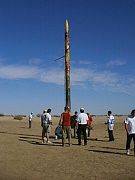
BFR
at Plaster Blaster - Jan.03
I was able to get it off the ground one week prior to my departure
to Iraq in January 2003 for nine months. I wasn't able to get
a good paint job done in time. I had my son and some of the other
club member kids have a painting party with and go at it.
The rocket achieved an altitude of 12, 357 feet and it was a
picture perfect recovery. When I returned in September 2003, I
was able to repaint it and launch it again. The first launch was
achieved with one N2000 (98 mm reload), two K700s (54 mm reloads)
and four J570s (38 mm reloads). All of them Aerotech motors. The
second flight in October 2003, it was launched with nine 38 mm
Caseroni Pro 38 motors and two J350 Aerotech motors.
The second flight was good, of course it didn't get too hi,
but being back from Iraq made it more worthwhile. We are scheduled
to go back in September 2004, so maybe there will be an Iraqi
rocket club sometime in the future while I am there :-)
I particularly liked this part of his message:
I was looking at the hobby space web site while I was in Iraq.
It was always nice to read articles from the site.
In a follow-up message he said:
"... When I had shown a magazine to an Iraqi man about my
hobby, he was very puzzled. He only thought that rockets were
used for war and nothing else. When I explained that rocketry
can be used for many helpful things, he thought that was good.
He hopes that something like that could be implemented for their
children with education and more in a peaceful way..."
Nuclear space navy... This
sounds like a great idea: Navy
May Help NASA Build Nuclear Reactor for Jupiter Mission - Space.com
- Feb.19.04. Despite all of the fear and sensationalism about
the dangers of nuclear power, the Navy continues to run numerous
ships with reactors and launching new ones all without anybody making
a big fuss about it. Though they don't have to deal with keeping
the mass as low as possible, surely they can offer some important
assistance to the development of safe and reliable space reactors.
Suiting up... Rand Simberg
notes that on-orbit assembly can preclude the need for development
of a huge and expensive new launcher for the new Moon/Mars exploration
program - Working
Hand In Glove - Transterrestrial Musings - Feb.18.04. He points
out that one technology area that needs work is "in developing
space suits that don't tire out the astronauts". He proposes
that NASA offer a portion of the money in its prize
funds to induce private firms to develop such suits.
Mitchell Clapp believes that when companies start actually working
in space, the technologies will develop out of that activity rather
than from NASA technology development programs: Where
There's A Will - Transterrestrial Musings - Feb.18.04
More space music... Alan Boyle
writes about the Pioneers of Mars song on the “To
Touch the Stars album: The
Martian anthem - Alan Boyle: Cosmic Log - Feb.18.04 -
In the article he also points to this interesting interview Answers
from Craig Woodson - Mars Millennium Project. Woodson responds
to questions about how sounds would be altered by the thin Martian
atmosphere. He also suggests that Martian explorers will surely
enjoy music making in their habitats and even build their own instruments.
News briefs... Some see good
prospects for space based businesses like advertising: Businessmen
say NASA can cash in on Mars visits: Execs tout advertising, other
money-making opportunities - HoustonChronicle.com - Feb.19.04...
... NASA responds to criticisms
of its decision
to dump the Hubble Telescope: NASA
Responds to Hubble Criticism - SpaceRef - Feb.18.04 ...
... This essayist recommends
turning Hubble over to a private foundation that can try to save
it with a low cost approach: Saving
Hubble: Putting privatization to the test.- National Review - Feb.18.04
Feb.18.2004
Space News
Space arts events... The latest
newsletter from Arts
Catalyst includes the following two items about upcoming events
involving space and the arts:
7th
Workshop on Space and the Arts -
"Space: Science, Technology and the Arts" ESTEC
ESTEC - ESA's European Space Research & Technology Centre in
Noordwijk, The Netherlands 18 - 21 May 2004
Organised by Leonardo/Olats and The OURS Foundation with the European
Space Agency and the International Academy of Astronautics - Commission
VI
Presentations are being solicited from space scientists, engineers,
technologists, artists, writers, journalists, art critics, curators
and philosophers.
The workshop on "Space: Science, Technology and the Arts" aims
to:
- provide a platform where new ideas/experiments relating to
the interaction of space science, technology and the arts can
be exposed and debated
- provide an environment where people, especially artists and
other culture professionals together with space scientists and
engineers can exchange
ideas and projects about space
- provide a meeting place where new space art and technology
projects can emerge and new teams and partnerships can be built
- nurture a domain of space activities that is becoming more
recognized in both the space community and in the mainstream
art world
- disseminate the ideas and projects by publicising the results
of the event
About 30-40 participants will be selected on the basis of a submitted
abstract of a proposed presentation.
Potential participants might like to consider submitting abstracts
for presentations addressing such topics as:
- the impact of space technologies on the arts and vice-a-versa
- the transfer of space technologies to art and design
- the role and involvement of space bodies in the arts
- designing art for the space environment - requirements, limitations
- synergies between the arts and space communities
- the interaction between space, arts and the public
- space and the new media arts
- using the arts to explore space
- the arts in orbit - use of the ISS for artistic and cultural
expression.
Authors need not, of course, limit themselves to these topics.
The deadline for abstract submission is 29 February 2004.
There is no charge for participation in the workshop, however
each participant will be responsible for their own travel and
accommodation expenses. A reasonably priced hotel with half-pension
has been reserved in the nearby town of Noordwijk and booking
information will be sent to all participants that are accepted.
This is an official European Space Agency sponsored conference
and the announcement is listed on the ESA
conference website.
In the meantime complete workshop details are available at: www.arsastronautica.com/texts/workshop.php
Information about the past 6 workshops on 'Space and the Arts'
can be found on the Leonardo/Olats web site: www.olats.org
Submission of papers to October symposium:
Call for Papers URGENT DEADLINE: Friday 20 February 2004
55th International Astronautical Congress
4 - 8 October 2004
Vancouver, Canada
Call for Papers
Deadline for Abstracts: 20 February 2004
IAA.6.16. 15th SPACE ACTIVITY AND SOCIETY SYMPOSIUM
Session: IAA.6.16.1. Sights and Sounds of Space
Space exploration has produced some of the most provocative and
captivating images of our time. Likewise, popular culture has
created its own images of space exploration which has made "space"
a powerful metaphor for the advancement of human achievement and
the human spirit. This session will bring together the different
characteristics and properties of space and examine the various
ways in which the theme and concept of space has found aesthetic
expression.
Sessions and events at the congress cover the whole spectrum of
space development and exploration.
For more information please visit the Vancouver
Congress website & International
Astronautical Federation (IAF) website:
How
to submit an abstract (pdf) - Abstract
form (pdf)
You can keep up with the latest in space arts at Ars
Astronautica Space Art News
News briefs... Amateurs continue
to make significant contributions to astronomy: Amateur
Astronomer Discovers Nebula - Sky and Telescope - Feb.17.04
The settlement cause
... Taylor Dinerman
makes the case that only a commitment to building a "new human
civilization beyond the Earth’s atmosphere" can justify and
sustain the new space initiative: The
Bush space vision and America's future by Taylor Dinerman - The
Space Review - Feb.17.04.
However, the proposition of
human settlements in space within the next few decades
is still not taken very seriously either by most policy makers or
the public. It's about where space tourism was before Tito came
along. I hope in this case, though, we don't have to wait till there
is an actual space settler before we can convince people that it
is not a crazy concept.
The major space advocacy groups agreed last
year to make space settlement their primary cause. By
bringing up the issue as often as possible and building a case for
it, they can gradually change public perceptions about it. They
will be assisted by the private
space projects that will start to prove over the next
few years that the cost of access to space can in fact come down
far enough for make settlement feasible.
News brief...
Speaking of the Space
Review, congratulations to Jeff Foust on its one year anniversary:
The
Space Review turns one by Jeff Foust The Space Review - Feb.16.04
Feb.17.2004
Space News
A great week for the SpaceShow...
Looks to be a special week for David Livingston. Tonight he will
talk to Walter Schirra, one of the famous Mercury Seven astronauts:
Tuesday, Feb. 17, 2004, 7:00-8:15pm PST, Space Show features
CAPTAIN WALTER M. SCHIRRA, JR., USN (RET.). Captain Schirra was
one of the original seven American astronauts, and logged over
12 days in space on three pioneering flights during the 1960's.
He is the only astronaut to go into space on Mercury, Gemini,
and Apollo spacecraft. Walter Schirra was chosen by NASA to become
an astronaut in 1959, while attending the Naval Test Pilot School.
This Sunday's show will be one that I'm particularly interested
in:
The Sunday, Feb. 22, 2004, 12:00-1:30pm PST, regular Space Show
features “To
Touch the Stars ,” A Musical Celebration of Space Exploration!
Joining The Space Show for this pre-recorded program will be Eli
Goldberg and Kristoph Klover, producers of this album, along with
Dr. Jordin Kare and Marianne Dyson, contributors to the album.
This particular Space Show Program is not live, however, should
you have any questions or comments for the producers or contributors,
please send them to me and I will make sure that the guests receive
them.
A special bonus show on Thursday will feature Greg Kerkx:
Thursday, Feb. 19, 2004, 1-2:30PM Pacific Time features a special
Space Show live recording session interview with Greg Klerkx,
author of “Lost in Space. Greg Klerkx as also written “The Fall
of NASA and the Dream of a New Space Age.” From 1997 until 2002,
Mr. Klerkx served as a senior manager with the SETI Institute,
the Silicon Valley based organization that uses advanced computing
and radio telescopes to seek evidence of intelligent life elsewhere
in the galaxy. Mr. Klerkx began his professional life as a journalist,
winning numerous writing awards as a reporter in Los Angels. He
now lives in London but continues to spend time on the West Coast.
The shows can be heard via streaming from Live365.com
SEI history revision...
A person who was at NASA at the time of the SEI says that the excerpt
given below
from Dwayne Day's article
contains some important factual errors. In particular,
"The Office of Exploration was not in existence when NASA's
'90-day study' produced the $400 Billion number; further, checking
with any of the principals [...] would have revealed that the
internal NASA JSC number was $100 Billion -- this number was doubled
by the comptroller at JSC and then doubled again by the Comptroller
at NASA Headquarters. These facts were then and are now widely
known with the space policy community in DC."
(I don't have a comments section yet, but if Mr. Day sends me a
rebuttal I'll be happy to post it.) My main point, though, that
the $400B number was wildly inflated is even more substantiated
by this version.
Mars can't win... There was
big disappointment in the 1960s when the first low resolution images
of Mars from the Mariner
flyby showed a Moon-like, heavily cratered surface. Since then,
orbiters have shown the surface to be quite spectacular and the
landers have shown their flat landing sites to look like the southwest
US.
To many people this has been a wonderful revelation. Mars is real
place where one can easily envision people someday visiting, staying,
and developing. However, as with this reporter - With
Close-Ups of Mars, the Mystery Gets Lost in Space - NY Times - Feb.17.04
- some wish for a more bizarre, alien surface. I expect there
are plenty of other moons and planets in the solar system that can
provide plenty enough of weirdness.
LUT campaign... The campaign
to save the Apollo
Launch Tower gets more publicity: On
Last Legs, Old NASA Tower Gains Supporters - NASA - Feb.17.04
See also Apollo
tower proposed as monument - collectSpace - Feb.17.04
(Note: Fred Becker is keeping me up to date with links on the campaign.)
News briefs...
Daphne Burleson dropped me a line to point me to her new
book: Space
Programs: Exploration and Research Efforts Outside the United States
by Daphne Burleson, 2004, McFarland& Co. ...
... More about the astronaut
perspective from space: Auroras
Dancing in the Night: Aboard the International Space Station, Expedition
6 Science Officer Don Pettit offers a unique perspective on auroras.
- NASA - Feb.12.04 ...
... Spending money in space
helps poor people on earth: Fishermen
get space guides - BBC - Feb.16.04...
... The challenges of debugging
from far, far away: Earthly
Software Rebooted Spirit - Wired News - Feb.16.04...
... Using satellites for transporting
big data dumps from remote locations: Canada
Funds Small Satellite Platform Demonstration - Space News - Feb.16.04...
... The marvelous IMAX film
Space
Station is now available for home viewing: IMAX
and Warner Home Video Announce DVD Release of Space Station - IMAX
- Feb.17.04
Feb.16.2004
Space News
Lies, damn lies and space costs...
James Oberg (
MSNBC - Jan.23.04 ) and Dwayne Day (Florida
Today - Feb.8.04) both wrote clarifying articles about the common
distortions in the media with regard to the potential costs of the
President's new space
initiative. Typically, the critics base their estimates
on the $400 billion dollar pricetag that NASA put on the Space
Exploration Initiative, which was proposed in 1989 by the previous
President Bush. Since then this number has become the favorite sledge
hammer to bash any proposals for space projects beyond the ISS.
Dwayne Day has now written an informative history of previous space
initiatives: Aiming
for Mars, grounded on Earth: part one - The Space Review - Feb.16.04.
He provides a detailed background of what led up to the SEI proposal
and how the huge price estimate was quickly invented by an agency
that opposed the initiative:
In early July, before any plan had been fully explored or endorsed
by the president, NASA Headquarters had produced a preliminary estimate
of the costs of both a lunar base and a human mission to Mars. This
estimate was produced by the Office of Exploration and included
such things as modifications to Space Station Freedom and development
of the Shuttle-C heavy lift launch vehicle. The 30-year plan had
a price tag of nearly $400 billion, which also included robotic
probes for lunar and Mars missions. Approximately half the cost
was for the Mars mission ($172.9 billion) and assorted scientific
probes ($13.85 billion), and the remainder for a lunar base ($209.46
billion). These numbers also included a 50% reserve—meaning that
after all of the items were added up, the agency added an additional
50% on top. The totals were removed from the document, although
anybody with a calculator could add them up.
This preliminary estimate included many programs that were not
necessary for the exploration plan and could be eliminated if
they were not desired, although they were not presented that way.
The estimate was in essence an agency wish list. Nevertheless,
it existed as a piece of paper with some very large dollar figures,
which made it a dangerous piece of paper, for the numbers could
be copied and leaked to the press and Congress and used to attack
the plan. That is what happened.
I had read several times that the $400B number was bogus. It's
nice to have now a reference that confirms this. ...
... Furthermore, even this
huge number is a sum over 30 years. Summing both capital and operating
costs over an arbitrary length of time is a common trick for attaining
a huge number to use against a government program. It is always
used with space projects. For example, this is how the ISS cost
comes to $100B. (The ISS may or may not be worth a fraction of that.
I just don't think this number is meaningful.)
That is fine in principle as long as it is applied to all programs,
not just those in space. Scientists should be particularly careful
about using this technique against human spaceflight projects. It
can very easily turn a proposed $1B accelerator, neutron source,
or space science spacecraft into a several billion dollar project.
Furthermore, such numbers should be seen in context. The US currently
has a $11 trillion GDP. Over 30 years this accumulates to $523 trillion
assuming a 3% yearly growth rate and constant dollars. For the 30th
year the GDP equals $26 trillion. The current federal budget of
about $2.3T grows to $5.4T by 2033 and accumulates to $109T. (Try
to keep these numbers in mind with regard to the deficit as well.
A $500B deficit is 4.5% of the GDP - not far from the deficits in,
for example, France/Germany, which have high tax rates plus ~10%
unemployment.)
In last weeks hearing of the Moon-to-Mars
commission one discussion involved the question of whether $150B
was enough to fund the new initiative. Lack
of Cash Could Doom Mars Plan - Wired - Feb.13.04 This makes
little sense since this is just a sum of the current NASA budget
of $15B for 10 years. Less than half of NASA's budget currently
involves human spaceflight, although the plan is gradually to remove
the distinction between the human and robotic programs.
There's certainly a requirement for the public and Congress to
ask for the cost of space programs and to demand that it be as honest
an estimate as possible. But it is also important that the numbers
thrown about be serious ones that are put into perspective and proportion,
and not just inflated for sound-bite shock value.
Space fan fiction video...
I try to avoid items about Star Trek type sci-fi, even though I
I enjoy it, because the point of HobbySpace
is to promote the idea that our future in space can be just as exciting
as that presented in these programs, even if faster-than-light travel,
visits by aliens, etc. never happen and we only have a vast solar
system to enjoy.
However, I sure wish that the excitement and energy inspired by
such programs could be channeled into Solar
Sci-Fi. For example, since it doesn't look likely that
there will soon be a TV program or movie based on a realistic near-term,
space exploration scenario, maybe some amateur group will create
one the way that fans are now making Star Trek inspired videos.
The Starship
Exeter amateur production of a STOS (Star Trek Original Series)
style episode has been very popular and it looks like they will
do another.
Today I learned about the Star
Trek: New Voyages fan fiction and high production value video
series that treats Kirk, Spock and McCoy as written characters (similar
to the way that James Bond is treated). They will be portrayed by
different actors each giving their own interpretation of the character.
They don't do impersonations of Shatner, Leonard Nimoy and DeForest
Kelly. Online
'Star Trek' goes to aid of Columbia crew's children -Indystar.com
- Feb.16.04 (via spacetoday.net)
Music to move a Mars rover ... In
the latest Prometheus
Music newsletter comes this news from Eli Goldberg:
I thought you'd all want to know that we just learned from Lisa
Lees that NASA/JPL selected "Pioneers of Mars" from the To
Touch the Stars CD to wake up the Opportunity Mars rover
for sol 20!
According to the Mission
Status [at the time. The status reports don't seem to be available
in an archive.... Feb.17.04: see the archive
at Space.com]
The sol's wake-up music was "I Like Dirt," by the Red Hot
Chili Peppers, and "Pioneers of Mars," by Karen Linsley and
Lloyd Landa.
This is exciting for an abundance of reasons. Many of you may
know that Karen's co-author and partner, Lloyd, died tragically
days before the song was debuted to a standing ovation at the
Mars Society conference in Toronto.
After that performance, Karen exclaimed in tears, "Get to Mars.
And then the notes of this song are heard on Martian soil, he
will live again."
(Rover wake-up music is not actually radiated to Mars, but is
played over the voice net, where it is typically heard by most
of the on-shift team for both rovers and at the Deep Space Network
station. Songs are typically popular tunes that relate to the
rover's planned activities of the day.)
We do not yet know who was responsible for honoring Lloyd's memory
in playing this song --- I sent copies to two people at JPL, and
Dr. Zubrin e-mailed a third --- but we are deeply appreciative
of it.
Mars music contest...
In its latest bulletin, the Mars
Society also noted the playing by JPL of the "Pioneers
of Mars". This song was the winner of the first Rouget de Lisle
Award contest sponsored by the Society in 1999. (Robert Zubrin was
also the force at NSS that led to the original Apollo Pro-space
music contest in 1997 that in turn became the original impetus for
a space music CD.)
Now the Society looks to repeat its success:
In view of the success of the Prometheus Music "To Touch the
Stars" CD, the Mars Society is proud to announce that it will
hold its Second Rouget de Lisle Award contest for songs celebrating
the cause of the human exploration and settlement of space.
We are asking for a tape or CD of songs, to be submitted together
with a hardcopy of the lyrics by no later than April 30, 2004
to Mars Society, Box 273, Indian Hills, CO 80454. Songs can be
any style; classical, folk, country, pop, jazz, rock and roll,
etc. A committee of judges will then down select to ten finalists,
who will be invited to play at the 7th International Mars Society
Convention, Palmer House Hilton, Chicago, IL, Aug 19-22 2004.
The audience will then vote for the winning songs. All finalists,
however, will submitted to Prometheus Records for consideration
for its next CD, and will also be forwarded to NASA for possible
use as wakeup songs for crews of the International Space Station,
the Mars Rovers, and the Cassini spacecraft which is now approaching
Saturn!
So tune up your harps, space bards, turn in your songs and prepare
to turn out for Chicago. Let your voices ring out into the solar
system. Mars needs music, and the Chicago conference is going
to be the Woodstock of Mars!
Feb.15.2004
Space News
Rocketry rover contest... Check
out the innovative Lander
Challenge contest now getting underway.
"Lander Challenge requires a competing team to launch a
sport rocket containing a simulated lander, to safely land the
lander, and to deploy a rover. The rover must then be remotely
navigated to a predetermined spot on the flying field."
The goal is to "encourage our junior, senior, collegiate and
even our adult hobby enthusiasts to learn more about rocketry and
space science."
Better get your mini-space explorer program off the ground soon.
Contest deadline is June 30th.
(Thanks to J. P. Anderson for this item)
Feb.14.2004
Space News
Moon dog envy... Check out
the very amusing Dog
on the Moon song by Garry Novikoff now available
on line (via Real Audio stream from Prometheus
Music). The song is one of 17 on the new To
Touch the Stars album.
News briefs ... SaveTheLUT.org
making progress: Apollo
Launch Tower Campaign Has Kicked Into High Gear - SpaceRef - Feb.13.04
...
... This Space
Station Sim at GRS Games is in development for release in December:
GRS
Games Develops Space Station:Sim with NASA Space Act Agreement -
GRS Games - Dec.15.04 (links via NASA
Watch) ...
...Another space debate: Mission
to Mars or Mission Impossible? Panel discussion - Georgetown Univ.
Law Center - Tuesday, Feb.17.04 (via Transterrestrial
Musings) ...
... ESA's SMART-1
lunar spacecraft continues its slow but steady trek to the Moon
via ion propulsion. SMART-1
Payload Commissioning - ESA - Feb.13.04. Click on "Orbit
View" in the menu on the homepage
for a nice applet display of the craft's current position. ...
... Check out the beautiful
and clever picture of Mars in the sky last summer: Amateur
Shoots Mars "Picture of the Year" - Sky and Telescope
- Feb.13.04 (via spacetoday.net).
...
... More about the solar
system internet development: Interplanetary
International Internet Launched - Space.com - Feb.12.04
...
... Yet more great Mars
Express images: Olympus
Mons - the caldera in close-up - ESA - Mars Express - Feb.13.04.
To see an applet display of the Mars Express orbit, go to the Mars
Express homepage and click on "Orbit View"
Feb.13.2004
Space News
Private Mars expeditions... I
should qualify my proposition below
that by 2025 a privately organized Mars mission could be feasible.
I'm not talking about tourist trips but exploration types of missions
like the North/South Pole expeditions of the early 20th century.
In this case, the missions would probably be funded by NASA, perhaps
with prizes
as has been suggested, e.g. $10 Billion to the first organization
to put a crew on the Martian surface and bring them back safely.
Space shelf stocker... Below
(see Filling Shelves)
I talked about NASA's nurturing of a space industry infrastructure.
Here is an example - A
company thrives in space: Its coatings are used by makers of Mars
landers (as well as Mars candy) - NJ.com - Feb.13.04 - that
I came across via spacetoday.net.
During the Apollo days, thousands of small companies like this one
formed to supply NASA directly or subcontracted to NASA's major
contractors. With the post-Apollo downturn, a great many such small
firms either died or shifted to other lines of work.
I'm hoping that a revived exploration push at NASA would in turn
trigger a new round of small company creation. In particular, I
would advocate that NASA contract out much more than it ever did.
No reason, for example, not to turn over LEO access, both for cargo
and passengers, to private contractors.
News briefs... A review of
the possibilities for a human spaceflight program in Japan: A
Capsule For Japan - Spacedaily - Feb.13.04...
... After some tough
years, it's nice to see the Space Camp program making
a comeback: Space
Camp enrollment taking off - Huntsville Times - Feb.13.04 (via
spacetoday.net)...
... The BBC discovers the space
memorabilia market: The
'holy grail' of autographs - BBC - Feb.12.04 ...
... I bet in the coming weeks
as the rovers rove, they will find many Mars mysteries like this
one: Mystery
Continues: Scientists Baffled by Spheres on Mars - Space.com - Feb.12.04
Hearing space ... Keith Cowing
reviews Wednesday's meeting of the Moon-to-Mars
commission in Congress
Expresses Enthusiasm and Doubt About New Space Policy - SpaceRef
- Feb.12.04. Too much conventional and corporate thinking for
my tastes. Hope future meetings get spiced up more with speakers
from the alt.space community and dynamic space startups.
Sports cars & rockets... Michael
Mealling at RocketForge
offers some interesting views of his own about the hearing: Comments
On The First President's Commission Meeting - RocketForge - Feb.12.04.
I particularly appreciate his comments on the need for exciting
projects to attract young people into technical fields. Math and
science careers require students to work like crazy for years and
years and to deal perpetually with delayed gratification. All the
while they see friends having a lot more fun. So why bother?
Michael suggests that a vibrant, growing commercial human spaceflight
industry will attract kids who will want to pursue studies that
will allow them to participate and to build lucrative careers. This
sounds like a real possibility to me. On the short term I expect
the X PRIZE competition to get the attention of a lot of young people
and change their views about space. While Star Trek may now seem
dorky, riding a real rocket to 100km will be the coolest experience
around.
The inspiration effect alone of exciting projects shouldn't be
discounted. I remember years ago reading an article about Chrysler's
resurgence as an automaker. The company had regained profitability
based on innovative and exciting designs. One particularly odd practice
of the company was its production of high end sports cars. The reporter
asked a Chrysler vice president why they bothered to make cars like
the Dodge Viper since the number produced was barely enough to break
even, much less add significantly to the bottom line.
The VP said that such projects were crucial because they got the
engineers excited and enthusiastic once again about building cars.
This inevitably had a positive effect when they returned to designing
family sedans. (It should be noted that several other mainstream
carmakers returned in the 1980s and 90s to supporting racing teams
for similar reasons.)
Parents, teachers, and politicians constantly rant about the need
to get kids to do better in math and science. Yet as the polls for
the space initiative indicate, those adults express only lukewarm
enthusiasm for those areas themselves. (Do as I say, not as I do.)
Until society recognizes the connection between exciting long term
scientific and engineering projects and the attraction of kids into
technical fields, then students will continue to succumb to the
lure of the more glamorous attractions of sports and music as Michael
talks about.
Feb.12.2004
Space News
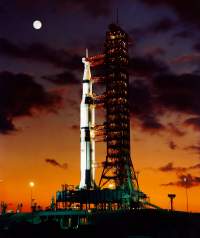
Save
the Apollo Launch Tower
Filling shelves... John Carter
McKnight starts with the policy hoax theme in The
Imperial Martian Wardrobe - Spacedaily/Spacefaring Web - Feb.11.04;
a theme that Rand Simberg dispenses with nicely in the article
mentioned below. However, I agree with the second half of McKnight's
essay in which he proposes that it will either be private projects
that reach Mars or we probably won't go at all. There just isn't
the deep level of interest and support by a majority of the public
for human spaceflight that is necessary to sustain such a big government
program over a such a long period. (See my essay.)
If privately financed projects manage to develop a vigorous LEO
industry within 10-15 years, which I argue is quite likely (see
one possible timeline),
then going on from there to the Moon and Mars is definitely feasible
by 2025 or so. They will do it in a way that is much smaller, cheaper
and flexible than a NASA program. (As others have pointed out, how
can a NASA that is afraid to service the Hubble become an organization
that is willing to take the risks and gambles needed to go to Mars?)
However, I disagree that the new initiative won't make major contributions
to this evolution in capability. Mr. McKnight says that "We'll
get there when exploration can take advantage of off-the-shelf technologies,
just as exploration has usually done in the past." But, as
I've argued before, somebody needs to fill those shelves to begin
with. In fact, someone needs to build and maintain the shelves themselves,
which represent the infrastructure of companies, engineers, technicians,
etc. that can supply and support such technologies.
A NASA focused on deep space will necessarily develop both this
infrastructure and a wide range of technologies that will benefit
others, even if it never gets a chance to use them itself. Areas
where NASA funding will be enormously helpful include development
of improved radiation shielding (optimized for effectiveness and
low mass) for the spacecraft, in
situ resource utilization methods for Mars bases, a planetwide
communications infrastructure with a network of orbiters (the Rovers
already are taking advantage of the current orbiters to communicate
with earth), and so forth.
As indicated below, I'm optimistic that even with a new administration,
NASA will continue on a process of renewal and significant change
brought about by the impetus of the initiative. I believe space
development is going to benefit greatly because of it, though it
may be in a more indirect manner than NASA expects.
News briefs... Satellite radio
looking strong: XM,
Sirius Giddy About Growth - TheStreet.com - Feb.12.04 - XM predicts
20M subscribers by 2010....
... The educational benefits
of a vigorous space program are not nearly appreciated enough: Fly
Me to the Moon...And on to Mars - FOXNews.com - Feb.12.04 *
Students
Prepare for Spirit's Crater Rim Run - Space.com - Feb.12.04
NASA: dressed up but no place to go?
By next January 20th, NASA will have changed significantly and irrevocably
by President Bush's new space
initiative. Even if it is Kerry who gets sworn in, he
will not be able simply to tell the agency to go back to the way
it was.
The initiative, unfortunately, came during the primary campaign
season and also at a time when the deficit appeared as important
issue. So a Kerry administration will quickly disavow it because
of its close affiliation to Bush and loudly proclaim that they have
no intention of sponsoring human missions to Mars or the Moon.
However, they will then be stuck with the question of what exactly
to do with the human spaceflight program. NASA will have already
canceled several programs, started several new ones, put the shuttle
on a short road to retirement, and in general reorganized and reoriented
itself for long term deep space exploration and development.
For the new JFK to cancel the whole human spaceflight program seems
out of the question. On the other hand, it will be wrenching, to
say the least, for the agency simply to be told to focus again on
the ISS and nothing else. Morale would obviously be devastated.
Besides, there would still be the question of LEO transportation.
Deciding to keep the shuttle going past 2010 will be untenable.
Yet approving a new vehicle system requires a compelling long term
case for human spaceflight that goes beyond access to the ISS.
There are many variations on the space policies a Kerry administration
would follow and it will be very interesting to see what happens
if he does win. Remember that Congress will almost certainly be
under Republican control, and probably even more tightly than now,
so that will limit his options (on everything) to some extent. My
guess is that after a long period of indecision and uncertainty
(and after finding a new administrator), the basic outline of the
initiative will remain but under a new name and with some variations
here and there to make it look different. Moon and Mars missions
will still be held as as goals but on a much longer term.
I listened to some of yesterday's hearing by the Moon-to-Mars
commission. The panel and the witnesses also emphasized the
problems of maintaining a vigorous program over a long period through
different administrations - Bush's
Space Vision Team Holds First Public Meeting - Space.com - Feb.11.04
- especially since public support is underwhelming at best.
One aspect of the initiative that will definitely be in trouble
under a Democratic administration is the nuclear propulsion and
power program (e.g. Reactor
research to power journey to Jupiter's moons - Spaceflight Now -
Feb.11.04) Tom Stafford in his presentation emphasized that
nuclear propulsion should be a top priority since it allows for
much faster trips to Mars, which in turn lowers costs significantly
for a manned mission (e.g. fewer supplies required.) A nuclear power
generator on the planet's surface would also be a tremendous resource
for a Mars base. However, antinuclear sentiments are extremely strong
in the Democratic base and the program would almost certainly be
eliminated.
News briefs... Rand rebuts
the space initiative hoax accusations: The
New NASA Moon Hoax - Transterrestrial Musings - Feb.11.04 ...
... The images coming from
the Mars Express are truly gorgeous: Valles
Marineris Region - ESA - Feb.11.04 ...
... This article tells how
they made the highly detailed simulation of the re-entry and landing
of the Mars rovers: Digitally
Directed, The Mars Missions - Astrobiology Magazine - Feb.11.04
...
... A space poem: I
dreamt I had to go to Mars by Jippo
Feb.11.2004
Space News
Alt advice... Keith Cowing
at NASAWatch.com
urges NASA to get a clue about the alt.space community. He says
they are "here to stay". (See item for Feb.10 about the
article Rocket
Man in the Christian Science Monitor). This is encouraging since
I know that Keith himself over the years has expressed skepticism
towards the private space projects and especially to some of the
statements from Rick Tumlinson who came up with the alt.space term.
Credibility is growing as projects move from vaporware to hardware.
The
SpaceShow this Sunday, Feb. 15, 2004 will feature
Steven Wolfe a noted author and former legislative aide for space
policy who drafted the Space Settlement Act of 1998 (contained in
P.L. 100-685) Mr. Wolfe's writings appear in The New York Times
and elsewhere. Mr. Wolfe will be discussing space exploration and
the proposed new space policy put forward by President Bush for
returning to the Moon and going to Mars with manned missions.
The Save
the Apollo Launch Tower petition
is now up to 4355 names.
Mars project leader goes sci-fi... The
Sci-Fi
Experience museum in Seattle, funded by Paul Allen, has hired
Donna Shirley
as its director: Real
rocket scientist to head sci-fi museum -seattlePI - Feb.11.04
(via spacetoday.net)
News briefs ... The President's
Moon-to-Mars commission,
mentioned below, is holding a hearing today that's streamed on line.
See their web page for the link....
... The limited range of Mars
explorers, discussed yesterday,
could be expanded with Exploring
Mars With Balloons - SpaceDaily - Feb.11.04....
... See the discussion
at Transterrestrial Musings of my retrospective
on Dwayne Day's critique
of MirCorp and potential space based businesses back in June of
2000. Dwayne was not impressed...
... A web site has become available
for the commission that will monitor NASA's progress in developing
its deep space exploration program: President's
Commission on Moon, Mars and Beyond (via Jon Goff)...
... Details of the earth-Mars
communications system: The
100-Million-Mile Network - eweek.com - Feb.10.04...
... Info on the making of the
3-D Mars images: How
3-D Works: Mars Revealed by Human-Like Eyes - Space.com - Feb.10.04
Feb.10.2004
Space News
The plain parts... This article
- So
close and still so far: Why the best parts of Mars are still out
of reach - Boston Globe - Feb.10.04 - deals with something I've
also wondered about. For safety and practicality, the Mars landers
have all gone to very flat areas of Mars. The public no doubt will
come to think that all of Mars is like that. However, we know from
orbiter
images that Mars has some of the most spectacular and dramatic
landscapes in the solar system. Unfortunately, none of the near
term missions look to have rovers or balloon/airplane vehicles that
can travel really long distances from a safe landing spot to the
wild parts.
News briefs... Why the colors
look a bit funny: How
the Red Planet Came Down With the Pink Blues - NY Times - Feb.10.04
...
... NASA stubbornly holds firm:
NASA
defends decision to cancel HST servicing mission - spacetoday.net
- Feb.10.04
Feb.9.2004
Space News
Choir practice... Jeff Foust
provides his impressions of the Park-Zubrin
debate : Seeking
a rationale for human space exploration - The Space Review - Feb.9.04.
He gives more points to Zubrin but basically says that each preached
to his respective choir and probably didn't change anyone's mind.
Jeff's broader point is that space advocates need a more powerful
argument, or set of arguments, to convince those outside of the
relatively small group of space enthusiasts that government human
spaceflight programs are worth the cost. I agree that it would be
great to have an overwhelming obvious benefit that we could point
to and not have to appeal to historical analogies (e.g. Jefferson's
dream by Jeffrey E. Brooks - The Space Review - Feb.9.04) or
a sense of adventure and faith in the future.
However, as I've proposed,
we won't win over the public with more clever debating tactics but
from real rockets and spacecraft built by private organizations
that fly and prove that spaceflight is practical, promising,
and not impossibly expensive. These projects, especially suborbital
RLVs, will convince the public that space is not just for astronauts
and that a much, much larger number of people will participate directly
in spaceflight. The dawning of that revelation will be far more
electrifying than even the most entertaining performance by Robert
Zubrin.
... A HS
reader had this to say about the debate:
"I enjoyed the debate between Zubrin and Park. I agree that
Zubrin had the upper edge though I too might be a bit biased.
Being a professional in the field of conflict resolution (police
officer for over a decade), I would like to offer a simple clarification
that rectifies both positions. Mr. Park is correct that there
should be no manned space program. At least there should not be
one for him. Just as there is a segment of society that should
not be given drivers licenses, Mr. Park and those who share his
mind set should not be allowed off of the earth. They would be
a danger to themselves and those around them."
Spacefaring alternatives or NASA bash...
The new book Lost in Space : The Fall of NASA and the Dream of
a New Space Age by Greg Klerkx (Amazon
commission links: US
UK)
gets divergent reviews:
Sure sounds like a book I would more agree with than not (I ordered
it today.) There's one thing that annoys me, though. If a nickel
went to the space effort for every book, article, and op-ed with
"Lost in Space" in the title, we could pay for a trip
to Mars in no time.
Saving the tower... NASA has
postponed the scrapping of the Apollo launch tower while campaigners
for its preservation try to come up with a feasible plan to raise
the $40M to restore it: NASA
delays tower destruction: Preservationists will try to save historic
pad - Florida Today - Feb.7.04 * Slashdot
posting. (It's a shame that NASA had not put a cover over it
years ago to protect it at least to some degree from the elements.)
News briefs ... Rocket Jones
is posting a series on building a model rocket: Build
It Archives - Rocket Jones - Nov.03-Feb.04 (via RocketMan
blog.)....
... Try out the Desktop
Rover at Plantraco...
... More on Hubble rescue options:
Anonymous
Documents Describe Shuttle Hubble Mission Risks - SpaceRef - Feb.8.04
...
... Taylor Dinerman says spysats
are not to blame: Intelligence
failure: spies and satellites - The Space Review - Feb.9.04
Feb.8.2004
Space News
Honest accounting... Dwayne
Day, space analyst and former regular on the sci.space newsgroups,
provides an excellent rebuttal to Alex
Roland and others who have blatantly distorted the goals and
costs of the new US
space policy: Debate
on Bush space plan has been loaded with falsehoods by Dwayne Day
- Florida Today - Feb.8.04
More accounting ... Mr. Day
made some monetary predictions of his own a few years ago in Chasing
profits in the void: MirCorp's economic success highly unlikely
by Dwayne A. Day - Florida Today - June.16.00. The article examined
the potential of various space business proposals that MirCorp,
as well as many advocates of space commercialization, had proffered
as potential revenue sources from a private space station.
As Day predicted, MirCorp did not prove viable. However, this was
due to the deorbiting of Mir by the Russians, under heavy pressure
from NASA, and not because its space businesses failed to produce
revenues. The company never really got a chance to implement its
business plan.
The one space business that MirCorp did manage to kickstart was
space tourism. It is interesting that the article is dated the same
day that the Wall Street Journal announced that MirCorp would arrange
for Dennis Tito to go to Mir. (I believe Day's article actually
came out earler in a rougher draft.) The deorbiting of Mir led Tito
to change his flight to the ISS and also to work with Space
Adventures instead of MirCorp. Nevertheless, MirCorp can get
credit for getting the mission off the ground.
Tito obviously proved that there was, and is, a market for space
tourists, even for tickets in the $10-20M price range. Space Adventures
has indicated that the number of potential ISS visitors is currently
around a dozen. So, "Likely revenue: Zero.", actual revenue:
$40M and growing.
Walt Anderson, a founder of MirCorp, subsequently teamed up with
Dennis
Wingo to form Orbital
Recovery, which, along with some European partners, is developing
a space tug to dock with and maintain comsats that are running out
of station-keeping fuel. (The company also would like to save
the Hubble Telescope.)
This relates to the issue of satellite repair and assembly in orbit
that Day mentions in his article. ("Likely revenue: Zero.")
Dennis Wingo worked for a couple of years with NASA to develop his
SkyCorp
plan to assemble and launch a constellation of small, low cost satellites
from the ISS that would provide internet services worldwide. They
would use the super high efficiency of electric ion propulsion to
reach a wide array of orbits without, as Day worries, having to
"change the laws of physics."
While Day claimed there was "no reason to assemble a satellite
in space", this is just wrong. A big portion of the cost and
time that goes into making a satellite is for tests (e.g. on a paint-shaker
device that vibrates the crap and everything else out of it) and
redundancies so that it will survive the tremendous stresses of
launch. With assembly and testing in space and then gentle acceleration
by ion propulsion, much of this cost can be eliminated.
With the Iridium/ICO/GlobalStar/Teledesic failures along with the
recession throughout the telecommunication industry, SkyCorp could
not raise the money for building the constellation. However, the
project helped to advance the concept of orbital assembly and it
looks valid and quite promising. (Orbital Recovery apparently developed
out of this project.)
Most of the other potential space businesses discussed in the article,
such as space advertising, show promise as well, especially as supplemental
income for space enterprises. (Except for work paid for by NASA,
I tend to agree that "Private scientific and pharmaceutical
research" won't be much of a money maker.) I hope to come back
occasionally in the coming years to Mr. Day's article and review
their progress vs. his predictions.
Progress near space ... Alfred
Differ of JP Aerospace
is providing regular updates on the development of the companies
prototype high altitude airship for the Air Force: Alfred
Differ - JP Aerospace Diaries - Frontier Files Online * NearSpaceManeuveringVehicle
- FFO - Images * Build
A Little - Test A Little: Away 24 by Alfred Differ - SciScoop -
Jan.31.04 (Links via K.Kaido)
Mars rocks, there and here...
While rovers examine rocks directly on the Red Planet - First
grinding of a rock on Mars - JPL - Feb.6.04 - there are still
scientists on earth still looking at Mars rocks here and finding
interesting results: UQ
researchers edge closer to question of life on Mars - UQ News -
Feb.5.04 * It's
Confirmed: Life Existed on Mars! - Roland Piquepaille - Feb.5.04
(Links via reader J. Rusi.)
News briefs... Another potential
revenue source for satellite TV companies: Samsung
to put satellite TV into cell phone: Company plans handset that
can receive multimedia programming broadcasts via satellite - InfoWorld
- Feb.06.04 ...
... At the end of his book
review - System
Failure: Two veteran journalists investigate a national disaster.
Reviewed by James Trefil - Washingtonpost.com - Feb.8.04 - James
Trefil nicely puts space accomplishments into their proper perspective....
... It seems to be coming a
tradition for spacecraft to receive their names from young people:
Daring
comet lander named Philae: The small robotic probe that Europe is
despatching to land on a comet has been named "Philae"
by a 15-year-old girl. - BBC - Feb.6.04
Feb.7.2004
Space News
Mars Debate: Humans vs. Robots ...
The transcript
for the Robert
Zubrin vs. Robert Park Debate last Thursday has now been posted.
I'm obviously totally biased but it sure seemed to me from reading
the transcript that Zubrin was the clear winner.
For example, I particularly liked this exchange after a geologist
questioned Park on whether a robot could replicate the capabilities
of a human field geologist:
Park: ...But in fact, I have been on missions with geologists.
They use the hands. They don’t have those hands when they’re locked
in a space suit. They’re looking through a visor. They’re hands
are - if you watch them use tools, they’re almost as limited as
my hands.
It’s not the same thing at all. You can’t pick a rock up and
heft it, you don’t get any feel of its composition, any sense
of hardness or texture. These things are all missing in a spacesuit.
If you can get the guy outside the spacesuit -- Terraform it
first, I guess.
DR. ZUBRIN: Well, before we terraform Mars, a simpler
-- a simpler approach is just to bring the rock inside the hab.
And then you can hold it in your hand, and look at it, and do
absolutely everything that a field geologist on Earth can do with
it.
Zubrin's answer is obvious and any scientist who was actually thinking
objectively about the issue would immediately see it. But Park is
so intent on ridiculing the need for humans in space, and coming
up with little cheap shots to slam it, that the obvious zooms right
past him.
Alan Boyle doesn't choose a winner - The
great space debate - Alan Boyle: Cosmic Log - Feb.6.04 - and
notes that the audience seemed a bit tilted towards NASA types.
I hope we will hear reports this week from others who were present
to provide a broad array of perspectives on the debate.
Ham tunes in Mars Express...
I knew that some German hams had used a 20m surplus space radio
dish to pick up transmissions from the Mars Express spacecraft while
it was in route: AMSAT
P5-A ground station successfully receives ESA's MARS-EXPRESS Probe
- AMSAT-DL - Nov.2003.
However, I've just now discovered that a radio amateur - Charles
Suckling, G3WDG - used a small dish (3m) to pick up sigals in December
just as the spacecraft reached Mars: Reception
of Mars-Express by G3WDG - AMSAT-DL. Since then he has heard
it in orbit and also picked up the Mars Odyssey spacecraft: Mars
Express / Mars Odyssey Reception by G3WDG and G4KGC. More details
available at Mars-Express
reception by G3RUH - AMSAT-DL - Nov.24.03.
This is good news for the AMSAT
Phase 5-A Mars mission. The biggest challenge of that mission
is not in reaching Mars but in developing a worldwide system of
hams who can maintain contact with the spacecraft.
Feb.6,
2004 Space News
The Spaceshow
this Sunday looks interesting:
The Sunday, Feb. 8, 2004 Space Show features Chip Proser, well-known
writer, director, cinematographer and film producer film, television,
and interactive media. Mr. Proser has either created, wrote, produced,
or directed numerous films and documentaries, including many having
to do with space. He has filmed space conferences including conferences
for the Space Frontier Foundation, he wrote for MARS Run for HBO,
and has won significant awards, including Emmy Awards, the Hatch
Award, a Peabody Award, and much more. Mr. Proser will be talking
with us about the reality of making space themed movies and entertainment,
as well as his latest work involving a documentary film on global
warming, climate change, the energy crisis and the solutions,
all involving the exploitation of space and colonizing of the
moon.
Please visit his website for full screen credits and more at
stickymedia.com/scripts.htm.
Listeners can ask questions, communicate, or chat with Mr. Proser
by calling toll free 1 (866) 687-7223, or by using dmlivings@yahoo.com
or drspace@thespaceshow.com. You can also use AOL IM/ICQ by using
the ScreenName "spaceshowchat."
Available via web streaming at www.live365.com/stations/dlivingston?site=dlivingston
Check out the Serenity
Base collaborative sci-fi project.
Mars briefs... Keith
Cowing posted this hilarious
animation that someone at NASA sent him ...
... After a serious illness,
it's nice to see Ray Bradbury up and giving a spirited defense of
space exploration: An
Interview With Sci-Fi Legend Ray Bradbury - FOXNews.com - Feb.5.04
...
... More serious Mars animations
and videos are available at Discovery
Channel :: Video Animation of Mars Rover and at JPL
Mars animations ...
... It's fun to spin fantasies
about some of the more bizarre
Mars images delivered over the years by the various orbiters
and landers, but you shouldn't take them seriously: Mars
Mirage - TCS: Tech Central Station - Feb.6.04 ...
... This report at the Planetary
Society gives a good overview of what's been happening with the
landers: Spirit
Suffers Minor Set-Back; Opportunity Finds Features "Unlike
Anything Seen on Mars," and Begins Trek to Outcrop -Planetary
Society - Feb.5.04 ...
... Future Mars exploreres
may communicate on the surface of Mars via Wi-FiI: Wi-Fi
Enters the Space Race - Wired - Feb.6.04 (see more about the
Space
Internet).
News briefs ... The transcript
of the big debate last night - Zubrin
vs. Park Debate - EPPC - Feb.5.04 [will be posted next week]
...
... While nowadays most people
know about direct-to-home satellite TV, I like to point out that
modern (post 1960s) cable TV was created by satellite delivery of
programming to local cable TV providers. Even today with high speed
fiber, satellites still provide a very competitive sevice: Cable-TV
satellite launches into orbit: Expect more high-definition - Florida
Today - Feb.6.04 ...
... Maybe even Britain will
wake up one of these days and begin a manned space program: Space
- the UK's financial frontier - Scotsman.com - Feb.6.04 ...
... Edgar
Mitchell responds to postings on his bulletin
board.
Feb.5,
2004 Space News
News briefs ... Here's a plug
for one of my main advertisers - SpaceToys.com
- Check out the beautifully detailed replicas
of the Apollo capsule, Mercury, Gemini, etc.
...
... The latest crew at the
Mars Society's Desert
Research Station reports on their work with construction techniques
and other projects: Mars
Desert Research Station, Mission Summary, Crew 22 - The Mars Society
...
... Research on lightweight
radiation shielding is good work for NASA: Fire
Away, Sun and Stars! Shields to Protect Future Space Crews - NASA
- Jan.14.04
Feb.4,
2004 Space News
Space permanence... The International
Space Station has disappointed even most space activists
and contributes only a small part to the projects planned in the
new space initiative: From
Glory to Sideshow: The Space Station's Story By William J. Broad
- NY Times - Feb.3.04.
I suggest that one everlasting contribution that it could make
to history is to become the place where permanent human residence
in space began. The President, in coordination with the other ISS
partners, should make a formal commitment to insuring that from
this time forward, there will always be humans living away from
earth.
I believe that the Russians hoped that Mir would be that starting
point back to where human space populations would trace their development.
Stupidly, NASA got them to dump that spacebreaking settlement into
the ocean. Here's a chance finally to make a beachhead from which
we will not withdraw, ever again.
Senior citizen countries in space...
As the European and Japanese populations grow older and older, the
assumption follows that they will take fewer and fewer risks and
avoid exciting, long range projects like exploring and developing
space. However, maybe there is hope yet for the old fogey nations:
Some people, though, will encourage them just to stay at home and
work in the garden: Letter
From Asia: This 21st-Century Japan, More Contented Than Driven -
NY Times - Feb.4.04
Budget items... The 2005 NASA
budget just released shows that the President's new space policy
is more than rhetoric. NASA is already reorganizing itself to implement
it, so even if Congress balks on some parts of it (or if a new president
has other priorities), it looks already like it will cause many
permanent effects.
Here are some budget related items of interest:
The cost of saving Hubble may
be less than what it seems. (See yesterday's Hubble
Tradeoffs item.) Rand Simberg points out - Misleading
Costs - Transterrestrial Musings - Feb.3.04 - that the incremental
cost of an extra shuttle flight can be significantly less than the
crude estimate calculated from just dividing the shuttle budget
by the nominal number of flights per year.
News briefs ... Efforts continue
to revive the AMSAT
AO-40 spacecraft: AO-40
Command Team Plays the Waiting Game - ARRLWeb - Feb.4.04
...
... It's really nice to see
that the company
founded by Pete Conrad is still doing well despite his tragic death:
California's
Universal Space Network, Inc. (USN) Announces Expansion of Capabilities
and Infrastructure in Hawaii and Alaska - CSA - Feb.2.04
Feb.3,
2004 Space News
Save Apollo history... More
about the effort to save the Saturn V launch tower from M. Travis
:
This week NASA plans to begin dismantling the Apollo Saturn V
launch tower, which for 21 years has been rusting in a heap behind
the KSC office complex. The bright red tower, 490 feet tall, stood
beside the moon rocket as it lifted off for the moon. The disposal
operation will take six months.
Sign this petition
to help save it (or parts of it at least) from the scrap pile.
Pass this [link and notice] around if you want it to be preserved.
www.petitiononline.com/LUT/petition-sign.html
* www.collectspace.com
Hubble tradeoffs... Jeff Foust
looks at the pluses and minuses of saving the Hubble telescope:
Life
after Hubble - The Space Review - Feb.2.04. I tend to agree
that unless a low cost alternative such as the Orbital Recovery
tug can work, the money for saving it might be better applied to
other missions.
Lunar server... TransOrbital's
lunar orbiter Trailblazer will allow for contacts over the internet:
Moon
mission will 'talk' to web surfers - New Scientist - Feb.3.04
[Note: TransOrbital is an appreciated advertiser at HS]
News briefs... Students need
rides to orbit and a place to stay: USU
hopes smaller container will keep experiments in space - The Salt
Lake Tribune - Feb.3.04 (via spacetoday.net)
...
... Still arguing but seems
like Occam's
Razor points directly at liquid water on the surface sometime
in the history of Mars: The
Growing Case for Water on Mars - Space.com - Feb.3.04 ...
... Nice overview of Mars images and what can be learned
from them: Wish
you were here: Imaging Mars - BBC - Feb.3.04
Losing Apollo history... Fred
Becker forwarded this message from Jim
McDade about the threatened destruction of a major artifact
of the Moon Race:
An important artifact of US space heritage is in imminent danger
of destruction. Apollo Lunch Umbilical Tower #1 is about to be
scrapped.
See: www.apollosaturn.com/lut.htm
& www.savethelut.org/doug_LUT/
Please read the excerpt below and use the links below to contact
members of the US Congress. Please let your elected official know
that you do not want to see this piece of history discarded. Read
on:
From KSC to employees:
LAUNCH UMBILICAL TOWER #1 (LUT-1) DECONTAMINATION AND DISPOSAL
The Environmental Program Branch will begin a project the first
week of February to decontaminate and dispose of Launch Umbilical
Tower #1 (LUT-1). The site is located on the northeast corner
of the intersection of Fifth Street SE and D Avenue SE in the
KSC Industrial Area. Contaminated paints on the tower will be
removed using a high-pressure water blasting system. The project
will continue for approximately 6 months. Heavy quipment will
be entering and exiting the site regularly. Please use caution
when driving by the site.
www.house.gov/
and www.senate.gov/
No hobgoblins
annoy this historian... From reader R. Rowland comes
this observation: "I found your link to Alex Roland's rant
in Florida Today interesting in light of his testimony
to congress last year. He proposes phasing out the shuttle and
ISS and using the money to develop a new shuttle. Of course if Bush
had proposed the same thing, there is no way a shuttle replacement
could be flying before 2008, and so Alex's plan would be subject
to exactly the same criticism that Alex levels at the new exploration
plan."
Update: T.L. James weighs in on the Roland rant: Like
Duh, So Was Apollo, Right? - Louisiana Mars Society - Feb.2.04
Note: I'm wasting a lot of space on Roland's essay. It's not that
Roland's opinion matters all that much, though he is often rolled
out on news programs about space issues. And it's not that NASA
couldn't screw up Moon/Mars missions as badly as it did Shuttle/ISS/X33/etc.
It's just that it's not proveable that NASA is unreformable and
that it must inevitably screw up everything from now on. And its
wrong to misuse one's credentials to give credibility to bogus numbers
and technical analysis just to push a political point of view and
to claim to know the innermost motivations of those you disagree
with.
Remembering the brave Columbia Seven
on Earth - Columbia
Memorial Dedicated at Arlington - NASA - Feb.2.04 - and on Mars
- Martian
hills dedicated to fallen Columbia crew - Spaceflight Now- Feb.2.04
News briefs ... Just heard
about this excellent space art gallery at Mars
Visions from one of the artists - Paul S. Hoffman
...
... For a pithy rebuttal to
the health care over space funding see this posting by Paul Blay
at sci.space.policy: "I've
discovered the cure for cancer!" (via Kaido Kert) ...
... Can't see Janet's breast
but this zoom in on the Super Bowl stadium is still pretty cool:
One
Looooong Pass - NASA Drops in on the Big Game - NASA - Feb.1.04
...
... Keep up with the local
Mars time with this Palm PDA program: MarsClock
(a clock for Mars by Ken Mankoff) (via NASAWatch)....
... Focusing in on distant
planets: Oxygen
at Extrasolar Planet, a First - Space.com - Feb.2.04
Feb.2,
2004 Space News
The future on display... Flat
TVs are here, so the future must be here as well!
In the spring of 1976 when I was a senior at the University of
Tennessee, Gene Roddenberry came to give a lecture before several
hundred enthusiastic fans. After the cancellation of the Star Trek
series and the failure of some other projects, he had been encouraged
by Arthur C. Clarke to try out the university lecture circuit. This
turned out to be quite a lucrative success for him, especially as
the series became more and more popular via reruns.
Following the showing of a bloopers reel and the original Menagerie
pilot episode, he came on to give a very uplifting and optimistic
talk about the future (as one might expect based on the tone of
his famous TV show.) I remember in particular that he mentioned
a recent visit to a research lab where he had seen a prototype of
a flat panel television (oohs and aahs from the audience). He confidently
predicted that such amazing technology would someday in the not
so distant future be available to everyone.
The 1970's were not just a time when (real) space exploration was
off the agenda of the public, but there was little interest in technology
and science of any kind. The counterculture's anti-tech attitudes
had become widespread, if not dominate in the US. NASA's budget
got cut but so did basic science research and most other R&D
areas. Only with the arrival of the PC and microelectronic revolutions
of the 1980s, coupled with rising economic competition from Japan
and the East Asian Tigers, did "high tech" become a phrase
that people recognized and known to represent an important and positive
trend.
So Roddenberry's nonconformist optimism stuck in my mind over the
years and the thin flat TV became emblematic of a cool, exciting
future. I have followed the development of flat
panel displays and I'm very pleased now to see the success
of the plasma and LCD screens, along with the promise of new technologies:
Does this mean the cool future is here? Well, for a baby boomer
brought up on visions of flying
cars, low cost space
transport, and Moon
bases, there is still a ways to go. The development of
the flat panel TV illustrates, however, that even the most difficult
technology can eventually arrive but that it can take awhile.
At around the time of Roddenberry's lecture my father gave me
an LCD watch, probably one of the first in the country. It seemed
like it shouldn't be so hard to scale up an LCD but it actually
took about 25 years to go from that little clock display to the
big screen LCDs now available at your local electronics store. The
LCD companies, mostly in East Asia, made that long trip by following
a step-by-step development cycle in which small incremental improvements
led to bigger markets that in turn provided bigger profits to reinvest
in the next improvements and so on and so on.
They also relied on parallel developments in the whole field of
microelectronics and the creation of a huge computer market that
welcomed displays with smaller footprints (and also looked really
cool.)
The moral of the story is that private companies can eventually
develop low cost space transport and even lunar bases but they will
need to follow a similar step-by-step development cycle. And they
should take advantage of technology advancements happening in parallel,
such as in the areas of lightweight, high-strength materials. The
X
PRIZE type suborbitals offer the first step that I hope
we will see taken this year. In the coming years we can watch them
develop into a real commercial passenger launch industry and eventually
reach orbit.
And I hope to monitor these exciting developments via my new 21.3"
LCD computer monitor!
News briefs ... Another spacecraft
survives a crisis: Mars
Rover Spirit Restored To Health - JPL - Feb.1.04
...
... There are reasons other
than science for spaceflight: A
Two-Planet Species? The right way to think about our space program
by William Langewiesche- The Atlantic- Jan./Feb.04
...
... Supersonic flight may
be quieter than expected: NASA
- Fixing What Yeager Broke: Reducing Sonic Booms - NASA - Jan.28.04
Feb.1,
2004 Space News
Space poetry... While discussing
the anniversary of the Columbia accident today, Rand Simberg mentioned
the Haiku poems contributed last year in commemoration of the tragedy:
Columbia
Haiku Contest - Transterrestrial Musings - Feb.2.03. This reminded
me of the small section of resources I've collected on space
inspired poetry. This includes SciFaiku,
which are sci-fi inspired Haiku poems.
One of these days I'm going to make a real effort to read the epic
poem Genesis
by Ben Turner who tells a grand story of the settlement and terraforming
of Mars. I've started it a couple of times but didn't get very far.
News briefs... Opportunity
spots hematite: Opportunity
finds what it went to Mars looking for - SPACEFLIGHT NOW - Feb.1.04
...
... Terraforming Mars starts
to look feasible on the centuries scale (rather than many-millennia
scale): Greening
the Red Planet - Astrobiology Magazine - Jan.30.04 ...
... Via a Slashdot
posting I came across this article: James
Cameron's Mars Reference Design - Astrobiology Magazine - Jan.30.04.
Cameron has commissioned high quality detailed renderings
of the Human
Exploration of Mars: The Reference Mission of the NASA Mars Exploration
Study Team - JSC - 1997 * Reference
mission slide version...
... Gee, all the work by the
White House group that spent several months gathering ideas and
data on possible space exploration missions could have been avoided
if they had only talked to ace aerospace engineer Alex Roland and
gotten THE TRUTH: Bush's
space plan a political hoax: Proposal won't fly, and president knows
it by Alex Roland - Florida Today - Jan.30.04. These days no
one can just say they disagree with a proposal or policy. They instead
must spout accusations of major crimes.
Continue
to January 2004 articles in archive