October
31, 2004
Space adventure preparation ... In
response to the progress in the development of a space tourism industry,
ETC Space,
a "world leader in aeromedical training for more than 35 years",
is starting a program that will offer similar training to space
adventurers: ETC's
EnTCo Announces Space Adventure Entertainment Product Line - ETC
Space - Oct.29.04.
Candidate astronauts will be able to experience "re-entry
G exposure, the effects of reduced atmospheric pressure, escape
from a malfunctioning space vehicle, weightlessness, and reentry
vehicle recovery." I imagine the "Ejection Seat Simulator
(ESS)" would be especially educational. (Via Space
Race News.)
October
30, 2004
News briefs... Alan Boyle
reports that GoldenPalace/daVinci
won't be launching anything anytime soon. Space
race update - Alan Boyle/Cosmic Log - Oct.29.04. He also gives
an update on the suborbital spaceflight legislation....
... The reusable Kliper
is apparently included in long term Russian space program plans:
New
Spaceship And Launch Vehicle The Foundation Of Russian Space Program
- RIA Novosti - Oct.29.04...
... Via a newsgroup I came
across this brief report about a talk given by Blue
Origin representatives on their project but no details of what
they said: Blue
Origin: A Vision for Private Space Development - Georgia Tech AiAA
News - Sept.28.04...
... Shuttle to fly next May
- NASA
Picks May 2005 for Launch Date - Space.com - Oct.29.04 - but
what happens after that is still a big unknown: Debate
About Shuttle's Future Heats Up - Space.com - Oct.29.04 * NASA
looks at less flights: Plans encourage full schedule; shuttle launch
goal still mid-May - Florida Today - Oct.29.04
October
29, 2004
The Space-Transport
launch of its Rubicon
2 vehicle will be "upcoming" and a video of the flight
will be made available shortly afterwards. According to a press
release:
"The launch will take place in the near future, on a date
to be determined shortly, from a site on the Makah Reservation
near Neah Bay, Washington. Immediately following the launch, launch
coverage will be made available on the Internet by the Seattle
firm, Digicast Corp. The launch, due to logistical concerns will
be closed to the public, but will be immediately available by
Digicast via webcast."
The Digicast website: www.digicastondemand.com.
[Update Oct.31: PR
at Space Race News.]
News briefs... The Romanian
ORCA project says
that "the construction of Orizont
vehicle is underway."...
... Still difficult after the
SS1 success for other companies to obtain money for suborbital spaceflight
projects: Space
Race Focuses on Money - Wired - Oct.29.04....
... Regulatory problems also
stand in the way: A
lot of ground to be covered before space tourism can fly - USATODAY.com
- Oct.28.04.
X PRIZE award ceremony is open
to the public:
ANSARI X PRIZE to be
awarded Nov. 6 to SpaceShipOne Team
St. Louis Science Center site for award ceremony and rally
(St. Louis, MO. Oct. 29, 2004) The $10 million ANSARI X PRIZE
will be awarded to Scaled Composites, LLC, creators of SpaceShipOne,
during a special ceremony and public rally Sat., Nov. 6, 2004,
10-11:30 am, at St. Louis University High School's athletic field
next to the St. Louis Science Center, 5050 Oakland Ave., St. Louis,
MO. Burt Rutan, Scaled Composite's team leader, will accept the
check from Peter Diamandis, MD, chairman of the X PRIZE Foundation.
Visitors should begin arriving at 9:30 am for a rally to greet
the Scaled Composites' team. The entire team, from engineers and
builders to the pilots, will attend. Check presentation ceremony
is 10:30 am followed by a full day of activities at the Science
Center. From approximately 11 am-3:30 pm visitors can meet the
Scaled Composites team, including Burt Rutan and pilots Brian
Binnie and Mike Melvill, get their autographs, and take photos.
In addition to meeting the team members at the Science Center,
visitors can participate in numerous hands-on activities related
to space flight, sign a giant congratulations banner for the Scaled
Composites team, see demonstrations of rocket launches, and take
your photo alongside an image of SpaceShipOne.
Paul Allen, chairman of Charter Communications and co-founder
of Microsoft, will attend the ceremonies along with Sir Richard
Branson, founder of the Virgin Group. Allen partnered with Rutan
to form Mojave Aerospace Ventures to fund the Scaled Composites
team. Branson's Virgin Galactic will sell sub-orbital space rides
for about $200,000 per person utilizing SpaceShipOne's technology.
Branson has pledged to reinvest any profits from Virgin Galactic
into developing other space tourism business.
In order to win the $10 million ANSARI X PRIZE, SpaceShipOne successfully
completed two manned flights, to a minimum of 100km (62.5 miles),
into space within a 14 day time period. SpaceShipOne completed
the first flight Wed., Sept. 29, and the second flight Mon., Oct.
4 to capture the prize.
The ANSARI X PRIZE was founded by the New Spirit of St. Louis
members who created the prize to further commercial space endeavors.
The Ansari family is the title sponsor of the prize. Sponsors
of the weekend ceremonies include: St. Louis Science Center, X
PRIZE Foundation, Champ Car World Series, 7-Up, M&Ms Chocolate
Candies, Enterprise Financial Services Corporation, and Regional
Chamber and Growth Association (RCGA). Media partners are St.
Louis Post-Dispatch and St. Louis Commerce Magazine.
News briefs ... More talk of
an early Shuttle shutdown. James Oberg reports on NASA internal
studies into whether the 28 Shuttle flights supposedly needed to
finish the ISS by 2010 can be significantly reduced: NASA
mulls early retirement for space shuttle: Preliminary studies look
at off-loading station building to rockets - James Oberg/MSNBC -
Oct.28.04...
... The last X-43A
flight will " fly no earlier than Nov. 8": NASA
Schedules Hypersonic X-43a, Mach-10 Flight Press Briefing - NASA
- Oct.28.04....
... NASA scramjet funding woes:
NASA
scramjets starved of oxygen - e4engineering.com - Oct.22.04.
October
28, 2004
Shuttles will return but to what future?...
The Shuttle return-to-flight campaign must deal with the risk of
a third vehicle loss: NASA
Works to Lower Shuttle, ISS Flight Risk - Space.com - Oct.27.04.
...
... A Shuttle manager talks
about degrees of risk and how each launch will involve "Ten
thousand gray choices": Letter
to the NASA Space Shuttle Team From Wayne Hale on Risk - NASA JSC/Spaceref
- Oct.26..04...
... Hale defines courage as
the willingness to die for a cause one believes in. Expanding humanity's
presence into space is certainly such a worthy cause but is the
Shuttle program also one? Who wants to be the last one to die for
a failed launch system?...
... OKeefe says NASA will "keep
pushing return to flight back” until the proper safety review organization
is in place: NASA
Chief: Public Approval, Independent Safety Group Key for Shuttle
Return to Flight - Space.com - Oct.28.04...
... A policy
paper floating around DC suggested that a Kerry administration
would try to retire the Shuttles after a few flights to finish the
ISS but John Glenn says there is no such plan: Kerry's
vision for space: Democrat would strongly back NASA's future by
John Glenn - Florida Today - Oct.27.04...
... A brief
policy statement on the John Kerry web site doesn't mention
the shuttle: Keith
Cowing comments....
... Meanwhile, the military
is proving that it is just as able as NASA at making space transport
incredibly expensive: Air
Force: 2 rocket fleets vital: Study examines whether paying only
for 1 wise - Florida Today - Oct.27.04
October
27, 2004
A man on a 5 year mission...
Burt Rutan plans to stop working on aircraft and concentrate on
spaceships: Space
Race 2: Flying High Beyond The Sky - UPI/SpaceDaily - Oct.27.04.
He says the space tourism vehicle for Virgin Galactic will differ
considerably from the SS1:
The backbone of the Branson venture, called Virgin Galactic,
will be five ships, each capable of flying at least five and more
likely around eight people at one time. SpaceShipTwo will not
look anything like its predecessor.
For one thing, Rutan must fix a stability problem caused by SpaceShipOne's
high upswept wings. For another, Rutan and Branson plan a ship
of luxury, with service and amenities that at least match Virgin
Atlantic's upper-class travel service. And that, as any airline
flier knows, starts with leg room.
Rutan said SpaceShipTwo will have about the same diameter crew
cabin as a Gulfstream V business jet, which measures slightly
more than 6 feet in height and 7 feet in width (1.9 meters by
2.2 meters.) Seats will fully recline so that even elderly passengers
- Rutan plans to fly his 88-year-old father - will be able to
handle the expected force of six times Earth's gravity upon descent.
The G-forces are higher than what SpaceShipOne's pilot experienced,
but that is because Rutan is aiming for a top altitude of between
84 miles and 87 miles (135 kilometers and 140 kilometers), rather
than the 62-mile, (100 kilometer) target required to win the Ansari
X Prize competition.
The extra altitude will add about another 90 seconds of weightlessness
for passengers to enjoy. Travelers will be able to do more than
watch how candy flies around in space - they can fly themselves.
Armadillo update... John Carmack
reports on progress with construction of a large vehicle and on
development of a bi-propellant engine: Vehicle
work, Regen lox engine - Armadillo Aerospace - Oct.27.04.
Chasing the X-34
dream... Last month SpaceDev announced
that it would begin a project to design a space tourism vehicle
called the Dream Chaser. The vehicle would use the company's
hybrid propulsion technology like the engine the company supplied
for the SpaceShipOne.
SpaceDev will collaborate on the design with NASA Ames and they
will base the design on NASA's X-34:
Scrapped
X-34 to be reborn - Florida Today - Oct.27.04. You can hear
Jim Benson, head of SpaceDev, speak about the project in his recent
interviews on the Space Show on Sept.
28th and Oct.19th.
As it turns out, Rand
Simberg postulated four years ago the possibility of a suborbital
space tourism vehicle based on a modified X-34 vehicle in his report:
Near-Term
Prospects For Space Tourism - June 8, 2000 (rtf).
However, he presented this more as a proof-of-principle concept
that as a practical suggestion. He thought clean-sheet designs would
be significantly cheaper to build and operate.
It doesn't appear that SpaceDev will try to modify and fly the
existing prototypes but simply start the design process from the
X-34 database. In addition to a different propulsion system, the
Dream Chaser will launch vertically while the X-34 was to be air
launched from Orbital Science's L-1011 aircraft. The X-34 was an
unmanned vehicle that would reach Mach 8 while the Dream Chaser
will carry three people and need only to reach Mach 3 or 4 to attain
the +100km target altitude. (X-34
at NASA History.)
It will be interesting to watch how the Dream Chaser project fares,
both technically and as a NASA/private company collaboration. Many
space advocates have urged that NASA return to the style of its
predecessor, the NACA,
and work in support of private space transport companies rather
than treating them as competitors or just as contractors hired to
build NASA designs.
News briefs ... Alan Boyle
discusses the composition of the exhaust of the SpaceShipOne hybrid
engine and its possible environmental effects: How
do private spaceflights affect environment?: The greening of rocketry
- MSNBC/Cosmic Log - Oct.26.04....
... Wernher
von Braun's serious rocketry work actually began outside of
government and industry with his involvement in the amateur German
Verein fur Raumschifffahrt (Rocket Society). Though he came to symbolize
giant military and government rocket projects, I think he would
be extremely pleased to see the development of low budget, low cost
private spaceflight via the X PRIZE and the SS1: Burt
Rutan takes a V2-powered wander down memory lane - The Register
- Oct.26.04
October
26, 2004
News briefs... Starchaser
continues to pursue its suborbital spaceflight project despite the
end of the X PRIZE. Here are some recent news items (via Space
Race News):
... Virgin
Galactic and its long term goals: Branson
aiming to build hotel in space - Scotsman - Oct.26.04 ...
... The WTN
X PRIZE seeks to motivate pursuits of scientific and technological
'Holy Grails': Ultimate
Prize Fights by Dominic Basulto - Tech Central Station - Oct.25.04
(via HS reader S. Starr).
News briefs ... Even if you
can't afford the tickets to the X
PRIZE Award Gala, you can still see the ceremony where they
will give the $10M check and the trophy to the SpaceShipOne team:
X
Prize party for the public - Alan Boyle/Cosmic Log - Oct.25.04...
... The Cal
State Long Beach/Garvey Spacecraft group carried out a static
firing test of their LOX/propyline engine last Saturday October
23th at the Mojave test site owned and operated by the Reaction
Research Society: Oct.25.04
- LOX/propylene static fire test ...
... The latest newsletter from
the Cal Space Authority: SpotBeam
California - CSA - Oct.25.04
October
25, 2004
"Six months ahead three months into
the schedule"... Burt Rutan gave a lengthy informal
talk at the recent Space Frontier Foundation conference in which
he spoke extensively about the SpaceShipOne project as well as other
topics such as his plans for new vehicles. Jeff Foust recorded the
talk and has now posted text excerpts of the presentation: Burt
Rutan, in his own words - The Space Review - Oct.25.04.
On the importance of starting with suborbital spaceflight:
"I recognized that if there was going to be space tourism
so that we can all fly that we have to make these vehicles extremely
robust and safe compared to any other manned spacecraft. Now certainly
that enormous step towards making them safe is to not go to orbit
first but to fly the Alan Shepard and Joe Walker flights. With
suborbital you get about the same view and you get the experience
of weightlessness. I tried to convince myself that this was good
enough as a first effort."
Where he wants to end up:
"I put out there that before I die I want to see affordable
travel to the Moon, that’s essentially where I’m going. What I
mean by affordable is not what Houston talks about affordable;
I’m talking about where a third of the people in this room can
afford to go to the Moon when I finally kick off. That’s my vision."
He also explains
why he thinks a vehicle certification process is crucial for commercial
suborbital space tourism and says it won't be as expensive as many
fear it will be....
.... Vanna Bonta writes about
the "most precious payload" carried by SpaceShipOne: Space:
what love's got to do with it - The Space Review - Oct.25.04
...
... More about Rutan's visit
to Huntsville: Rutan
meets his rocket heroes - BBC - Oct.25.04.
News briefs... Mark Shuttleworth
sees suborbital vehicles as laying the groundwork for private space
flight: Next
challenge for space industry: Space tourist: "We're on the
cusp of a new era" - CNN.com - Oct 25, 2004 (Via two HS
readers)...
... Dumping the shuttle as
soon as possible is a priority in a draft space policy paper for
a possible Kerry administration but there doesn't seem to be much
about private companies offering alternative space transport: Draft
Paper Provides Insight Into NASA Space Policy Options by Keith Cowing/NASA
Watch - SpaceRef - Oct.24.04. (From his editorials and from
quotes in articles, my impression is that John Logsdon is critical,
if not dismissive, of the importance of private space transport
development.)
News briefs... Space tourist
rides via Rocketplane
Ltd. in Oklahoma: Path
to the final frontier may lead through Burns Flat - The Oklahoman
- Oct.24.04. (Via spacetoday.net)...
... Scaled has posted some
pictures
from the first X PRIZE flight.
October
24, 2004
The Armadillo forum has this
latest Q&A
entry from John Carmack.
News briefs... More about the
strong early signs that space tourism is a real business: Branson's
space gamble pays off - The Guardian - Oct.22.04 ...
... British reporter locates
someone in Mojave who isn't impressed with all this space stuff:
Branson
plays space invaders in California desert - Independent - Oct.23.04...
... Burt Rutan ventures into
a NASA town to spread the word of a new way to do space: X-Prize
winner says NASA needs another von Braun: Burt Rutan speaks at Space
Center, to talk at Moontown - Huntsville Times - Oct.23.04
(Links via spacetoday.net).
October
23, 2004
News briefs... Will Wild
Fire fly before Kindersley
freezes over? Launch
Deadlines Won’t Cancel Private Spaceflight, Canadian Says - Space.com
- Oct.22.04...
... A committee
of space notables organized by the Planetary Society releases a
study of technological and strategic options for implementing a
manned exploration policy: Extending
Human Presence into the Solar System: An Independent Study for The
Planetary Society on Strategy for the Proposed U.S. Space Exploration
Policy - Planetary Society - Oct.04 (pdf)
October
22, 2004
News briefs... Have you bought
your X PRIZE dinner ticket yet? Invitation
to attend $10M Ansari X PRIZE Award GALA November 6th, 2004 - X
PRIZE Space Race News! - Oct.21.04 ...
... Alan Boyle talks about
the party X
Prize party news - Alan Boyle/Cosmic Log - Oct.20.04 plus he
gives an update on GoldenPalace/daVinci
and Space
Transport's rocket flight plans...
... Here's more on da Vinci:
Private
Spaceship Faces Deadline - Discovery Channel - Oct.22.04 ...
... Sure wish all of the Enterprise's
sister ships were safe and sound in museums: Space
shuttle Enterprise is centerpiece of museum - Scripps-Howard - Oct.21.04
Good Galactic omens... Encouraging
signs of strong enthusiasm for Virgin
Galactic 's suborbital space tourism flights:
"In all, more than $1.45 billion (£800 million) has been pledged
-- years before the Virgin Galactic spaceship is even built, Branson
said."
No telling how many of these 7000 astronaut hopefuls will really
put down their cash when rides are avalable but if only a thousand
do that would still provide a healthy ~$100M profit on a ~$100M
investment.
(Links via spacetoday.net).
Multi-talented nuclear rocket... Bruce
Behrhorst interviews Russell Joyner of the Propulsion Systems Analysis
group at Pratt & Whitney about a design (created in collaboration
with several collaborators at other organizations) of an innovative
thermal nuclear rocket for in-space propulsion: Pratt
&Whitney Thermal Nuclear Rocket Entry: Triton - NuclearSpace.com.
The Triton can perform in two propulsion modes. In high efficiency,
medium thrust mode, hydrogen is gasified by the high temperature
of the "fast-spectrum beryllium-reflected CERMET-fueled nuclear
reactor" and the gaseous hydrogen is accelerated out through
the nozzle giving an Isp
of greater that 900 seconds.
The second mode uses thrust augmentation with Liquid Oxygen (LOX)
to provide double the thrust. "The LOX is combusted with gaseous
hydrogen that has exited the reactor core supersonically downstream
of 'the throat' at optimum injection points within the regenerative
section of the nozzle."
In addition, the reactor can provide power for the spacecraft.
It could provide a long duration Mars mission with 25-100 kW electric.
October
21, 2004
News briefs ...
XCOR Aerospace
announces progress in its piston-pump
project: XCOR
Makes Progress On DARPA-Funded Pump-Fed Rocket Program - XCOR -
Oct.21.04 (Includes a video
of the pump in action.) ...
... Lompoc, California, home
to Vandenberg Air Force Base, wants some of the suborbital space
tourism action: The
stuff of big dreams - The Lompoc Record - Oct.20.04.
October
20, 2004
Da Vinci update... GoldinPalace/daVinci
has 10 days left on its current launch permit: Da
Vinci X Prize Project Faces Final Insurance Deadline - UPI/SpaceDaily
- Oct.19.04.
Senate intentions... The cover
story in this week's Space News is about HR 3752. Not a whole lot
new except for a conversation with one of the Senate Commerce Committee
staffers. The staffer was reported to have said that
"it was not the committee's intention to required the FAA
to absolutely guarantee passenger and crew safety before licensing
suborbital operators. However, the staffer said, the committee
does not want the FAA to be entirely silent on passenger safety
either."
The staffer believed there was time left this year to pass a bill
that was crafted to "mitigate inaccurate interpretation of
our intent".
SAS update on spaceflight legislation...
Here's the latest message from Henry Vanderbilt of the
Space Access Society:
Space Access Update #105
10/19/04
Copyright 2004 by Space
Access Society
If you've begun to detect a pattern in the intros to our last
few Updates, you're not alone. Once again we write in extreme
haste, and have to pass over much good and interesting news -
this time to cover a subject of considerable urgency.
Contents this issue:
- HR 3752 In Jeopardy - License
To Fly, Or Death Of An Industry?
HR 3752 Current Status
(See our Update #102, at http://www.space-access.org/updates/sau102,
for some background on Federal regulation of the promising new
US private passenger-carrying spaceflight industry.)
A law usefully clarifying current Federal commercial launch regulations
as they affect carrying commercial passengers, HR
3752, The Commercial Space Launch Amendments Act of 2004,
has been working its way through the Congress since last winter.
In brief, HR 3752 alters existing law to both allow and encourage
the Federal Aviation Administration's Advanced Space Transportation
division (FAA AST) to license low-cost reusable commercial passenger-carrying
space vehicles on an informed- consent-to-risk basis that gives
the new industry a chance to grow, rather than strangling it in
the cradle with unrealistically rigid standards that the new technology
cannot yet support.
HR 3752 passed the House by a vote of 402-1 this summer, in
a form that wasn't perfect (it created considerable uncertainty
via a too-narrow definition of "suborbital rocket" that excluded
some serious current design approaches) but that with a bit of
common sense from the FAA might have worked reasonably well.
The bill then went to the Senate Commerce Committee, where it
ran into its first major snag - a Senator from a state hosting
a reusable rocket company whose design fell outside the "suborbital
rocket" definition put a hold on the bill. This part of the story
has a happy ending; the FAA division that had previously refused
to budge on that overly narrow definition eventually budged, and
a new expanded definition was written into the Senate version
of HR 3752.
By then though two more months had passed, the elections were
close at hand, and the practical options for passing HR 3752 had
narrowed down to Senate Commerce Committee staffers working out
an acceptable version with their House counterparts, then both
Senate and House passing identical new versions under fast-track
"unanimous consent" rules. This should have been no problem; we're
told the House was (and is) happy with the revised more-inclusive
definition of a suborbital rocket.
But someone, for whatever reason, threw a spanner in the works,
altering another section of the bill that defined allowable levels
of risk in a manner that would have killed the budding new industry
stone dead. Briefly, HR 3752 said that risk to uninvolved members
of the public had to be kept many-nines low, risk to crewmembers
was a matter for FAA AST to work out with individual companies
as part of the licensing process, while passengers simply had
to be fully informed of the risks involved. The change was a simple
one - FAA AST was to become responsible for ensuring the same
many-nines level of safety for crew and passengers of the new
vehicles as that required for uninvolved bystanders.
This may even have been well-intentioned; it could have sounded
reasonable to someone not well-informed about the field. But the
practical effect would be to require astronomical numbers of successful
test flights of any new vehicle to statistically prove a many-nines
reliability level, before either passengers or crew would be allowed
on board. The relatively immature state of reusable rocket technology
aside, no unpiloted or remote-piloted vehicle has ever come close
to that reliability level. This change was an industry-killer.
The bill as fatally altered was set to move out of the Senate
Commerce Committee for quick unanimous-consent passage by the
Senate at the start of October. Only another hold by a Senator
on the Committee stopped this at the last second, at which point
the various parties agreed to sit down and work out differences
over the election break, and if a version could be agreed on,
pass it by unanimous consent in the final post-election session
of this Congress. That's where things stand now.
What To Do
If you're a US citizen from one of the fifty states, you have
two Senators. Fax or phone them in DC, or contact them back at
home if the election campaign gives you a chance, and ask them
to support a version of HR 3752 acceptable to the FAA and to the
members of the new reusable rocket industry. If appropriate, go
on to give a very brief supporting pitch, to the effect that this
new industry has huge promise for the US, that it's appropriate
to have the FAA stringently regulate risk to the general public,
but that industry participants have to be able to take some risks
in these early days in order to learn enough so that rockets can
eventually be as safe as airplanes only got after generations
of accumulated aviation experience.
For contact info, go to http://www.vote-smart.org
and enter your nine- digit zip code (look at one of your bills)
in the Find Your Representatives box. Scan down to your two Senators,
click on their names, and you should have all the info you need.
If you fax, be polite, brief, and straightforward - keep it
well under one page of reasonably large and readable print (a
paragraph that's read is better than an essay that isn't), make
your basic point at the start, support it briefly, then sign it
with your name, city, and state and send it. (No paper-mail letters
- word is those currently are backed up for months by security
checks - and email comes in such volumes that individual emails
carry almost zero weight. If you want to write, fax it.)
If you phone, ask to speak to whoever handles commercial space
matters for your Senator, then when you're connected to that staffer
(or more likely their voicemail) do the same as for a fax - make
the basic support request, then if appropriate back it up briefly,
thank them for their time, and ring off. If they have questions,
do your best to answer them - briefly! - you might want to go
over the background here and in SAU #102 before calling - then
once done, thank them and ring off.
Don't assume because you didn't read this until a week or two
after we sent it out that it's no longer urgent. The window for
effective action on this will likely be open well into November.
Stay tuned for further word; we'll report as soon as we know anything.
Meanwhile - fax and call!
Space Access Society's sole purpose is to promote radical reductions
in the cost of reaching space. You may redistribute this Update
in any medium you choose, as long as you do it unedited in its
entirety. You may reproduce sections of this Update beyond obvious
"fair use" quotes if you credit the source and include a pointer
to our website.
Space Access Society
http://www.space-access.org
space.access@space-access.org
"Reach low orbit and you're halfway to anywhere in the Solar System"
- Robert A. Heinlein
October
19, 2004
News briefs... More SS1 articles:
... Plus another space tourism
article: Final
frontier: Space tourism - Boston Globe - Oct.18.04. This author
definitely understands the plan:
"The road from here to fully reusable orbital rockets, though,
can be accomplished entirely in the tried-and-true aviation tradition
of build a little, test a little, learning new lessons along the
way and applying them to the next test vehicle."
Exploration studies...
NASA announced the contracts for the Space
Exploration Studies back on Sept. 1. Spaceref has posted the
presentations (in PDF format) given by the teams on their proposed
designs: NASA:
Taking the Vision to the Next Step - NASA/Spaceref - Oct.18.04.
I've not read all of them but the t/Space
presentation is particularly interesting. For example, these
Safety & human rated vehicle bullet points are right
on:
- Safety results from design choices, not oversight
- Attempting to produce safety by inspection, quality control,
documentation, meetings, etc., is ineffective and costly
- The right choices include a robust and resilient concept,
vehicles with ample margins and reserves, and high flight
rates using smaller vehicles
- Flight history determines if a vehicle is "human rated"
- Requires hundreds of flights for statistical validity
- "Determination-by-analysis" is just an estimate
- Cost is an object
- Expensive systems have too few units built to give resiliency
to the architecture, and/or high operating costs lead to unsafe
low flight rates.
Amen.
News briefs...
The Space
Show this evening will once again feature Jim Benson of SpaceDev
who "will be discussing new projects and the SpaceDev participation
in the X-Prize flights with SpaceShipOne." ...
... Aerospace engineers can
apply for rocket regulating jobs at AST: Commercial
Space Transportation - FAA / AST....
... More on Winglee's MagBeam
space transport: Magnetic
beams could power swifter spacecraft - New Scientist - Oct.18.04
...
... More good press for space
tourism: Space
tours pique public's interest - Florida Today - Oct.17.04....
... While at Mojave for the
SS1 flight I noticed activity around Orbital Science's L-1011
Stargazer, which is used to launch Pegasus
rockets. I now know why: Stargazer
Departs for DART Mission - Alan's Mojave Airport Weblog - Oct.18.04
* NASA
Announces Dart Launch Schedule - NASA - Oct. 18.04. See also
DART -
MSFC and DART
- NASA HQ.
October
18, 2004
SS1 briefs ... Scaled has updated
the SpaceShipOne
/ White Knight flight log with entries for the September 29th
and October 4th X PRIZE flights. (Via a HS
reader)...
... The Rocket
Boosters have done quite well for local Mojave charities: Rocket
Boosters to share success - Antelope Valley Press/Space Race News
Oct.15.04...
... The latest issue of Aviation
Week includes the interesting article: Pilots Reflect on
SpaceShipOne Development. Unfortunately it's only available
by paid subscription so far. Some of the highlights include:
- Neither SpaceDev
nor eAc produced
motors with the thrust profiles that Scaled wanted for the SS1.
Scaled wanted a
- "slow ramp-up to give the pilot time to pull the nose
to a vertical ascent before full thrust started, so that impulse
was not wasted in the horizontal direction ...."
- " [Then] maximum thrust to get acceleration done quickly
while still in the atmosphere so aerodynamic controls would
be effective to counter thrust asymmetries."
- "[And finally] a tailoff of thrust that matched the
craft slipping out of the atmosphere, to get the last bit
of impulse with thrust low enough to be countered by declining
aerodynamics. With the ideal profile, this tailoff would start
at 140,000 ft. at 80 kt. equivalent airspeed (KEAS)."
- A chart shows big discrepancies between the profiles of the
two motors from the companies and this ideal profile SpaceDev
won the contract mostly because the eAc motor required a longer
burn time to reach the desired altitude.
- Handling in the in the first 10-15 sec after ignition is particularly
difficult and in general the Work load on the pilots was very
high. E.g. Mike Melvill said:
- "On my first powered flight there wasn't enough mental bandwidth...I
didn't hear or feel anything, I just focused on the display.
By the third time I noticed a lot more. The rocket made a
weird howling noise at high altitude; I didn't notice that
on the first flight."
- The simulator was less than perfect, e.g.
- "'hard to remember that the sim doesn't fly exactly
like the real aircraft,' [Pete] Siebold says. 'It's harder
when the sim teaches you techniques that just don't work in
the aircraft.'"
- During the design phase
- "the pilots wanted stability augmentation, but Rutan
wanted simple, reliable manual cable controls. SpaceShipOne
has achieved its goal of being the first private spaceship
... but only through a high level of pilot skill, courage,
and training."
- Virgin Galactic wants the SS2 to be "very straightforward
to handle" and "the Scaled pilots are sure that means
the next craft will have stability augmentation."
News briefs ... John Carmack
reports on the progress in building their next large vehicle and
with the bi-propellant engine development: SFF
'04, Vehicle base, LOX engine work - Armadillo Aerospace - Oct.17.04...
...Here is a profile of Peter
Diamandis: A
Lone Dreamer Fuels A New Space Age - AP/TBO.com - Oct.16.04
...
... Here's some guy's comments
on prizes for technology inducement: On
the Contrary: Do Good! Win a Prize! - The New York Times - Oct.17.04...
... More on space tourism safety:
Safety
weighs heavily on space tourism: Space tourism is beginning to take
off, but who will protect the paying astronauts -- and the rest
of us here on the ground? - Miami Herald.com - Oct.17.04
October
15, 2004
A real space business... This
article looks at the prospects for Richard Branson's space tourism
startup: Virgin
Galactic's Space Odyssey: Richard Branson's plans for suborbital
tourism may sound pie-in-the-sky, but he has details all worked
out - Business Week - OCt.15.04
I think it's starting to sink in that suborbital space tourism
is not like the "factories in low earth orbit" type of
hand-waving of the 1980s.
- There is now an actual working prototype vehicle that proves
the concept.
- There are high-quality market studies showing a sufficient number
of customers to support a business plan based on such a vehicle.
- One company (Space
Adventures) has taken deposits for suborbtial space flights
already from several dozen people and another company (Virgin
Galactic) has had people trying to make reservations even
before the company is ready to take them.
There's certainly no proof that it will be a multi-billion dollar
business very soon. However, suborbital space tourism looks like
it can produce profits in the multi-tens of millions and possibly
multi-hundreds of millions of dollars.
Of course, nothing is guaranteed. Regulatory and liability roadblocks
could delay flights for many years. A serious recession could greatly
diminish the market.
Nevertheless, it sure seems to me that big progress is being made.
Within just a few years we have seen proposals of human spaceflight
businesses go from wild fantasies to a real market in which serious
money is being invested by hard-nosed business people who believe
a decent return can be made on that investment.
DaVinci news... GoldenPalace/daVinci
says they still plan to launch soon: A
da Vinci Project Update for Canadian Town - Space.com - Oct.15.04.
However, as this article indicates - Little
spaceport on the prairie - Wired - Oct.15.04 (starts midway
down the page) - their government launch permit is only good through
Nov. 1.
News briefs... Andrew Pakahomov's
laser propulsion group at the University of Alabama gives a micro-craft
a micro-boost: One
wee hop for a laser 'craft' might also be a giant leap - Univ. of
Alabama at Huntsville - Oct.1 04 ...
... Robert
Winglee at the University of Washington gets NASA funds to study
his Magnetized
Beamed Plasma Propulsion(MagBeam) propulsion concept that could
provide for quick interplanetary flights: New
propulsion concept could make 90-day Mars round trip possible -
Univ. Washington - Oct.14.04 * Ride
the mag-beam to Mars - Alan Boyle/Cosmic Log - Oct.14.04 ...
... Maybe with all that oil
money coming in, Russia will spend some on rocket development: Russia
Prepares Launch of New Space Shuttle - MOSNEWS.COM - Sept.16.04....
... MSS gives an update on
their igniter project: Second
Generation Igniter Progress - Masten Space Systems - Oct.14.04....
... Another AP report on the
status of the suborbital legislation: Senate
Dispute May Scuttle Space Tourism Bill - AP/Space.com - Oct.14.04...
... Burt Rutan and his SS1
team get to appreciate a fine automobile: From
Elsie to Elise: Spaceshipone designer Burt Rutan takes the latest
Lotus out for a spin - AutoWeek - Sept.27.04 (via Cosmic
Log) ...
... At the Space
Frontier meeting last weekend, the SS1 project and the X PRIZE
received honarary awards: X-Prize,
SpaceShipOne Receive Awards – Pair "Blew the Hinges Off the Door
to the Frontier" - SFF - Oct. 14.04...
... After accepting the award,
Burt Rutan proceeded to give an informal talk at the banquet that
lasted for more than an hour and half. He spoke about the SS1 project
and also on other topics such as how he got interested in spaceflight
originally. (One attendee told me that this talk alone was worth
the cross-country trip to Long Beach.) Jeff Foust will be reporting
on it in one of his upcoming Space Review issues.
October
14, 2004
News briefs... Leonard David
spoke with Burt Rutan the day after the final SS1 X PRIZE flight:
Burt
Rutan: Building 'Tomorrowland' One Launch at a Time - interview
with Leonard David - Space.com - Oct.14...
... More about Burt Rutan
here: Focus
on SpaceShipOne's creator - AFP/iafrica.com - Oct.14.04 (via
spacetoday.net)
...
... The final X-43A flight
to occur next month:
MACH 10 Free Flight of Hypersonic X-43A Slated for November - NASA
Dryden - Oct.13.04...
... Note the Exploring
and Privateering Space Conference in Huntsville, Alabama, Nov.12-14,
2004 that I posted above (via Space
Race News).
News briefs... AP reports on
the status of the suborbital legislation: Dispute
may scuttle space tourism bill - AP/CentreDaily - Oct.13.04
(via spacetoday.net)
...
... Alan Boyle gives the latest
on the SpaceX launch schedule and Burt Rutan's lunar travel plans
in The
rocket report - Alan Boyle/Cosmic Log - Oct.13.04...
... The Space
Tourism Initiative organization is sponsoring both an industry
summit and a public
conference: Space
Tourism Initiative Announces Trade-Only Space Tourism Summit - SpaceDaily
- Oct.12.04.
HS visibility... It's always
great to get a plug
in Alan Boyle's weblog and to see HS on
his link list. Another morale boost came with the latest issue of
Space News. Brian Berger has an article about Gary Hudson, whose
Air Launch and
t/Space
startups won $14M in government funding this year. He includes a
quote from the interview
I did with Gary last year in which Gary said "someone needs
to spank NASA..." Berger refers to HobbySpace.com as "an
online publication that caters to the entrepreneurial crowd".
Glad to hear it has become a crowd.
October
13, 2004
News briefs... Armadillo Aerospace
has posted on their home
page a video shown at the recent Space Frontier Foundation meeting.
Along with some cool animation, it shows lots of clips of rocket
tests and other development work carried out by the team over the
past year or two...
... Irene Klotz reports on
the X PRIZE Cup and regulation challenges facing suborbital space
transport companies: Space
Race 2: After The X Prize by Irene Mona Klotz - UPI/SpaceDaily -
Oct.12.04 (I think the flight path restrictions issue is another
reason Rutan is not happy with AST.) ...
... Jeff Foust reports on the
indemnification issue: Saving
commercial launch indemnification - Space Politics - Oct.12.04.
The SpaceX update for August/September
is now posted. I reported earlier
oon developments at their Vandenberg pad.. Here are some highlights
from the technical updates section:
- Aluminum was replaced on the engine fuel manifold with inconel
to prevent a cracking problem.
- The Merlin engine produces 81,000 lb thrust and "in fact
the engine has to be detuned to bring thrust down to within specifications
for Falcon I."
- " All major launch pad construction is complete..."
- The pad infrastructure is much simpler than most other US facilities
and "bears a closer resemblance to the current Russian/Ukrainian
approach or the early US Thor architecture."
- Replacing the aluminum interstage with an optimized carbon fiber/honeycomb
design saved both weight and costs.
- There has been some growth in engine mass but it still appears
that the first stage will meet their propellant mass fraction
target of 94%.
News briefs... Space
Transport has rescheduled the Rubicon-2 flight to October 24th
but will fire a Three-Stage
Rocket on the 17th ...
... Space elevator companies
are seeking intermediate applications to achieve incremental development
of the technology: Space
elevator effort starting on ground floor: Evangelists focus on down-to-earth
realities, not sky-high dreams by Alan Boyle - MSNBC - Oct.12.04
...
... The Third
International Symposium on Beamed Energy Propulsion (ISBEP 3)
at Rensselaer Polytechnic Institute in Troy, New York on October
11 - 14, 2004 gets some publicity: Scientists
shine a light on lasers in spaceflight: RPI gathers experts for
symposium on "beamed energy propulsion" - timesunion.com
(Albany, N.Y.) - Oct.12.03...
... Another article on the
Air Force radar that tracked the SS1: Edwards
system monitors SpaceShipOne during flights - Spaceflight Now -
Oct.11.04....
... The Demonstration
for Autonomous Rendezvous Technology (DART) will be launched
later this month: NASA
spacecraft moves one step closer to fall launch - NASA MSFC - Sept.30.04
Galactic enthusiasm ... The
Virgin Galactic
web site has gotten 7.5 million visitors since it opened a couple
of weeks ago. About 185 people came in person to the office seeking
more information and asking about making reservations: Space
adventurers race to get aboard Virgin ship - CNET News.com - Oct.12.04.
Certification issues... I mentioned
below that
Burt Rutan has said for his next generation SS2 he will pursue a
flight certification from the aviation side of the FAA rather than
a launch license from the AST
office in the FAA. In response to that entry, a HS
reader sent me a link to the history
of the Beechcraft/Raytheon Starship, which Scaled Composites helped
to design and for which it built an 85% scale prototype. The article
describes the long and difficult process forced upon the companies
by the FAA to certify this radical (at the time), all-composite
vehicle.
So I find it rather surprising that Burt believes that certification
will be the faster regulatory approach for a spaceship. In this
interview
he doesn't talk about certification, but perhaps it is his experiences
with lawsuits arising from his kitplanes (see the Q&A midway
down on this
page) that have convinced him that certification is the best
defense if a SS2 accident leads to a similar court case. (Or perhaps
the insurance companies that he has talked to believe that it is.)
On the other hand, many of the smaller companies building manned
suborbital rocket vehicles are very worried that a certification
process would be far more expensive and time consuming than they
could possibly absorb at this early stage. Each company's vehicle
will be unique and so each would require a certification process
starting from scratch, or nearly so. Companies struggling to raise
a few tens of millions of dollars to design and build a vehicle
will obviously be in trouble if they need a hundred million dollars
to certify it.
They would prefer the HR3752 regulatory approach, which offers
a passenger "consent form" style waiver protection. However,
whether this would actually provide an effective shield from lawsuits
is not a sure thing either.
(BTW: the August/September
2004 issue of the Smithsonian Air & Space Magazine has an
excellent article on the many trials and tribulations that occurred
in the development of the Starship, which has now been discontinued
by Raytheon.) ...
... The Instapundit discusses
commercial space regulation: Good
News and Bad News for Commercial Space by Glenn H. Reynolds- Tech
Central Station - Oct.12.04
October
12, 2004
Supply-side rockets... I was
so preoccupied last week with the SS1 flight that I forgot to highlight
this article at the Space Review: A
"Moore's Law" for space transportation: what will it take? by David
Hoerr - The Space Review - Oct.4.04. David looks at the possibility
of generating a Moore's Law type of process in which lower orbital
launch costs attract more and more users who in turn drive the development
of even lower cost rides.
The usual scenario for producing lower costs to orbit involves
a private company designing and building a vehicle, making two or
three of them, and then selling rides to orbit for payloads and
people (e.g. Kistler
Aerospace.) David, a co-author of The
Rocket Company, suggests a different approach, one similar
to that presented in the book, in which a company concentrates just
on building vehicles and then sells as many vehicles as possible
to spaceline companies and other countries (assuming ITAR
issues can be dealt with) who focus on using them for transporting
cargo and people to orbit.
He suggests starting off with a "small, flexible, affordable
vehicle", which would most likely use a two-stage-to-orbit
(TSTO) design and provide a payload capability in the four or five
thousand kilogram range. This is similar to the payload of the DC-3
that created a viable commercial air transportation industry.
In the early decades of aviation, the only people making money
were the ones building and selling airplanes. People bought airplanes
before they had any profitable use for them. As more airplanes
were sold, more people could experiment with them to figure out
how to make money, and the airplane manufacturers could use those
revenues and attract additional investments to pay for the enhancements,
improvements, and technology developments that reduced costs and
ultimately gave us the air transportation industry that we have
today. The supply of airplanes led to the development of the demand
for air transportation services. Let’s take a similar “supply-side”
approach to opening the space frontier!
News briefs... The Space
Transport home page says that they will try a launch of the
Rubicon-2 demonstrator this weekend...
... GoldenPalace/daVinci
is still dealing with development issues and has not yet announced
when its first flight will take place: Canadian
spaceship representative visits Sask. to prepare for launch - Saskatoon
StarPhoenix - Oct.11.04 ( via spacetoday.net)....
... AP report on the Space
Frontier meeting: Space
Tourism Seeking Public Investors - AP/NY Times - Oct.12.04....
... Civilian space wings (for
pilots and crew only): Now
Earning Wings, a New Kind of Astronaut - NY Times - Oct.12.04.
SS1 briefs... The Scaled Composites
web site had posted special pages dedicated to the first
and second
X PRIZE flights...
... This multimedia viewer
- AOL
Research and Learn : Ansari X Prize - presents the X PRIZE flight
at different angles.
October
11, 2004
News briefs... The latest edition
of the Space
Review includes the following articles of interest:
... A video
of the second SS1 X PRIZE flight has been posted on the Tier One
site. (Via a HS reader.)
Regulation notes...
The Space Review also has this discussion of the suborbital regulation
bill situation: When
good legislation goes bad by Jeff Foust - The Space Review - Oct.11.04.
Jeff includes links to the original HR3752
and a copy of the Senate version
posted at SpaceWatch....
... In a recent Arocket
posting, John Carmack reports on a discussion with Burt Rutan
about dealing with regulations on suborbitals. Burt said that he
plans to certify his next vehicles rather than get AST
launch licenses as he did with the SS1. Though he has never certified
an aircraft he apparently has such strong objections to the current
AST regulation regime that he wants to go the certification route
instead.
Certification
in this context refers to the process that the FAA uses to judge
a model of aircraft as safe for paying passengers. I know little
about the certification procedure but I've heard that it is especially
time-consuming and expensive for a completely new aircraft model
as opposed to that for a modified version of a previously certified
aircraft.
I wonder how the aviation section of the FAA will deal with a completely
new type of craft that is rocket powered and operates in both air
and space? I assume Burt has gotten some indication from them that
certification is doable in a reasonably finite time. Otherwise,
it seems like a huge gamble to go this route.
On the other hand, I've been told that certification is the best
defense in law suits arising from vehicle accidents. While not 100%
effective, it is a big help to tell a jury that the vehicle in question
was certified by the FAA to be designed and built with sound engineering
practices and technology. ( For liability protection, the current
suborbital legislation relies on waivers signed by the passengers.)
SS1 roll
problem in the first X PRIZE flight is explained
in more detail by an article in the latest Aviation Week: SpaceShipOne
Wins Ansari X Prize - Aviation Week - Oct.10.04. (A photo of
the earth taken by Brian Binnie near apogee is on the cover.)
A slightly negative angle of attack (AOA) at high Mach reduced
the directional stability and the SS1 yawed about 8 deg. Then a
"strong dihedral effect coupled the yaw into roll, and the
nose pitched up about 15 deg. as well, starting a snap roll motion
that was uncomfortable for Melvill."
That soon settled into a pure roll at about 180deg./sec. Before
aerodynamic controls became useless due to the thinning atmosphere,
Melvill was able to reduce the roll to about 140deg./sec using left
rudder and rudder trim.
After the engine was shut down and the feather deployed, he was
able to use the cold-gas reaction control system to eliminate the
roll completely. Rutan was glad to see this tested but noted that
it used up most of the gas and said "we don't need to try that again."
For the second flight, a positive AOA was maintained. However,
you don't want too much else the craft goes on its back. So a less
aggressive pullup was done. These measures successfuly prevented
the roll problem.
One other interesting item in the article. With the licensing money
from Virgin
Galactic plus the X PRIZE purse, the return will nearly match
Paul Allen's total investment in the SS1 project. (At the post-flight
news conference, however, there was mentioned the possibility that
at least some of the purse will be split into bonuses for the Scale
Composites team members.)
October
10, 2004
Space Frontier reports...
Michael Mealling continues his posting
of brief summaries of talks at the Space
Frontier meeting in Long Beach this weekend.
BTW: I was amazed yesterday when I happened to hear one of the
hourly five minute news report on NPR (National Public Radio) and
it ended with a brief item about the Space Frontier Conference.
The announcer said that commercial space development was being discussed
and then mentioned the recent X PRIZE flights.
Unusual, to say the least, for a space advocacy meeting to get
attention like that. The times seem to be changing.
Radio space reports...
NPR has also posted several of its reports on the
X PRIZE, SpaceShipOne and commercial space development. This includes
an interesting hour long show from the latest Science Friday in
which "The Future of Private Space Travel" was discussed.
Guests included Rick Tumlinson and Bob Haltermann (former executive
director, Space Travel and Tourism Division at the Space
Transportation Association).
News briefs ...
Various articles on commercial spaceflight developments
(via spacetoday.net):
... Plans continue
to develop for the Russian Kliper
RLV: New
Reusable Spacecraft To Lift Off After 2012 - Novosti RIA - Oct.9.04
(Now it's a question of whether the funding will grow!) ...
... The EELV
program is no bargain for the military: Rocket
program deep in the red: Military miscalculations combined with
depressed commercial market lead to $14.4 billion overrun - Florida
Today - Oct.10.04 * Most
defense space projects over budget - Florida Today - Oct.10.04
October
9, 2004
Blue Kremlinology ...
Hard to discern what's happening behind the high
azure walls at Blue
Origin but I just thought I'd pass along this tidbit. It appears
that the blurb on the homepage about the jobs available has changed
recently. (At least according to my link checker, my lousy memory,
and the last entry at archive.org.)
It says that since June 2003 they doubled the size of the "Seattle-based
design team" and it lists the names of several companies, e.g.
Kistler, DC-X, Sea Launch, etc., where the personnel previously
played "key roles".
Suborbital legislation... It
ain't over till it's over, as they say in sports. There is still
a remote chance that HR-3752 will be resurrected in the short lame
duck session of Congress after the election: Good
intentions, bad legislation - Space Politics - Oct.8.04.
If some Senators actually do get involved with the bill rather
than letting some staffers decide on their own the future of an
entire industry, then something good might come out of all this
afterall....
... Michael
Mealling also is posting
summaries of talks at the Space
Frontier meeting in Long Beach this weekend and gives this report
on Jim Muncy's presentation: Jim
Muncy talks about the bill - RocketForge - Oct.7.04 ...
... Meanwhile, the big
guys make sure they get their priorities attended to: House
Passes Bill Extending Protection for Satellite Launches - SpaceRef/House
Science Committee - Oct.8.04 ...
... Alan Boyle reflects
on the legislative disappointment at the end of an otherwise glorious
week for the fledgling private spaceflight industry: Hands
off our spaceships! - Alan Boyle/Cosmic Log - Oct.8.04
News briefs ... The
Air Force awards a contract to SpaceDev for continued design of
a small launcher based on the company's hybrid engine technology:
SpaceDev Awarded $1.5M Phase II Small Launch Vehicle Contract -
SpaceDev - Oct.7.04....
... The agenda for
the next AST COMSTAC meeting has been posted: Agenda
for COMSTAC (Commercial Space Transportation Advisory Committee)
meeting Oct.27-28 - FAA / AST ...
... Alan Boyle profiles
Interorbital
Systems as an example of an ex-X PRIZE team dealing with the
end of the race: Space
racers set sights on orbital frontier: After X Prize, some rivals
seek more lucrative payoff by Alan Boyle - MSNBC - Oct.8.04
...
... National Geographic
provides a list of fun factoids about the SS1 project: SpaceShipOne
Burns Rubber, Laughing Gas - More Fun Facts - National Geographic
- Oct.7.04...
... Here's more about
the radar tracking system used by the Air Force to follow the SS1:
Edwards
system monitors SpaceShipOne during flights - Air Force Link - Oct.8.04
October
8, 2004
SS1 articles ...
Jeff Foust has posted a special issue of the Space
Review in response to the success of the SS1 flight:
Space tourism notes... Here
is the kind of customer the alternative space companies need more
of: San
Diego flight fans hope to find the right stuff in zero-gravity ride
- SignOnSanDiego.com - Oct.8.04.
Like many Americans who are considered middle class, if his house
is included then his net worth most likely reaches to a few hundred
thousand dollars. So while the initial $200k price for a flight
on the SS2 would be outside his reach, if the price came down to
the $50K range, a flight enthusiast like him would jump at the chance
for the experience of a lifetime. And it wouldn't threaten his economic
situation any more than if he bought a BMW as a second or third
family car.
Despite all the whining, the American middle class is incredibly
wealthy
both in relative and absolute terms. Per
capita GDP has nearly tripled since the start of the Space Age
in 1957. See this article
and this one
for some perspective. ...
... Customers are already lining
up for the SS2: First
Edinburgh man in space - New Scotsman - Oct.8.04 -
"We’ve had people literally coming up to our doors with cheques
for the first flights as well, even though we aren’t taking bookings
or deposits yet. Trevor Beattie, who is a very well known advertising
guru, actually came out to the Mojave Desert and wrote Richard
out a cheque, and we’ve also had Gene Simmons from the rock band
Kiss who asked where he could send the money.
"We even had Captain Kirk himself - William Shatner - who said
he wanted to be a part of this. It’s been an unbelievable reaction.
... The US has a window of
opportunity to take advantage of the technologies created by companies
like Scaled Composites but eventually other countries will catch
up: Does
U.S. have right stuff for space tourism? - baltimoresun.com - Oct.8.04
Suborbital bill crashes, industry survives...
According to Alan Boyle at MSNBC - Suborbital
legislation suddenly sinks: Amended bill said to carry ‘poison pill’
for spaceflight - MSNBC - Oct.7.04 - Rep. Dana Rohrabacher of
California has managed to get HR-3752 withdrawn from consideration.
This kills the legislation for this year but it avoids the negative
consequences of a potentially deadly mandate inserted into the bill
at the last minute.
(See the discussion at Legislative
Emergency - Transterrestrial Musings - Oct.7.04.)
I'm not a lawyer or an expert on this bill but here is how I understand
the problem. The part of the legislation in question deals with
the required level of safety these vehicles must provide with respect
to three groups:
- The uninvolved public - i.e. people on the ground in
schools, cars, houses, etc. who have nothing to do with the operation
of the vehicle in any way. (Not clear to me if people attending
a "rocket air show" are completely uninvolved but that's
a separate matter.)
- Paying passengers
- Crew members
Everyone agrees that vehicle operations should achieve the very
highest level of safety possible for the uninvolved public. Generally,
this is obtained by launching in remote areas and arranging a flight
so that a failure at any point along the trajectory will avoid damage
to populated areas. The licenses for test operations obtained by
Scaled Composites and XCOR required a huge amount of study of a
wide range of potential disaster scenarios and they had to show
that the probability that these would result in injuries to people
on the ground was extremely low.
With the current AST licenses for test flights, the crew (i.e.the
pilot and any other company employees on board) are allowed to take
personal risks as they see fit.
Under the original HR-3752
legislation, paying passengers, who are labeled as "space flight
participants, would be fully informed of the dangers of the flight
and they would supply "written informed consent".
It's a big source of argument as to how much protection such consent
agreements would provide if, say, family members of a person killed
in a crash decided to sue the company who built the vehicle. I tend
to believe they are a good deal better than nothing but some knowledgeable
people disagree.
The mandate inserted into the legislation would have required that
the licensed vehicles provide both passengers AND crew the same
level of protection as that required for the uninvolved public.
That's obviously impossible. To prove that kind of safety, you would
need to fly a vehicle thousands of times to build up the statistical
base. But how can you do that for an SS1 type vehicle without a
pilot? You can't get there from here.
At least this particular threat is gone now that the bill is withdrawn.
However, it's difficult to see where things will go from here. There
is a lot of disagreement among the suborbital companies as to how
best to protect the industry from lawsuits and how to attract affordable
insurance rates. Burt Rutan, for example, was not a supporter of
HR-3752 (though I don't believe he was an active opponent either).
Ideally, the suborbital vehicle companies would come together and
agree on a common approach but that's very unlikely due to various
competitive and personal disagreements.
So stay tuned. The regulatory and liability problems are going
to be at least as tough to solve as the financial and technical
challenges over the next couple of years.
Black Sky is excellent... Tonight
I saw the Discovery Channel program "Black
Sky: The Race for Space" about the SS1 project and, as
Burt Rutan indicated at the press conference, it really is super.
Gives a marvelous insider's view of the struggles and triumphs of
the project. It will be shown again on October
10th.
See also Alan Boyle's comments at New
light on 'Black Sky' - Alan Boyle/Cosmic Log - Oct.7.04. I also
ordered my DVD at Black
Sky: The Race for Space DVD -- Discovery Channel Store -- 713826.
Putting your payload on the Falcon...
Check out the Payload
Users Guide - Falcon Launch Vehicle - Oct.2004 now available
on the SpaceX website.
News briefs... Here's an AP
report on the regulation issues: Space
Tourism Faces Safety Regulations - AP/Space.com - Oct.7.04...
... At least Congress could
manage to pass a bill honoring the SS1 team: House
Passes Resolution Honoring X Prize Recipients - ComSpaceWatch -Oct.7.04...
... L.A. discovers Mojave:
Mojave,
California: Spaceport - LA CityBEAT / Valley BEAT - Oct.7.04....
... SpaceDev touts its hybrid
propulsion system on the SS1: SpaceDev
Powers SpaceShipOne To Historic Heights As Well As The Ansari X-Prize
Victory - SpaceDev - Oct.4.04.
October
7, 2004
Suborbital bill hijacked... Just
got this message Jeff Greason of XCOR
Aerospace that the current legislation to assist the development
of the suborbital spaceflight industry has been distorted by Senate
staffers into something that will instead smother the industry in
the cradle:
There is a last-minute move by some staffers in the Senate to
heavily amend HR
3752. The amendments would completely change the charter of
the office of commercial space transportation (AST),
placing the safety of the crew and passengers on equal footing
with the safety of the uninvolved public. Since that is well beyond
present technology, it would effectively stop development of the
industry in the U.S.. It is too late to fix the bill before the
session adjourns, but not too late to stop it. If you or people
you know have connections to any Senator, please ask them to put
a "hold" on HR 3752. That prevents it from passing by unanimous
consent. We may have less than 24 hours.
If the bill is "held" there may be opportunity to fix it in
a post-election session -- but if not, we would still rather the
bill die than pass with these poison-pill amendments.
If your Senator is on the Commerce Committee, that's even better:
commerce.senate.gov/about/membership.html
Suborbital science
market opening... I've written several times about my
efforts to contact various scientists to question them about how
they might take advantage of low cost, reusable suborbital spacecraft
like the SS1. Unfortunately, most either did not respond at all
or gave me a brush-off. Van Allen, for example, sent a canned anti-manned
spaceflight response.
One space scientist, who puts experiments on sounding rockets,
responded to my specification of a one week turnaround and a $200k
price tag with "I don't believe these numbers (either the turnaround
or the cost). Similar promises were made about the space shuttle
30 years ago, and they turned out to be grossly overoptimistic."
Now that such performance has in fact been proven by the SpaceShipOne,
these kinds of knee-jerk rejections will gradually be replaced by
enthusiasm for the new vehicles. Substantially lower costs, rapid
re-flight opportunities, safe return of payloads, and nearby operator
monitoring will make them irresistible.
Researchers working with sounding rockets in areas such as atmospheric
sciences, magnetospherics, astronomy, microgravity, and remote sensing
will want to use them. Also, those developing sensors and other
equipment for orbital and deep space vehicles will want to carry
out suborbital flight tests. (Of course, those who absolutely have
go substantially higher than 100-150km will still be stuck with
sounding rockets.)
For now, though, their experiments won't be riding on the SS1.
Rutan has decided to turn down requests for such services so that
he can concentrate on using the vehicle to test technologies for
the SS2: 'No
experiments' for SpaceShipOne - BBC - Oct.7.04. This leaves
an opening for those who are developing vehicles with similar capabilities.
Currently NASA provides only a few tens of millions of dollars
for sounding rockets, but that's still a decent sized market for
vehicles that are developed for only a few tens of millions of dollars.
In addition, other agencies like NOAA and DOD want to fly suborbital
experiments. DARPA, for example, was one of those trying to arrange
for rides on the SS1.
While waiting for the regulation/liability situation with regard
to passenger flight to work itself out, science/engineering payloads
could offer a substantial interim bridge market.
Tracking and filming the SS1...
Ron Dantowitz and Marek Kozubal are known here for their detailed
photos
of spacecraft in orbit with ground based amateur telescopes.
They were able use those same skills to track and film the SS1.
Here are their web pages about the September
29th flight and the October
4th flight and they also got on the radio: Filming
the X-Prize, from Far Below - NPR - Oct.5.04.
News briefs... Irene Klotz
reports on the next Rutan spaceship: The
Birth of SpaceShipTwo - SpaceDaily - Oct.5.04
...
... Columnist Max Boot notes
the success of the private space entrepreneurs: Space,
the Final Free Market: The success of SpaceShipOne means the sky's
no limit for the private sector. - LA Times - Oct.7.04
...
... Similar comments at The
Triumph of Truth and Technology by Michael Potter and Rick Tumlinson
- SpaceDaily - Oct.6.04 ...
... The complete broadcast
of the SpaceShow from Mojave on Oct. 5th for the second X PRIZE
flight is now online at SS1
X2 Flight - The Space Show with Dr. David Livingston and Patrick
Beatty, Thomas A. Olson ...
... Rand Simberg answers questions
about the significance of the flight in this 6 minute interview
with Warren Olney: Radio
Interview Link - Transterrestrial Musings - Oct.6.04
...
... The X PRIZE Cup has its
first major corporate sponsor: International
Fuel Technology Looks to the Stars as the First Major Sponsor of
the X PRIZE CUP - International Fuel Technology Oc.4.04
...
... Tech moguls are funding
the new space movement: Geeks
in space - CNET - Oct.6.04.
October
6, 2004
SS1 impressions... Joan Horvath
posts her report
on SpaceShipOne's prize winning flight. This is the third in her
series on the SS1 flights in which she has focused on the people
and the mood of the events. See the previous reports from June
21st and the first
X PRIZE flight on Sept.29th.
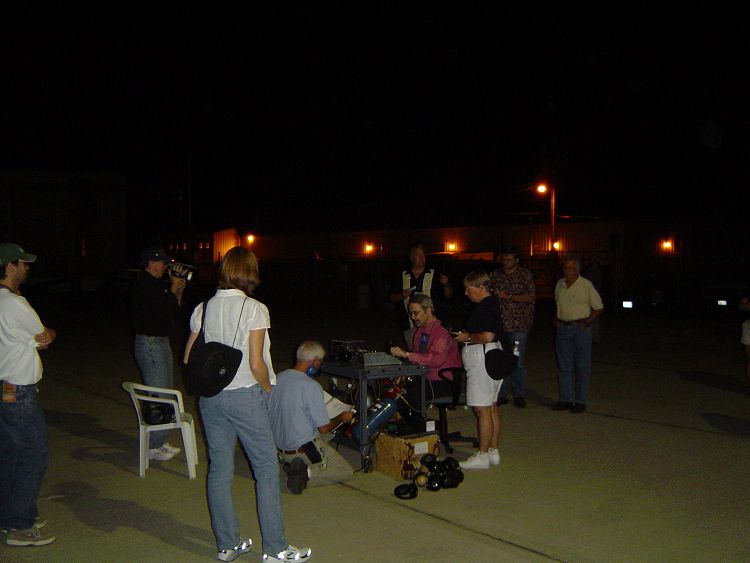
XCOR party... I saw Joan at
the XCOR part on
Sunday night, where she did a fine job pushing the firing button
on the company's famous Tea
Cart Engine:
|
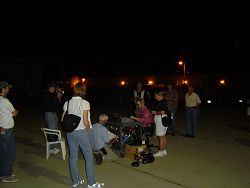
Doug Jones (seated) sets up the Tea Cart engine while
Joan (standing) watches carefully.
|
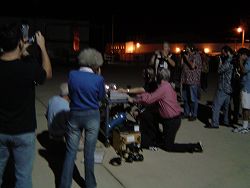
Joan fires the engine. Excuse the blurred image. The noise
was blowing out my ears at the time.
|
My thanks to XCOR for the excellent party and the
open house
access to the EZ-Rocket and their other fine creations.
|
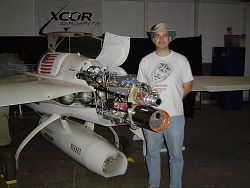
Andrew Case stands by the business end
of the EZ-Rocket.
|
SS1 flight news... This Thursday
the Discovery
Channel to Air Exclusive Footage of Aviation Pioneer Burt Rutan's
SpaceShipOne Capturing the $10 Million X Prize - SpaceRef - Oct.5.04...
... Burt Rutan is now racing
to develop a safe, low cost space tourism vehicle: Branson
says space tourism is three years away - Spaceflight Now - Oct.4.04
...
... 7 UP will release details
in 2005 about its space tourism contest but it did give out a cute
flyer at the post-flight news conference: 7
UP to Offer Free Space Flight - X PRIZE Space Race News! - Oct.4.04
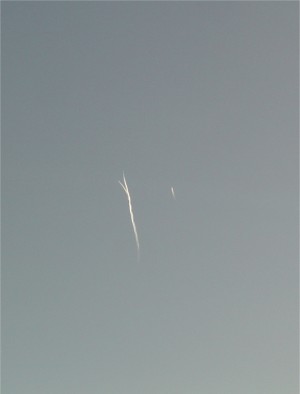
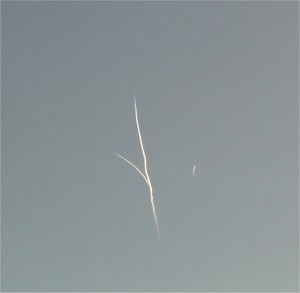
SS1 X2 flight pictures:
Suborbital legislation... In
his latest newsletter, Charles Lurio says that a Senate Commerce
staffer has gone beyond eliminating the liability waiver item and
actually inserted specific safety mandates into the legislation
for suborbital passenger vehicles. At this very early stage in the
development of the industry, this could smother it completely. ...
... Alan Boyle notes the importance
of regulation in creating a space tourism industry: Regulating
the rockets - Alan Boyle/Cosmic Log - Oct.4.04
X PRIZE Cup news... Here are
some articles about the X
PRIZE Cup:
America's Space Prize status... Rumor
has it that NASA was going to split the expense of the $50M purse
with Bigelow but the agency got "cold feet" at the last
moment. An official announcement about the contest is now postponed
to late November: America's
Space Prize: Reaching Higher Than Sub-Orbit - Space.com - Oct.6.04
News briefs... Canadian
Arrow shows pictures on its home page of the flight
qualification tests of its 57,000 lb thrust main engine posted
on Oct.2.04...
... Space Transport congratulates
Scaled Composites and promises to continue its own program to develop
space tourism technology. Due to bad weather expected this weekend,
the Rubicon 2 launch will take place "on the 16th or 17th of
October from a site on the Makah Reservation near Neah Bay, Washington":
STC
Focuses On Future Markets After SS1 Wins X PRIZE - STC - Oct.4.04
(MS Word file) ...
... John Carmack answers questions
about the Armadillo program on the X
PRIZE - Official Armadillo Q&A thread...
... Rocketplane Ltd. arranges
for a space tourism reservation program: Rocketplane
and Incredible Adventures to Offer Suborbital Flights - Rocketplane
Limited, Inc. - Oct.4.04.
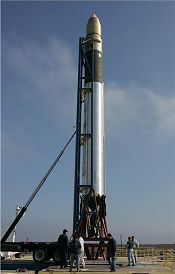
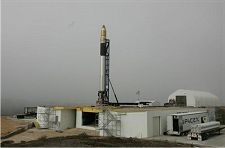
3:00 am - Even
more commercial space progress... I will post more on
the SS1 launch in the morning but just got a preview of the next
SpaceX update and
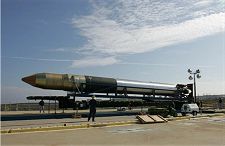
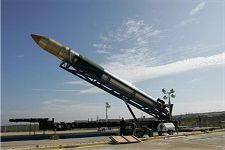
want to give you a peek. These pictures show the Falcon I on its
mobile launcher and a view of the rocket on its launch pad at Vandenberg:
Some highlights from the update:
- "Time to rotate vertical is about 15 minutes" and
will get faster with practice.
- Circular white building in lower right picture is a retractable
hanger that provides shelter while the vehicle is worked on. It
moves back shortly before launch.
- Other milestones that remain include:
- Complete flight qualification of the engines.
- Range safety approval for launch
- Full vehicle hold down firing
- Integrat the TacSat-1 satellite
- Launch to 500km orbit
- "first available launch window that works for both SpaceX
and Vandenberg is mid to late January."
The Falcon V design has been modified. The upper
stage will use a single Merlin engine rather than two Kestrel
engines. This has "major effect on mass to orbit due to improved
mass fraction, higher specific Impulse and better staging efficiency."
This and other improvements give the following boosts in payload
for the new design vs the old one.
| Orbit |
Payload (New) |
Payload (Old) |
| 200 km, 28.5 deg |
6020 kg
|
4,200 kg
|
| 400 km, 51 deg |
5450 kg
|
3,570 kg
|
| 700 km, sun-synch |
4780 kg
|
3,000 kg
|
| GTO 9 deg |
1920 kg
|
1,250 kg
|
| Escape velocity |
1200 kg
|
840 kg
|
October
5, 2004
On the road... Connected to
a wireless network at Long Beach Airport. Really amazing to get
a broadband link just sitting here waiting to board. (Hope I'm not
taking back lots of worms and viruses as souveniers!). [1:30am Oct.6th
- Well, not totally amazing. I could download material but couldn't
upload anything for some reason. Anyway, now that I'm back home
I will upload this before beginning today's updates.]
At the press conference, Burt Rutan couldn't say enough good things
about the Discovery Channel documentary - Black
Sky: The Race for Space - on the SS1 project. He had his whole
team over to watch it at his home on Sunday night. (The vehicles
were all preped, fueled and ready to go the next morning.) He said
the program captured the essence of what an incredibly tough job
it was to develop the Tier One project.
Unfortunately, I didn't get to see it but it looks like it will
be repeated next Sunday. There will also be an update on the X PRIZE
this Thursday: Race
for Space - Discovery Channel for time info.
I just looked at spacetoday.net
and there are three and half pages of links for today and they are
almost all about the SS1 flight. These two chosen at random are
quite interesting: Left
in the dust - Florida Today - Oct.05.04 * Space
invaders: SpaceShipOne wins the X-Prize: SpaceShipOne has become
the first privately funded craft to reach space. It could be your
turn next - Economist.com - Oct.5.04
Boarding is about to start so I will log off. Regular posting tomorrow
and more comments about the X2 flight.
October
4, 2004
Some SS1 snapshots... Manage
to get a pass into the VIP area along with a couple of thousand
other people:
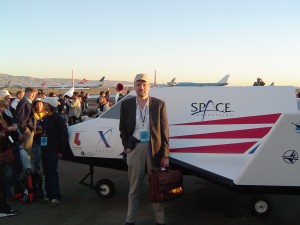
... This sequence shows the
contrail of the SS1 splitting off from that of the White Knight.
The small contrail is that of one of the three chase planes.
In the SS1 newsroom... Alan
Boyle and Leonard David are sitting a couple of tables away in the
media room so I should probably link to their stories: SpaceShipOne
wins $10 million X Prize Flight also bests X-15 altitude record
- MSNBC - Oct.4.04 * SpaceShipOne
Wins $10 Million Ansari X Prize in Historic 2nd Trip to Space -
Space.com - Oct.4.04.
And Bill Harwood is sitting a few meters away form me: SpaceShipOne
soars to $10 million X Prize - Spaceflight Now - Oct.4.04. I
just met Maggie McKee of New Scientist: SpaceShipOne
wins X Prize for spaceflight - New Scientist * Oct.4.04...
... More links at Space
Race News and spacetoday.net....
... John Carmack reflects on
Armadillo's X PRIZE efforts in his latest update: X-Prize,
Engine work, Vehicle work - Armadillo Aerospace - Oct.3.04...
... Here are Jeff Foust's photos
from the first flight and comments
on the event.
Risky undercurrent... The unexpectedly
rapid rolling in the Sept.29th flight left a lot of people a bit
worried about the next flight. I think Burt in turn was annoyed
that reporters made such a big deal about it. When today's flight
went so flawlessly it seemed almost anticlimatic. In the press conference,
Burt said that his goal for the vehicle for Virgin Galactic is to
achieve reliabilty higher than that of the first commercial airliners.
Here Jeff Foust comments on the risks that the suborbital industry
must deal with: Dealing
with the risks of space tourism - The Space Review - Oct.4.04.
SpaceShipOne Wins the
X PRIZE!!
SS1 does it again... I saw
history in the making today. It was a marvelous experience to be
here to witness such a flawless spaceflight. The roll problem from
Wednesday was fixed (a report on the technical details about changes
in the trajectory and other operations will be released later) and
the vehicle reached a record setting altitude - 367,442 ft (112km),
beating the highest altitude flown by the X-15.
At the news conference, X PRIZE judge Rick Searfoss said that the
SS1 fulfilled all the competition requirements to win the full $10M
purse. The money and trophy will be awarded at an official ceremony
in St. Louis on Nov. 6th. The X PRIZE contest was inaugurated in
St. Louis on May 18, 1996.
What a great feeling. Like many space enthusiasts from the 60s,
I've waited a long, long time to observe a genuine victory in the
long struggle to bring spaceflight closer to the reach of the private
individual. This was really a big step towards making that happen.
I'm heading to a victory party now and will try to add updates
later today. Regular postings will continue on Wednesday.
Jeff Foust has posted lots of links to articles
about the flight.
October
3, 2004
Heading to Mojave... I hope
that I can find a connection while I'm there and can post on the
pre-flight happenings as well as the flight itself. See the above
list of webcasters for video, audio, and text reports during the
flight.
The procedure
should go as before:
- White Knight with the SpaceShipOne will takeoff from the Mojave
Spaceport at 7:00 a.m. local time (10.00 a.m. EDT; 1400 GMT).
- About an hour later White Knight will reach an altitude of nearly
50,000 feet where SS1 is dropped at 8:00 a.m. PDT (11:00 a.m.
EDT; 1500 GMT)
- and SS1 ignites its rocket engine
- Powered flight of about 80 seconds
- SpaceShipOne coasts up to an altitude of at least 62 miles and
then reenters the atmosphere
- Glides to a landing on the Mojave runway by 8:30 a.m. PDT (11:30
a.m. EDT; 1530 GMT)
A press conference will be at 10:30 a.m. PDT (1:30p.m. EDT, 1730
GMT).
GO SPACESHIPONE!!
SS1 news briefs... Scaled has
posted a video
of the September 29th flight...
... Lots of school kids coming
to watch the flight: 40
buses heading for SpaceShipOne liftoff - AV Press - Oct.2.04
(via a HS reader)
...
... Private space companies
are getting down to business: Can
Do Private Space Companies Set Tone for Future Spaceflight - SpaceRef
- Oct.2.04 ...
... More on the SS1 roll:
SpaceShipOne
Rolling Rumors: Rutan Sets the Record Straight by Leonard David
- Space.com - Oct.2.04 * Why
SpaceShipOne spun - Alan Boyle/Cosmic Log - Oct.2.04...
... Another report on the
SS1 program:
SpaceShipOne: One down, one to go: A private rocket takes its first
flight toward winning the $10 million X-Prize by Bill McCoy - Astronomy
-Oct.2.04 (Via spacetoday.net)
October
2, 2004
The Stevie Austin saga continues...
Check out the latest update to the Stevie
Austin Project. From the latest report,
"Stevie returned to us briefly today, looking very well
rested and ready for her next launch. She brought along the core
members of the STC
Team, for an in-person meeting with Dr. James and a tour of
the Rubicon ICU/R Facility."
"Dr. James examined Stevie one last time to ensure that
she is fully prepared for the Rubicon II Mission, which is currently
scheduled for launch on the weekend of October 9 & 10, 2004. Stevie
is more than ready. This important Mission will blast Stevie and
the Rubicon II Rocket to an altitude of approximately 4 miles
high - which will fully test all vital rocket systems, including
launch, flight, and a very exciting Apollo-style ocean splash
down by parachute (where Stevie and the Rubicon Space Capsule
will be recovered from the ocean by boat.) Dr. James has agreed
to attend the launch as Mission Medical Specialist to make sure
Stevie stays in top shape throughout her Mission."
Episode Six will include "action-packed footage of the Launch,
the Flight, the Splash Down and the Capsule Recovery from the ocean."
News briefs... NASA TV will
definitely provide a webcast
of Monday's flight. (via a HS reader.)
...
... Alan Boyle gives a list
of books coming out about the X PRIZE and some of the rocket projects:
Real-life
rocket tales - CosmicLog/MSNBC - Oct.1.04.
Hurricanes delay shuttle return
to flight: Storms
snag shuttle plan: Earliest return to flight would be May, NASA
says - Florida Today - Oct.2.04...
... According to the event
organizers, "Federal Aviation Administration (FAA) Administrator
Marion C. Blakey and FAA Associate Administrator for Commercial
Space Transportation Patricia Grace Smith are planning to attend
the preparation and launch of SpaceShipOne..."
SS1 roll report... Once Mike
Melvill used the reaction control system thrusters (RCS), the rolling
stopped: Burt
provides some preliminary information about the rolling motions
seen on the First X-Prize Flight - Scaled Composites - Oct.1.04.
(Via a HS reader.)
SS1 webcasts... A HS
reader notes that NASA
TV may not webcast flight 2 as it did with flight 2 since there
is a Soyuz Expedition 10 press conference scheduled for Monday morning.
However, another alternative stream is from the Science
Channel.
Da Vinci launch permit... More
about the GoldenPalace/daVinci
launch permit: Canada
Still Has Eyes on X Prize - Wired - Oct.1.04...
... Here's the official statement:
Da
Vinci Team Application Approved By Transport Canada - Transport
Canada - Oct.1.04. (Via Space
Race News).
Space Access Update... The
latest update from Henry Vanderbilt hasn't been posted yet at the
Space Acces Society web
site so I will post it here:
Space Access Update
#104
9/29/04
Copyright 2004 by Space
Access Society
______________________________________________________________________
These last few years, we've gone from our spring Space Access
conference straight to working hard for a living. This year it's
been harder work than ever, because we're finally rearranging
things to spread the load out so we'll no longer have to vanish
from the scene for months at a time. We still have a couple months
to go in this year's (hopefully final) marathon - but sometimes
history calls too loudly to ignore. Forgive the haste of what
follows...
________________________________________________________________________
Contents this issue:
- X-Prize Half-Won, Orbital Prize, Tourism Company In The
Works
- HR 3752 In Senatorial Limbo - License To Fly - Call or Fax!
- SAS Runs "Alt Space Access" Sessions Friday Oct 8th At Upcoming
Space Frontier Foundation Conference, Oct 8-10 in Long Beach
CA
________________________________________________________________________
X-Prize Half-Won, Orbital Prize, Tourism Company In The
Works
When the world changes, sometimes it changes fast.
The Scaled Composites SpaceShip One today succeeded in making
the first of the two official flights required to win the X-Prize.
The flight was not uneventful - SS1 got into a high-rate roll
partway through the rocket burn and did not stabilize again till
after the motor was shut down, but the altitude goal was achieved
and the reentry and glide landing went smoothly. Mike Melville,
the pilot, has said the roll might have been his fault; we expect
it'll be a while before definitive word on what the problem was
comes out. We will say that finishing the flight successfully
speaks well for both the robustness of the system and the skill
of the pilot.
SS1's second offical X-Prize flight was tentatively scheduled
for Monday October 4th before today - we understand more definite
word on the second flight should be out tomorrow.
Meanwhile, Aviation Week & Space Technology reports that Robert
Bigelow, founder of the orbital inflatable habitat builder Bigelow
Aerospace, plans to announce a new $50 million prize for the first
private passenger-carrying orbital ship. Bigelow reportedly will
provide $25 million of the prize funding to get things rolling,
and will be seeking a co-sponsor or sponsors for the new prize.
(Part of the huge amount of news from this summer we need to write
about Real Soon Now is that Bigelow Aerospace will be doing a
series of flight tests of their habitat modules over the next
few years, component tests, then subscale, then full scale.)
And finally, Richard Branson of Virgin Atlantic Airlines has announced
he will be licensing SpaceShip One technology in order to start
a suborbital tourism spaceline within three years. The really
amazing thing here is that the cable business show report on this
we caught today took it seriously, with a minimum of boggling
and only a couple bad jokes.
The times, they are a-changing. Fast.
There is far more going on than just these three things, but we
have no more time to report on them tonight. RSN, sigh... Or come
out to the Queen Mary in Long Beach a week from Friday! (See our
last news item for details.)
________________________________________________________________________
HR 3752 In Senatorial Limbo - License To Fly - Call or Fax!
See our Update #102 (http://www.space-access.org/updates/sau102)
for details of HR 3752, The Commercial Space Launch Amendments
Act of 2004 - in brief, it's a new law that allows the FAA to
license low-cost reusable commercial space vehicles on a basis
that gives the new industry a chance to grow, rather than strangling
it in the cradle.
HR 3752 passed the House by a vote of 402-1. It is neither partisan
nor controversial. It is currently stuck in the Senate Commerce
Committee for no good reason anyone can tell us, and may well
die there when the 108th Congress ends later this year. If that
happens, all the hard work and progress to date is wiped out,
and it has to start all over again next year.
We apologize for not doing a really detailed piece on how to affect
this, but time is tight, both for us tonight and for this bill.
Please, check http://commerce.senate.gov/about/membership.html
and see if a Senator from your state is on the list. If so, phone
their office (the numbers are there) or fax a short note (you'll
have to dig for fax numbers, but faxes are considered more effective)
and ask them to report HR 3752 favorably out of committee, so
the Senate can pass this beneficial and non-controversial bill
and the US private space industry can get rolling. (No paper letters
- word is those currently are backed up for months, and this session
of Congress has only days to run before they recess pre-election.)
(There will probably be a "lame duck" session post-election, which
will be the final chance to pass this bill this year, so keep
working this over the election recess if HR 3752 doesn't move
before then.)
________________________________________________________________________
SAS Runs "Alt Space Access" Sessions Friday
Oct 8th At Upcoming
Space
Frontier Foundation Conference, Oct 8-10 in Long Beach CA
Our friends at the SFF asked us if we'd put together a "mini-Space
Access Conference" to run Friday of their upcoming annual Space
Frontier Conference, and we failed to say no. Friday October 8th,
9 am to noon, 2 pm to 5, get a taste of what we do for two and
a half days every spring. Confirmed presentations: AirLaunch LLC,
Andrews Space & Technology, Armadillo Aerospace, JP Aerospace,
Rocketplane Ltd, XCOR Aerospace, plus FAA AST Regs Discussion
and A Special Surprise Presentation. Catch a cross-section of
the players in this exciting new low-cost launch industry!
The conference will be on the Queen Mary hotel in Long Beach California.
See
http://www.space-frontier.org/Events/SFC13 for details on
hotel rooms and conference rates. See you there! (If we live through
this next week's work...)
________________________________________________________________________
Space Access Society's sole purpose is to promote radical reductions
in the cost of reaching space. You may redistribute this Update
in any medium you choose, as long as you do it unedited in its
entirety. You may reproduce sections of this Update beyond obvious
"fair use" quotes if you credit the source and include a pointer
to our website.
________________________________________________________________________
Space Access Society
http://www.space-access.org
space.access@space-access.org
"Reach low orbit and you're halfway to anywhere in the Solar System"
- Robert A. Heinlein
October
1, 2004
News briefs... GoldenPalace/daVinci
receives government permission for manned flights: Canadian
Ansari X PRIZE Team Receives Government Approval to launch into
Space - daVinci - Oct.1.04 ...
... Here's a very
nice video of the SS1 flight that includes shots from the onboard
camera: www.spaceflightnow.com/launch.mov.
(Via Coding
In Paradise) ...
... Jim Benson
of SpaceDev talks
about the SS1 engine and the Dream
Chaser suborbital vehicle project in a SpaceShow
interview on Sept.28th...
... This article
gives a brief explanation of the dihedral effect and how it might
have caused the SS1 roll: SpaceShipOne:
Monday Launch Is On - Wired - Oct.1.04...
... More NASA response: NASA
Official Sees Role in Space for Private Companies - VOA - Oct.1.04
* NASA
Brass Laud X Prize as Natural Extention of Agency's Work by Leonard
David - Space.com - Oct.1.04...
... More pictures of SS1 flight
one by Alan Radecki: page
1, page
2.
News briefs ...
The official altitude for SS1 and Mike Melvill: It's
Official: X-Prize officials say Mike Melvill climbed to 337,500
feet this morning - X PRIZE - Sept.30.04 ...
... Here's an
interesting report from the Cal Space Authority on the sophisticated
radar system used to track the SS1: SPADS
Parallels Pioneering Effort of SpaceShipOne as SS1 Clears the First
Hurdle - CSA - Sept.30.04...
... Speaking of
the CSA, their latest newsletter is posted: SpotBeam
California - September 30, 2004...
... Sean O'Keefe
congratulates the SS1 team: NASA
Salutes Spaceshipone Team After Second Flight - NASA HQ - Sept.29.04....
... I didn't
know till afterwards that NASA TV was also webcasting the flight.
I assume they will do it again on Monday. Here is the NASA
TV main page ...
... CSA has also
posted the Request For Information from NASA on the issue of how
commercial firms might provide space transportation services to
the agency: NASA
Special Notice: Commercial Space Transportation Services in Support
of the National Aeronautics and Space Administration - CSA.
I mentioned the RFI previously
(via NASA
Watch), but it seems just now to be getting attention in the
media. Info is due by Oct.15th.
Heading for Mojave...
I will be attending the flight on Monday and will try to post from
there if possible. Unfortunately, I have not been given press credentials
(blog discrimination!) but expect it will be a great experience
regardless of where I watch it from. [Update: Looks like
I am in fact on the media list. Got a Press Info Sheet in the email
today. Just need to get there in time on Sunday to register.] ...
.... See you at
the "all night" Rock
Concert sponsored by Apogee
Books for members of the National
Space Society (do I have to bring my NSS ID?). They are showcasing
the new book Space
Tourism by John Spencer.
More SS1 news...
Here are additional articles (mostly via spacetoday.net)
on the announcement of the second flight:
Second
X PRIZE Flight - Monday October 4th
No delay for space flight... Just
got this message
via the X PRIZE newsletter distribution:
Dear X PRIZE Members-
As you may know, yesterday, Burt Rutan's Mojave Aerospace Ventures
Team successfully reached an altitude of 337,500 feet with Mike
Melvill (the pilot) onboard plus ballast (approx. 180 Kg). This
flight was deemed by the Judges as a successful first flight for
the $10 million Ansari X PRIZE.
We have just received official notice from Burt Rutan that SpaceShipOne's
second flight (X2) will take place Monday morning, October 4th.
Expected flight timeline:
* Takeoff at 7am PT
* Ignition at 8am PT
* Landing at 8:30am PT
* Press Conference to announce official Altitude at 10:30am
PT
The entire flight can be viewed LIVE at www.xprize.org
on our global webcast.
Please spread the word to your friends. Tune in and help us
celebrate the birth of the Personal Spaceflight Revolution!
Best,
Peter H. Diamandis
Chairman & Founder X PRIZE Foundation
More SS1 news... Apparently
there was no information released with the announcement of Monday's
flight about the analysis of the roll on the SS1 flight...
... Alan Boyle reports on the
announcement: All
systems go for prize-winning space launch SpaceShipOne to go ahead
with planned Monday flight - MSNBC Sept.30.04...
... October 4th will be the
47th anniversary of the launch of Sputnik, the first artificial
satellite. By chance, in my Sputnik
links I had this article from 1997 by Alan: Sputnik
started space race, anxiety: 40 years later, Cold War rivals cooperate
in space ventures - MSNBC - Oct.4.97.
Flawed suborbital legislation may pass...
In his latest newsletter, Charles Lurio says that there
is still a chance that HR3752 may pass in this session but unfortunately
a crucial liability protection provision may be removed.
The provision that a passenger "flies at his/her own risk, given
that he/she is informed about the vehicle's test/operations record"
was intended to provide at least some protection from runinous lawsuits
if an accident occurs. Some former proponents of the legislation
believe that it would be "far better to kill the Bill"
than let it pass without this provision.
News briefs... Alan Boyle ponders
the future of spaceflight in the aftermath of the SS1 X PRIZE flight:The
space road ahead - Alan Boyle/Cosmic Log - Sept.30.04 ...
... Brad Stone at Newsweek
wants prices for suborbital flights to come down: A
Small Step for Private Space Travel: SpaceShipOne rolled to victory
today, but the nascent space-tourism industry hasn't soared yet.
Increased competition could help the business get off the ground
- MSNBC/Newsweek - Sept.29.04 ....
... The Economist reports on
Virgin space tourism:
Space tourism: Virgin Territory: Sir Richard Branson aims for the
moon - Economist.com - Sept.30.04...
... This article looks at the
risks of these early days of commercial spaceflight: Want
to travel on a private space jet? Pack nerves of steel. - csmonitor.com
- Sept.30.04.
Continue to September 2004